Search
Invitrogen
Glypican 3 Monoclonal Antibody (SP86)
{{$productOrderCtrl.translations['antibody.pdp.commerceCard.promotion.promotions']}}
{{$productOrderCtrl.translations['antibody.pdp.commerceCard.promotion.promocode']}}: {{promo.promoCode}} {{promo.promoTitle}} {{promo.promoDescription}}. {{$productOrderCtrl.translations['antibody.pdp.commerceCard.promotion.learnmore']}}
{{$ctrl.translations['antibody.pdp.skuNotes.additionalInformation']}}:

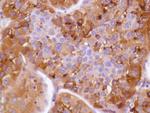
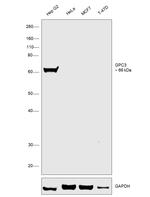
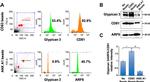
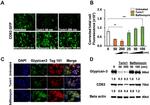
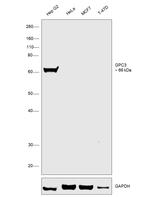
Please note: We are reviewing Western blot images included in the antibody testing data in our catalog, including those provided by third parties. Unless expressly labeled or annotated as “raw-unedited”, Western blot images included in the antibody testing data in our catalog may have been edited, optimized or otherwise adjusted for presentation.


产品信息
MA5-16368
应用
建议稀释比
已发表文章
产品规格
种属反应
Human
已发表种属
Human
宿主/亚型
Rabbit
/ IgG
分类
Monoclonal
类型
Antibody
克隆号
SP86
抗原
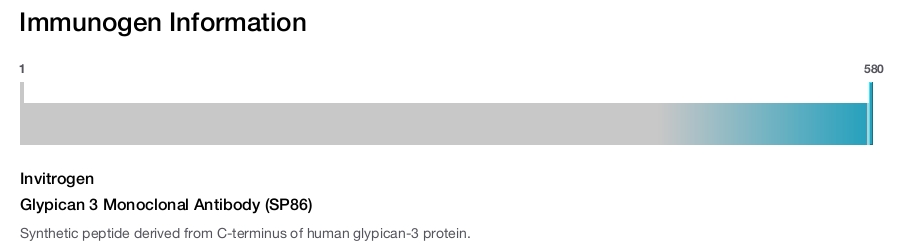
Synthetic peptide derived from C-terminus of human glypican-3 protein.
偶联物
Unconjugated
Unconjugated
Unconjugated
形式
Liquid
浓度
0.466 mg/mL
规格
233 µg
纯化类型
Protein A
保存液
PBS, pH 7.2, with 1% BSA
内含物
0.1% sodium azide
保存条件
-20°C, Avoid Freeze/Thaw Cycles
运输条件
Ambient (domestic); Wet ice (international)
RRID
产品详细信息
Heat-mediated antigen retrieval is recommended prior to staining, using a 10mM citrate buffer, pH 6.0, for 10 minutes followed by cooling at room temperature for 20 min. Following antigen retrieval, incubate samples with primary antibody for 30 min at room temperature. A suggested positive control is placenta or liver carcinoma.
靶标信息
GPC3 is a cell surface proteoglycan that bears heparan sulfate. This protein may be involved in the suppression/modulation of growth in the predominantly mesodermal tissues and organs, and may play a role in the modulation of IGF2 interactions with its receptor and thereby modulate its function. Members of the glypican-related integral membrane proteoglycan family contain a core protein anchored to the cytoplasmic membrane via a glycosyl phosphatidylinositol (GPI) linkage. These proteins may play a role in the control of cell division, growth regulation, and tumor predisposition. Deletion mutations in GPC3 are the cause of Simpson-Golabi-Behmel syndrome (SGBS), also known as Simpson dysmorphia syndrome (SDYS). SGBS is a condition characterized by pre- and postnatal overgrowth (gigantism) with visceral and skeletal anomalies.
仅用于科研。不用于诊断过程。未经明确授权不得转售。
生物信息学
蛋白别名: cell surface protein; precursor core protein cleaved by furin; glypican proteoglycan 3; GTR2-2; GTR22; heparan sulphate proteoglycan; intestinal protein OCI-5; OCI-5; secreted glypican-3; unnamed protein product
基因别名: DGSX; GTR2-2; MXR7; OCI-5; SDYS; SGB; SGBS; SGBS1
UniProt ID: (Human) P51654
Entrez Gene ID: (Human) 2719
anatomical structure morphogenesis
regulation of signal transduction
cell migration
cell migration involved in gastrulation
positive regulation of protein catabolic process
positive regulation of endocytosis
negative regulation of smoothened signaling pathway
regulation of canonical Wnt signaling pathway
coronary vasculature development
cell proliferation involved in kidney development
mesenchymal cell proliferation involved in ureteric bud development
mesonephric duct morphogenesis
positive regulation of canonical Wnt signaling pathway
regulation of protein localization to membrane
regulation of non-canonical Wnt signaling pathway
Disclaimer

Clicking the images or links will redirect you to a website hosted by BenchSci that provides third-party scientific content. Neither the content nor the BenchSci technology and processes for selection have been evaluated by us; we are providing them as-is and without warranty of any kind, including for use or application of the Thermo Fisher Scientific products presented.

