Search
Invitrogen
VEGF Receptor 2 Recombinant Rabbit Monoclonal Antibody (SP123)
{{$productOrderCtrl.translations['antibody.pdp.commerceCard.promotion.promotions']}}
{{$productOrderCtrl.translations['antibody.pdp.commerceCard.promotion.promocode']}}: {{promo.promoCode}} {{promo.promoTitle}} {{promo.promoDescription}}. {{$productOrderCtrl.translations['antibody.pdp.commerceCard.promotion.learnmore']}}
{{$ctrl.translations['antibody.pdp.skuNotes.additionalInformation']}}:
Please note: We are reviewing Western blot images included in the antibody testing data in our catalog, including those provided by third parties. Unless expressly labeled or annotated as “raw-unedited”, Western blot images included in the antibody testing data in our catalog may have been edited, optimized or otherwise adjusted for presentation.

产品信息
MA5-16417
产品规格
种属反应
Human
宿主/亚型
Rabbit
/ IgG
Expression System
proprietary
分类
Recombinant Monoclonal
类型
Antibody
克隆号
SP123
抗原
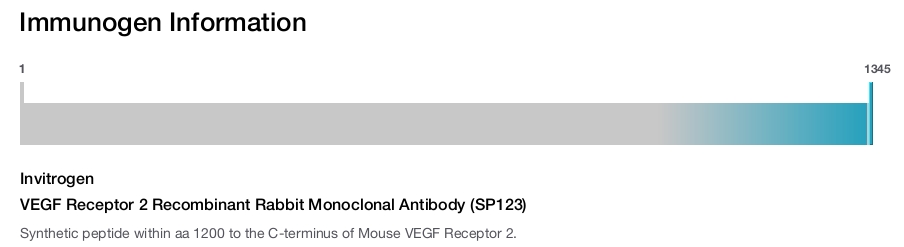
Synthetic peptide within aa 1200 to the C-terminus of Mouse VEGF Receptor 2.
偶联物
Unconjugated
Unconjugated
Unconjugated
形式
Liquid
浓度
0.035 mg/mL
规格
17.5 µg
纯化类型
Protein A/G
保存液
PBS, pH 7.6, with 1% BSA
内含物
0.1% sodium azide
保存条件
-20°C, Avoid Freeze/Thaw Cycles
运输条件
Ambient (domestic); Wet ice (international)
RRID
产品详细信息
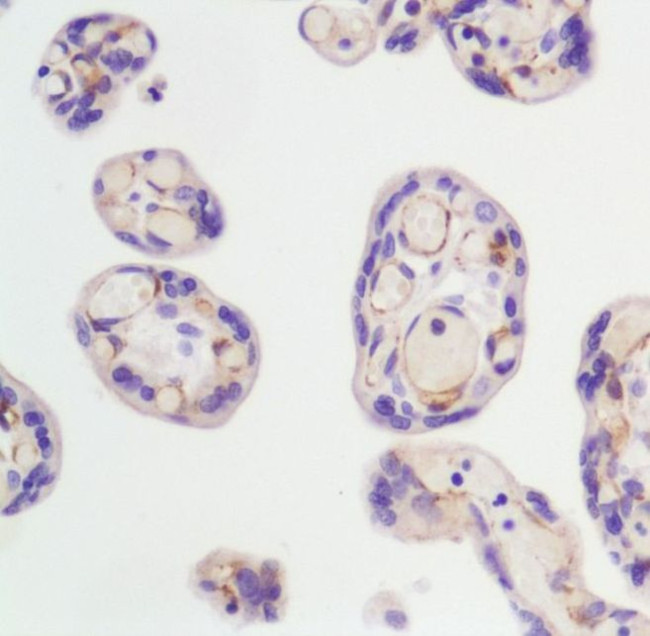
Heat-mediated antigen retrieval is recommended prior to staining, using a 10mM citrate buffer, pH 6.0, for 10 minutes followed by cooling at room temperature for 20 min. Following antigen retrieval, incubate samples with primary antibody for 30 min at room temperature. A suggested positive control is placenta tissue.
靶标信息
KDR (FLK1, VEGFR2) is a type III receptor tyrosine kinase. It binds vascular endothelial growth factor with high affinity in vitro, and is expressed early in development by endothelial cell precursors. FLK1 (VEGF Receptor 2) encodes one of the two receptors of the VEGF. This receptor, known as kinase insert domain receptor, is a type III receptor tyrosine kinase. The signalling and trafficking of this receptor are regulated by multiple factors, including Rab GTPase, P2Y purine nucleotide receptor, integrin alphaVbeta3, T-cell protein tyrosine phosphatase, etc. Mutations of FLK1 (VEGF Receptor 2) are implicated in infantile capillary hemangiomas.
仅用于科研。不用于诊断过程。未经明确授权不得转售。
篇参考文献 (0)
您是否在文献中引用过该产品?请点击下方按钮邮件告知我们。
生物信息学
蛋白别名: CD309 antigen; fetal liver kinase-1; kinase insert domain receptor (a type III receptor tyrosine kinase); protein-tyrosine kinase receptor Flk-1; sCD309; soluble CD309; soluble VEGFR 2; soluble VEGFR2; tyrosine kinase growth factor receptor; unnamed protein product; VEGF R2; VEGFR-2; tyrosine kinase
基因别名: CD309; FLK1; VEGFR; VEGFR2
UniProt ID: (Human) P35968
Entrez Gene ID: (Human) 3791
protein kinase activity
protein tyrosine kinase activity
transmembrane receptor protein tyrosine kinase activity
vascular endothelial growth factor-activated receptor activity
integrin binding
protein binding
ATP binding
coreceptor activity
growth factor binding
vascular endothelial growth factor binding
identical protein binding
cadherin binding
Hsp90 protein binding
angiogenesis
patterning of blood vessels
vasculogenesis
positive regulation of protein phosphorylation
positive regulation of endothelial cell proliferation
vasculature development
endocardium development
endothelium development
transmembrane receptor protein tyrosine kinase signaling pathway
positive regulation of cell proliferation
regulation of cell shape
positive regulation of endothelial cell migration
negative regulation of gene expression
positive regulation of macroautophagy
cell migration
peptidyl-tyrosine phosphorylation
positive regulation of cell migration
positive regulation of BMP signaling pathway
embryonic hemopoiesis
cellular response to vascular endothelial growth factor stimulus
vascular endothelial growth factor receptor-2 signaling pathway
vascular endothelial growth factor signaling pathway
negative regulation of apoptotic process
regulation of MAPK cascade
positive regulation of MAPK cascade
negative regulation of neuron apoptotic process
positive regulation of blood vessel endothelial cell migration
endothelial cell differentiation
positive regulation of angiogenesis
protein autophosphorylation
vascular endothelial growth factor receptor signaling pathway
positive regulation of positive chemotaxis
positive regulation of focal adhesion assembly
positive regulation of protein kinase B signaling
positive regulation of mitochondrial depolarization
epithelial tube morphogenesis
vascular wound healing
positive regulation of ERK1 and ERK2 cascade
semaphorin-plexin signaling pathway
positive regulation of cell migration involved in sprouting angiogenesis
positive regulation of mitochondrial fission
positive regulation of nitric oxide-cGMP mediated signal transduction
cellular response to hydrogen sulfide
negative regulation of endothelial cell apoptotic process
positive regulation of endothelial cell chemotaxis
positive regulation of vasculogenesis
Disclaimer

Clicking the images or links will redirect you to a website hosted by BenchSci that provides third-party scientific content. Neither the content nor the BenchSci technology and processes for selection have been evaluated by us; we are providing them as-is and without warranty of any kind, including for use or application of the Thermo Fisher Scientific products presented.

