Search
Invitrogen
EpCAM Monoclonal Antibody (VU-1D9)
{{$productOrderCtrl.translations['antibody.pdp.commerceCard.promotion.promotions']}}
{{$productOrderCtrl.translations['antibody.pdp.commerceCard.promotion.promocode']}}: {{promo.promoCode}} {{promo.promoTitle}} {{promo.promoDescription}}. {{$productOrderCtrl.translations['antibody.pdp.commerceCard.promotion.learnmore']}}
{{$ctrl.translations['antibody.pdp.skuNotes.additionalInformation']}}:
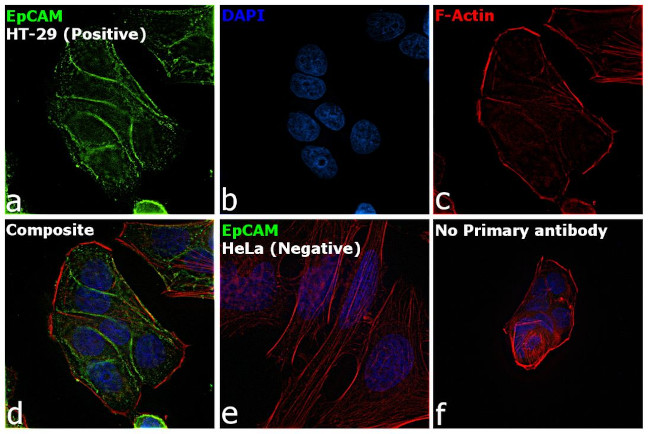
图: 1 / 5
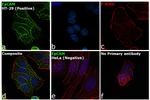
EpCAM Antibody (MA5-16973) in ICC/IF
Immunofluorescence analysis of EpCAM was performed using HT-29 and HeLa cells. The cells were fixed with 4% paraformaldehyde for 10 minutes, permeabilized with 0.1% Triton™ X-100 for 15 minutes, and blocked with 2% BSA for 1 hour at room temperature. The cells were labeled with EpCAM Mouse Monoclonal Antibody (Product # MA5-16973) at 1:500 dilution in 0.1% BSA and incubated overnight at 4 degree and then labeled with Goat anti-Mouse IgG (H+L) Highly Cross-Adsorbed Secondary Antibody, Alexa Fluor Plus 488 (Product # A32723) at a dilution of... View More
Please note: We are reviewing Western blot images included in the antibody testing data in our catalog, including those provided by third parties. Unless expressly labeled or annotated as “raw-unedited”, Western blot images included in the antibody testing data in our catalog may have been edited, optimized or otherwise adjusted for presentation.


产品信息
MA5-16973
应用
建议稀释比
已发表文章
产品规格
种属反应
Human
已发表种属
Human
宿主/亚型
Mouse
/ IgG1
分类
Monoclonal
类型
Antibody
克隆号
VU-1D9
抗原
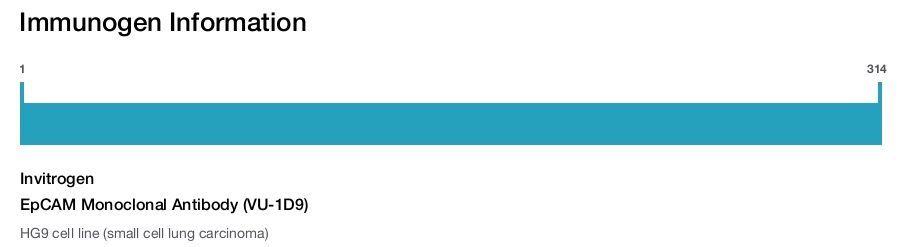
HG9 cell line (small cell lung carcinoma)
偶联物
Unconjugated
Unconjugated
Unconjugated
形式
Liquid
浓度
1 mg/mL
规格
500 µg
纯化类型
Protein A
保存液
PBS
内含物
no preservative
保存条件
-20°C, Avoid Freeze/Thaw Cycles
运输条件
Ambient (domestic); Wet ice (international)
RRID
产品详细信息
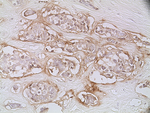
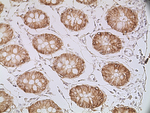
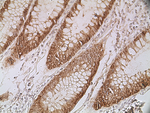
This product requires protein digestion pre-treatment of paraffin sections using trypsin or pronase. A suggested positive control for immunohistochemical applications is large bowel. For FACS analysis, use 10 µL of the suggested working dilution to label 1x10^6 cells in 100 µL.
This product is a low-endotoxin, preservative-free formulation.
Mouse anti Human CD326 antibody, clone VU-1D9 recognizes epithelial cell adhesion molecule (Ep-CAM), a approximately 34 kDa cell surface antigen otherwise known as CD326, MOC31 or Ber-EP4.
靶标信息
Ep-CAM (epithelial adhesion molecule, epithelial specific antigen, ESA) is a transmembrane glycoprotein expressed in the epithelium with a molecular weight of approximately 40 kDa, which functions as an epithelial cell adhesion molecule. Ep-CAM functions as a homotypic calcium-independent cell adhesion molecule, and has a direct impact on cell cycle, proliferation and metabolism of epithelial cells and fibroblasts due to its ability to rapidly induce the proto-oncogene c-myc and the cell cycle regulating genes cyclin A and E. Ep-CAM mediates Ca2+-independent homotypic interactions. Formation of Ep-CAM-mediated adhesions have a negative regulatory effect on adhesions mediated by classic cadherins, which may have strong effects on the differentiation and growth of epithelial cells. Ep-CAM overexpression was suggested to be associated with enhanced epithelial proliferation. Ep-CAM is highly expressed in human carcinomas, and is a marker for tumors of epithelial lineage. Ep-CAM is expressed on baso-lateral cell surface in most simple epithelia and many carcinoma types. Also, Ep-CAM reportedly distinguishes adenocarcinomas from pleural mesotheliomas.
仅用于科研。不用于诊断过程。未经明确授权不得转售。
生物信息学
蛋白别名: adenocarcinoma-associated antigen; adenocarcinoma-associated antigen precursor (KSA); cell surface glycoprotein Trop-1; epithelial glycoprotein (EGP) precursor; epithelial glycoprotein 314; hEGP314; human epithelial glycoprotein-2; major gastrointestinal tumor-associated protein GA733-2; membrane component, chromosome 4, surface marker (35kD glycoprotein); TACSTD1; trophoblast cell surface antigen 1; tumor-associated calcium signal transducer 1; unnamed protein product
基因别名: Ber-Ep4; BerEp4; DIAR5; EGP-2; EGP314; EGP40; ESA; HNPCC8; KS1/4; KSA; LYNCH8; M4S1; MIC18; MK-1; MOC-31; TACSTD1; TROP1
UniProt ID: (Human) P16422
Entrez Gene ID: (Human) 4072
ureteric bud development
positive regulation of cell proliferation
signal transduction involved in regulation of gene expression
positive regulation of transcription from RNA polymerase II promoter
stem cell differentiation
cell-cell adhesion
negative regulation of cell-cell adhesion mediated by cadherin
positive regulation of stem cell proliferation
Disclaimer

Clicking the images or links will redirect you to a website hosted by BenchSci that provides third-party scientific content. Neither the content nor the BenchSci technology and processes for selection have been evaluated by us; we are providing them as-is and without warranty of any kind, including for use or application of the Thermo Fisher Scientific products presented.

