Search
Invitrogen
AIF Recombinant Rabbit Monoclonal Antibody (5F0Y1)
{{$productOrderCtrl.translations['antibody.pdp.commerceCard.promotion.promotions']}}
{{$productOrderCtrl.translations['antibody.pdp.commerceCard.promotion.promocode']}}: {{promo.promoCode}} {{promo.promoTitle}} {{promo.promoDescription}}. {{$productOrderCtrl.translations['antibody.pdp.commerceCard.promotion.learnmore']}}
{{$ctrl.translations['antibody.pdp.skuNotes.additionalInformation']}}:
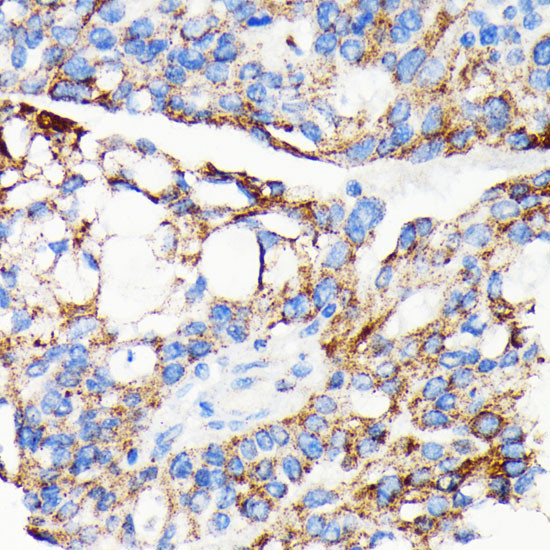
图: 1 / 2
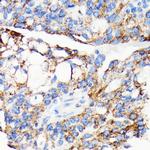
AIF Antibody (MA5-35290) in IHC (P)
Immunohistochemistry analysis of AIF in paraffin-embedded human oophoroma. Samples were incubated with AIF Monoclonal antibody (Product # MA5-35290) using a dilution of 1:100 (40x lens). Perform microwave antigen retrieval with 10 mM PBS buffer pH 7.2 before commencing with IHC staining protocol.
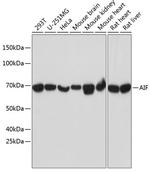
Please note: We are reviewing Western blot images included in the antibody testing data in our catalog, including those provided by third parties. Unless expressly labeled or annotated as “raw-unedited”, Western blot images included in the antibody testing data in our catalog may have been edited, optimized or otherwise adjusted for presentation.


产品信息
MA5-35290
应用
建议稀释比
已发表文章
产品规格
种属反应
Human,
Mouse,
Rat
宿主/亚型
Rabbit
/ IgG
Expression System
HEK293 cells
分类
Recombinant Monoclonal
类型
Antibody
克隆号
5F0Y1
抗原
Synthetic peptide
偶联物
Unconjugated
Unconjugated
Unconjugated
形式
Liquid
浓度
0.25 mg/mL
规格
25 µg
纯化类型
Affinity Chromatography
保存液
PBS, pH 7.3, with 50% glycerol, 0.05% BSA
内含物
0.02% sodium azide
保存条件
-20°C, Avoid Freeze/Thaw Cycles
运输条件
Ambient (domestic); Wet ice (international)
RRID
产品详细信息
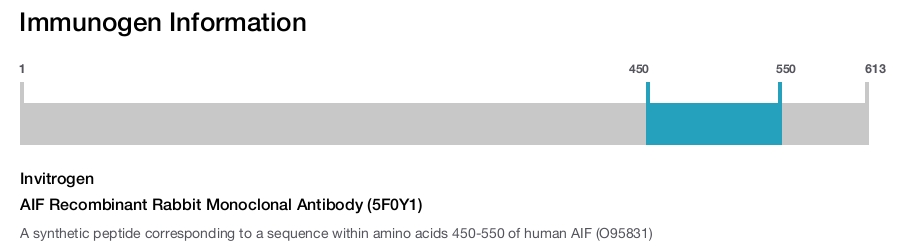
Immunogen sequence: RRVEHHDHAV VSGRLAGENM TGAAKPYWHQ SMFWSDLGPD VGYEAIGLVD SSLPTVGVFA KATAQDNPKS ATEQSGTGIR SESETESEAS EITIPPSTPA V
靶标信息
Apoptosis Inducing Factor (AIF) causes chromatin condensation and DNA fragmentation. AIF was recently identified, and cloned. Apoptosis is characterized by several morphological nuclear changes including chromatin condensation and nuclear fragmentation. These changes are triggered by the activation of members of caspase family, caspase activated DNase, and several novel proteins. Like the critical molecules, cytochrome c and caspase-9, in apoptosis, AIF localizes in mitochondria. AIF translocates to the nucleus when apoptosis is induced and induces mitochondria to release the apoptogenic proteins cytochrome c and caspase-9. AIF induces chromatin condensation and large scale DNA fragmentation, which are the hallmarks of apoptosis, of the isolated nucleus and the nucleus in live cells by microinjection and apoptosis stimuli. AIF is highly conserved between human and mouse and widely expressed. Mutations in the AIF gene cause combined oxidative phosphorylation deficiency 6, which results in a severe mitochondrial encephalomyopathy. Alternative splicing results in multiple transcript variants of AIF and a related pseudogene has been identified on chromosome 10.
仅用于科研。不用于诊断过程。未经明确授权不得转售。
篇参考文献 (0)
您是否在文献中引用过该产品?请点击下方按钮邮件告知我们。
生物信息学
蛋白别名: AG1; AGR1; AIF; apoptogenic protein; apoptosis-inducing factor 1, mitochondrial-like; apoptosis-inducing factor, mitochondrion-associated 1; apoptosis-inducing factor, mitochondrion-associated, 1; auditory neuropathy, X-linked recessive 1; cell death factor; ER protein 18; ER protein 19; ERP18; ERP19; hAG-1; harlequin; hTLP19; MGC111425; NADH oxidase; pcd8; PDCD8; PDIA16; programmed cell death 8 (apoptosis-inducing factor); programmed cell death protein 8; RP3-438D16.2; striatal apoptosis-inducing factor; testicular secretory protein Li 4; TLP19; unnamed protein product; UNQ713/PRO1376
基因别名: AIF; AIFsh2; AUNX1; CMT2D; CMTX4; COWCK; COXPD6; DFNX5; Hq; NADMR; NAMSD; PDCD8; SEMDHL
UniProt ID: (Human) O95831, (Rat) Q9JM53, (Mouse) Q9Z0X1
Entrez Gene ID: (Human) 9131, (Rat) 83533, (Mouse) 26926
DNA binding
NADH dehydrogenase activity
protein binding
NAD(P)H oxidase activity
oxidoreductase activity
oxidoreductase activity, acting on NAD(P)H
protein anchor
protein dimerization activity
NADH binding
FAD binding
poly-ADP-D-ribose binding
electron-transferring-flavoprotein dehydrogenase activity
response to ischemia
apoptotic process
response to toxic substance
neuron differentiation
mitochondrial respiratory chain complex assembly
positive regulation of apoptotic process
positive regulation of programmed cell death
positive regulation of neuron apoptotic process
protein import into mitochondrial intermembrane space
neuron apoptotic process
positive regulation of necroptotic process
intrinsic apoptotic signaling pathway in response to endoplasmic reticulum stress
cellular response to hydrogen peroxide
cellular response to estradiol stimulus
cellular response to hypoxia
cellular response to nitric oxide
mitochondrial disulfide relay system
response to L-glutamate
regulation of apoptotic DNA fragmentation
cellular response to aldosterone
response to oxidative stress
apoptotic mitochondrial changes
respiratory electron transport chain
Disclaimer

Clicking the images or links will redirect you to a website hosted by BenchSci that provides third-party scientific content. Neither the content nor the BenchSci technology and processes for selection have been evaluated by us; we are providing them as-is and without warranty of any kind, including for use or application of the Thermo Fisher Scientific products presented.

