Search
Invitrogen
PP1 alpha/beta Recombinant Rabbit Monoclonal Antibody (24GB1385)
{{$productOrderCtrl.translations['antibody.pdp.commerceCard.promotion.promotions']}}
{{$productOrderCtrl.translations['antibody.pdp.commerceCard.promotion.promocode']}}: {{promo.promoCode}} {{promo.promoTitle}} {{promo.promoDescription}}. {{$productOrderCtrl.translations['antibody.pdp.commerceCard.promotion.learnmore']}}
{{$ctrl.translations['antibody.pdp.skuNotes.additionalInformation']}}:
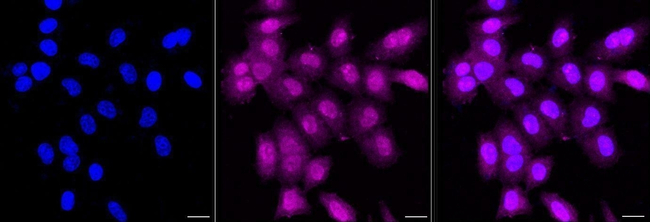
图: 1 / 3
PP1 alpha/beta Antibody (MA5-57182) in ICC/IF
Immunocytochemistry analysis of PP1 alpha/beta in HepG2 cells. Sample was incubated with PP1 alpha/beta monoclonal (Product # MA5-57181) antibody at a dilution of 1:1,000, followed by DAPI and Alexa Fluor 647. Protein abundance based on laser intensity and smart gain: Medium. Scale bar, 20 μm.
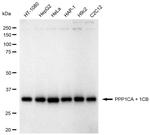
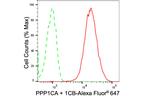
Please note: We are reviewing Western blot images included in the antibody testing data in our catalog, including those provided by third parties. Unless expressly labeled or annotated as “raw-unedited”, Western blot images included in the antibody testing data in our catalog may have been edited, optimized or otherwise adjusted for presentation.


产品信息
MA5-57182
应用
建议稀释比
已发表文章
产品规格
种属反应
Human,
Mouse,
Rat
宿主/亚型
Rabbit
/ IgG
Expression System
HEK293F
分类
Recombinant Monoclonal
类型
Antibody
克隆号
24GB1385
抗原
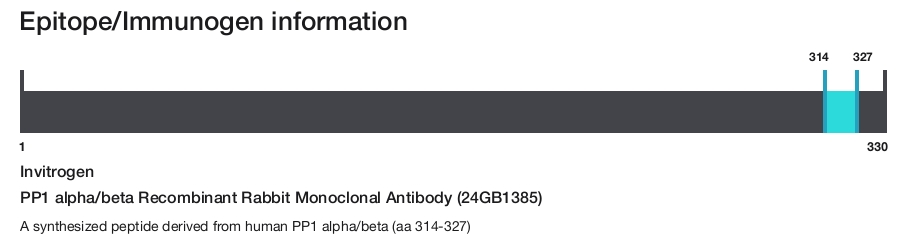
A synthesized peptide derived from human PP1 alpha/beta (aa 314-327)
偶联物
Unconjugated
Unconjugated
Unconjugated
形式
Liquid
浓度
0.4 mg/mL
规格
8 µg
纯化类型
Affinity chromatography
保存液
PBS, pH 7.4, with 50% glycerol
内含物
0.02% sodium azide
保存条件
-20°C
运输条件
Ambient (domestic); Dry ice (international)
RRID
靶标信息
PP1 is a major serine/threonine phosphatase that reverses kinase signaling to regulate the cell cycle, glycogen metabolism, transcription, RNA splicing, cytoskeletal dynamics, and synaptic plasticity. The catalytic subunits PP1 alpha (PPP1CA) and PP1 beta (PPP1CB) have near-identical cores, with functional specificity dictated by binding to diverse regulatory/targeting proteins (e.g., RVxF motif partners such as spinophilin, MYPT1, PNUTS) and inhibitors (I-1, I-2). Through these complexes and post-translational control, PP1 precisely dephosphorylates substrates to drive mitotic exit, modulate muscle contractility and metabolism, and tune neuronal signaling. Dysregulation of PP1 alpha/beta contributes to cancer, metabolic and cardiovascular disease, and neurodegeneration.
仅用于科研。不用于诊断过程。未经明确授权不得转售。
篇参考文献 (0)
您是否在文献中引用过该产品?请点击下方按钮邮件告知我们。
生物信息学
蛋白别名: epididymis secretory sperm binding protein Li 80p; myosin phosphatase; PP-1A; PP-1B; PPP1CB; protein phosphatase 1, catalytic subunit, alpha isozyme; protein phosphatase 1, catalytic subunit, beta isozyme; protein phosphatase 1, catalytic subunit, delta isozyme; protein phosphatase 1-beta; protein phosphatase 1-delta; protein phosphatase I alpha subunit (PPPIA) (EC 3.1.3.16); Protein phosphatase type 1 alpha, catalytic subunit; protein phosphatase-1a; protein phosphatase-1d; serine/threonine protein phosphatase PP1-alpha 1 catalytic subunit; testicular tissue protein Li 155; unnamed protein product
基因别名: 1200010B19; dism2; HEL-S-80p; MP; NSLH2; PP-1A; PP-1B; PP1A; PP1alpha; PP1B; PP1beta; PP1c; PP1Cbeta; PP1Cdelta; PPP1A; PPP1beta; Ppp1c; PPP1CD
UniProt ID: (Human) P62136, (Human) P62140, (Rat) P62138, (Mouse) P62137, (Mouse) P62141, (Rat) P62142
Entrez Gene ID: (Human) 5499, (Human) 5500, (Rat) 24668, (Mouse) 19045, (Mouse) 19046, (Rat) 25594
phosphoprotein phosphatase activity
protein serine/threonine phosphatase activity
iron ion binding
protein binding
protein phosphatase 1 binding
hydrolase activity
phosphatase activity
ribonucleoprotein complex binding
macromolecular complex binding
transition metal ion binding
cadherin binding involved in cell-cell adhesion
RNA polymerase II CTD heptapeptide repeat S5 phosphatase activity
myosin phosphatase activity
protein kinase binding
myosin-light-chain-phosphatase activity
promoter clearance from RNA polymerase II promoter
regulation of glycogen biosynthetic process
regulation of glycogen catabolic process
protein dephosphorylation
response to lead ion
lung development
circadian regulation of gene expression
positive regulation of transcription elongation from RNA polymerase II promoter
negative regulation of transcription elongation from RNA polymerase II promoter
regulation of circadian rhythm
entrainment of circadian clock by photoperiod
telomere maintenance in response to DNA damage
positive regulation of glycogen biosynthetic process
branching morphogenesis of an epithelial tube
protein stabilization
cell-cell adhesion
positive regulation of termination of RNA polymerase II transcription, poly(A)-coupled
positive regulation of extrinsic apoptotic signaling pathway in absence of ligand
regulation of cell adhesion
regulation of translational initiation in response to stress
positive regulation of Ras protein signal transduction
regulation of canonical Wnt signaling pathway
MAPK cascade
telomere maintenance
glycogen metabolic process
transcription from RNA polymerase II promoter
transcription elongation from RNA polymerase II promoter
regulation of translation
negative regulation of triglyceride catabolic process
double-strand break repair via alternative nonhomologous end joining
Disclaimer

Clicking the images or links will redirect you to a website hosted by BenchSci that provides third-party scientific content. Neither the content nor the BenchSci technology and processes for selection have been evaluated by us; we are providing them as-is and without warranty of any kind, including for use or application of the Thermo Fisher Scientific products presented.

