Search
Invitrogen
MIF (Imalumab Biosimilar) Recombinant Human Monoclonal Antibody
{{$productOrderCtrl.translations['antibody.pdp.commerceCard.promotion.promotions']}}
{{$productOrderCtrl.translations['antibody.pdp.commerceCard.promotion.promocode']}}: {{promo.promoCode}} {{promo.promoTitle}} {{promo.promoDescription}}. {{$productOrderCtrl.translations['antibody.pdp.commerceCard.promotion.learnmore']}}
{{$ctrl.translations['antibody.pdp.skuNotes.additionalInformation']}}:
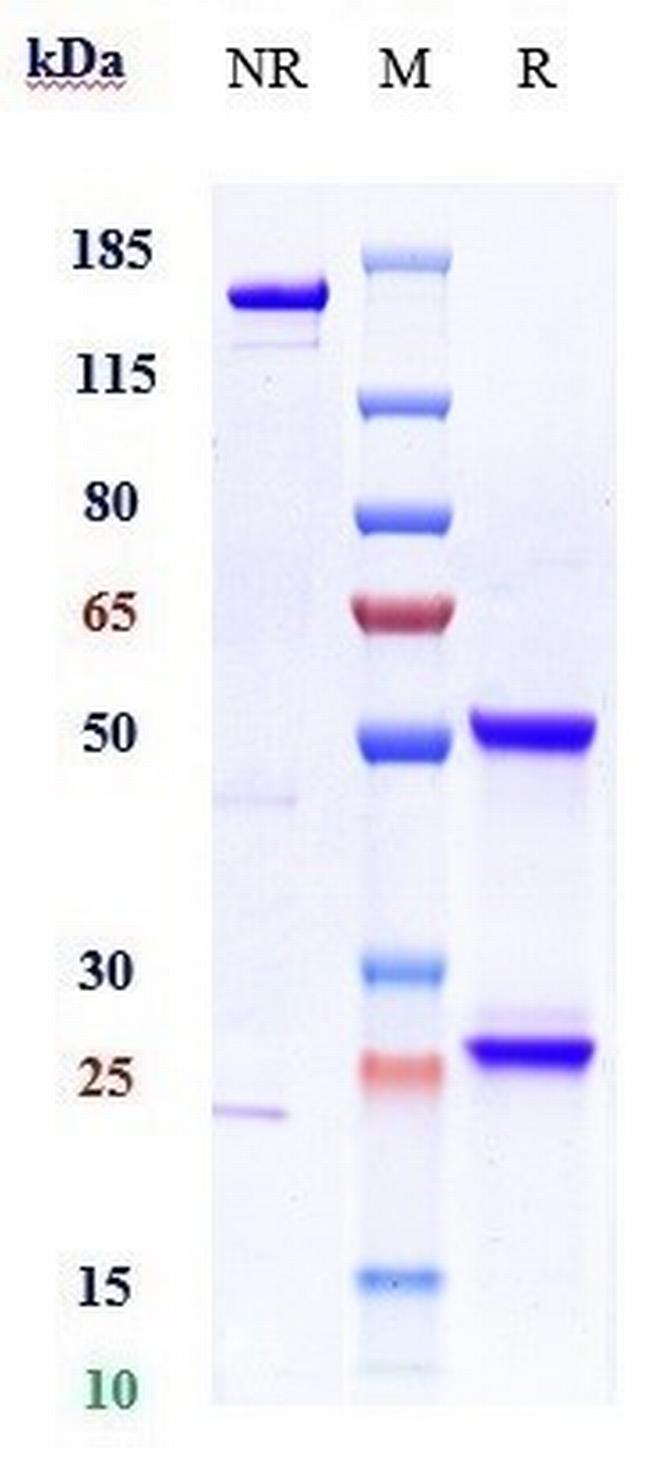
Please note: We are reviewing Western blot images included in the antibody testing data in our catalog, including those provided by third parties. Unless expressly labeled or annotated as “raw-unedited”, Western blot images included in the antibody testing data in our catalog may have been edited, optimized or otherwise adjusted for presentation.

产品信息
MA5-58711
应用
建议稀释比
已发表文章
产品规格
种属反应
Human
宿主/亚型
Human
/ IgG1
Expression System
CHO cells
分类
Recombinant Monoclonal
类型
Antibody
偶联物
Unconjugated
Unconjugated
Unconjugated
形式
Lyophilized
浓度
1 mg/mL once reconstituted
规格
100 µg
纯化类型
Protein A
保存液
25mM histidine, pH 6.2, with 0.01% Tween 80, 8% sucrose
内含物
no preservative
保存条件
-20°C, Avoid Freeze/Thaw Cycles
运输条件
Ambient (domestic); Dry ice (international)
RRID
产品详细信息
For reconstitution, add sterile, distilled water to achieve a final antibody concentration of 1 mg/mL. Gently shake to solubilize the protein completely. Do not vortex. Reconstituted products should be stored at -80 °.
靶标信息
MIF (macrophage migration inhibitory factor) was one of the first cytokine activities to be discovered and was initially described as a T cell-derived factor that inhibits the random migration of macrophages (Weiser 1989). Recently, MIF was rediscovered as a pituitary hormone that act as the counterregulatory hormone for glucocorticoid action within the immune system (Bernhagen 1993, Mitchell 1995). MIF was released from macrophages and T cells in response to physiological concentrations of glucocorticoids. The secreted MIF counter-regulates the immunosuppressive effects of steroids on immune cell activation and cytokine production (Bucala 1998). MIF plays a critical role in the host control of inflammation and immunity.
仅用于科研。不用于诊断过程。未经明确授权不得转售。
篇参考文献 (0)
您是否在文献中引用过该产品?请点击下方按钮邮件告知我们。
生物信息学
蛋白别名: epididymis secretory sperm binding protein; glycosylation-inhibiting factor; HGNC:7097; L-dopachrome isomerase; L-dopachrome tautomerase; macrophage migration inhibitory factor (glycosylation-inhibiting factor); MGC107654; MIF; migration inhibitory factor; phenylpyruvate tautomerase; unnamed protein product
基因别名: GIF; GLIF; MMIF
UniProt ID: (Human) P14174
Entrez Gene ID: (Human) 4282
prostaglandin biosynthetic process
positive regulation of cytokine production
negative regulation of mature B cell apoptotic process
cell surface receptor signaling pathway
positive regulation of cell proliferation
negative regulation of gene expression
negative regulation of macrophage chemotaxis
carboxylic acid metabolic process
negative regulation of cell migration
positive regulation of B cell proliferation
positive regulation of lipopolysaccharide-mediated signaling pathway
positive regulation of prostaglandin secretion
positive regulation of tumor necrosis factor production
negative regulation of myeloid cell apoptotic process
positive regulation of phosphorylation
regulation of macrophage activation
negative regulation of apoptotic process
negative regulation of DNA damage response, signal transduction by p53 class mediator
positive regulation of innate immune response
positive regulation of fibroblast proliferation
positive chemotaxis
positive regulation of myeloid leukocyte cytokine production involved in immune response
protein homotrimerization
positive regulation of ERK1 and ERK2 cascade
regulation of cellular response to stress
positive regulation of arachidonic acid secretion
positive regulation of cAMP/PKA signal transduction
negative regulation of intrinsic apoptotic signaling pathway in response to DNA damage by p53 class mediator
positive regulation of chemokine (C-X-C motif) ligand 2 production
negative regulation of cellular senescence
Disclaimer

Clicking the images or links will redirect you to a website hosted by BenchSci that provides third-party scientific content. Neither the content nor the BenchSci technology and processes for selection have been evaluated by us; we are providing them as-is and without warranty of any kind, including for use or application of the Thermo Fisher Scientific products presented.

