Search
Invitrogen
Fumonisins Recombinant Mouse Monoclonal Antibody (2E11)
{{$productOrderCtrl.translations['antibody.pdp.commerceCard.promotion.promotions']}}
{{$productOrderCtrl.translations['antibody.pdp.commerceCard.promotion.promocode']}}: {{promo.promoCode}} {{promo.promoTitle}} {{promo.promoDescription}}. {{$productOrderCtrl.translations['antibody.pdp.commerceCard.promotion.learnmore']}}
{{$ctrl.translations['antibody.pdp.skuNotes.additionalInformation']}}:
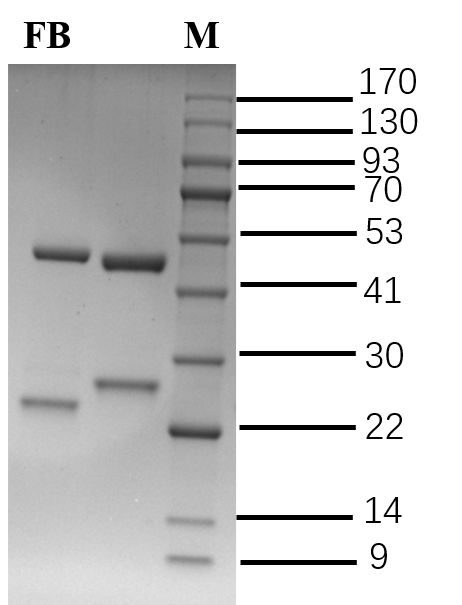
图: 1 / 1
Fumonisins Antibody (MA566480) in SDS-PAGE
SDS-PAGE characterization of Fumonisins under reducing conditions. Lane M: Protein marker (kDa); Lane FB: Purified Fumonisins Recombinant Monoclonal (Product # MA566480). Fumonisins showing heavy chain (~50 kDa) and light chain (~25 kDa). Gels were stained with Coomassie Brilliant Blue R-366.
Please note: We are reviewing Western blot images included in the antibody testing data in our catalog, including those provided by third parties. Unless expressly labeled or annotated as “raw-unedited”, Western blot images included in the antibody testing data in our catalog may have been edited, optimized or otherwise adjusted for presentation.

产品信息
MA566480
产品规格
种属反应
Chemical
宿主/亚型
Mouse
/ IgG
Expression System
CHO cells
分类
Recombinant Monoclonal
类型
Antibody
克隆号
2E11
抗原
Conjugate of FB hapten and KLH.
偶联物
Unconjugated
Unconjugated
Unconjugated
形式
Liquid
浓度
10 mg/mL
规格
200 µg
纯化类型
Protein G
保存液
PBS
内含物
0.09% sodium azide
保存条件
-20°C
运输条件
Ambient (domestic); Wet ice (international)
RRID
靶标信息
Fumonisins are a class of mycotoxins primarily produced by Fusarium species, posing significant threats to food safety and public health due to their prevalence in staple crops such as maize, peanuts, and rice. Structurally, fumonisins resemble sphingoid bases, allowing them to inhibit ceramide synthase, which disrupts sphingolipid metabolism, leading to growth inhibition and apoptosis in various cell types. Fumonisin B1 (FB1) is the most prevalent and toxic variant, affecting nutritional value and sensory characteristics of feed, thereby reducing food intake and production performance. The biosynthesis of fumonisins involves complex enzymatic and genetic regulation, with ongoing research focusing on controlling contamination in food supply chains. Understanding the mechanisms of fumonisin toxicity and developing biological detoxification strategies are crucial for mitigating their impact on health and agriculture.
仅用于科研。不用于诊断过程。未经明确授权不得转售。
篇参考文献 (0)
您是否在文献中引用过该产品?请点击下方按钮邮件告知我们。
Disclaimer

Clicking the images or links will redirect you to a website hosted by BenchSci that provides third-party scientific content. Neither the content nor the BenchSci technology and processes for selection have been evaluated by us; we are providing them as-is and without warranty of any kind, including for use or application of the Thermo Fisher Scientific products presented.

