Search
Invitrogen
Fipronil Recombinant Mouse Monoclonal Antibody (3B1)
{{$productOrderCtrl.translations['antibody.pdp.commerceCard.promotion.promotions']}}
{{$productOrderCtrl.translations['antibody.pdp.commerceCard.promotion.promocode']}}: {{promo.promoCode}} {{promo.promoTitle}} {{promo.promoDescription}}. {{$productOrderCtrl.translations['antibody.pdp.commerceCard.promotion.learnmore']}}
{{$ctrl.translations['antibody.pdp.skuNotes.additionalInformation']}}:
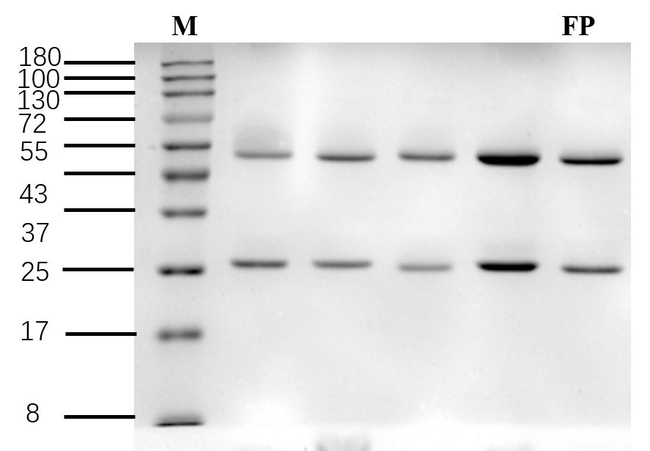
图: 1 / 1
Fipronil Antibody (MA566499) in SDS-PAGE
SDS-PAGE characterization of Fipronil under reducing conditions. Lane M: Protein marker (kDa); Lane FP: Purified Fipronil Recombinant Monoclonal (Product # MA566499). Fipronil showing heavy chain (~50 kDa) and light chain (~25 kDa). Gels were stained with Coomassie Brilliant Blue R-506.
Please note: We are reviewing Western blot images included in the antibody testing data in our catalog, including those provided by third parties. Unless expressly labeled or annotated as “raw-unedited”, Western blot images included in the antibody testing data in our catalog may have been edited, optimized or otherwise adjusted for presentation.

产品信息
MA566499
产品规格
种属反应
Chemical
宿主/亚型
Mouse
/ IgG
Expression System
CHO cells
分类
Recombinant Monoclonal
类型
Antibody
克隆号
3B1
抗原
Conjugate of FP hapten and KLH.
偶联物
Unconjugated
Unconjugated
Unconjugated
形式
Liquid
浓度
9.5 mg/mL
规格
200 µg
纯化类型
Protein G
保存液
PBS
内含物
0.09% sodium azide
保存条件
-20°C
运输条件
Ambient (domestic); Wet ice (international)
RRID
靶标信息
Fipronil is a phenylpyrazole insecticide widely used in agricultural and residential settings to control pests. Its structure consists of a pyrazole ring, which contributes to its insecticidal properties by disrupting the central nervous system of insects. Fipronil functions by blocking the gamma-aminobutyric acid (GABA) receptor, leading to hyperexcitation and eventual death of the pest. Recent studies have focused on developing biosensors for detecting fipronil residues due to its environmental persistence and potential health risks. These biosensors, such as electrochemical aptasensors and fluorescence-based systems, utilize novel mechanisms like primer exchange reactions and noncanonical G4-quadruplex aptamer binding to achieve high sensitivity and specificity in detecting trace amounts of fipronil in food products and environmental samples.
仅用于科研。不用于诊断过程。未经明确授权不得转售。
篇参考文献 (0)
您是否在文献中引用过该产品?请点击下方按钮邮件告知我们。
Disclaimer

Clicking the images or links will redirect you to a website hosted by BenchSci that provides third-party scientific content. Neither the content nor the BenchSci technology and processes for selection have been evaluated by us; we are providing them as-is and without warranty of any kind, including for use or application of the Thermo Fisher Scientific products presented.

