Search


引用和文献 (8)
Invitrogen™
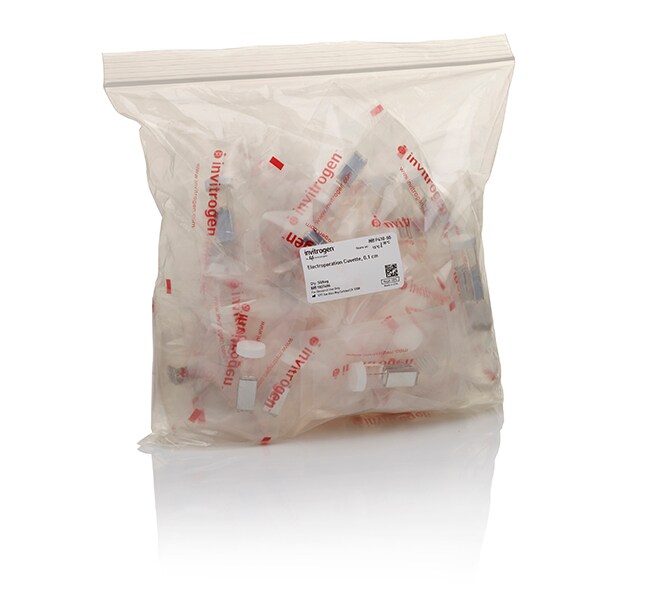
电穿孔比色皿,0.1 cm
这些比色皿可在将 DNA 导入细菌、酵母和哺乳动物细胞的电穿孔过程中使用。特点包括:•几乎兼容所有常见的电穿孔仪器•经过伽马射线照射且单独包装,确保无菌•颜色编码的弹扣盖,便于区分不同规格推荐将这种比色皿用于我们所有电穿孔感受态细胞。了解更多信息
| 货号 | 数量 |
|---|---|
| P41050 | 50 each |
货号 P41050
价格(CNY)
1,916.00
飞享价
Ends: 31-Dec-2026
2,395.00共减 479.00 (20%)
Each
数量:
50 each
价格(CNY)
1,916.00
飞享价
Ends: 31-Dec-2026
2,395.00共减 479.00 (20%)
Each
这些比色皿可在将 DNA 导入细菌、酵母和哺乳动物细胞的电穿孔过程中使用。特点包括:
•几乎兼容所有常见的电穿孔仪器
•经过伽马射线照射且单独包装,确保无菌
•颜色编码的弹扣盖,便于区分不同规格
推荐将这种比色皿用于我们所有电穿孔感受态细胞。
•几乎兼容所有常见的电穿孔仪器
•经过伽马射线照射且单独包装,确保无菌
•颜色编码的弹扣盖,便于区分不同规格
推荐将这种比色皿用于我们所有电穿孔感受态细胞。
仅供科研使用。不可用于诊断程序。
规格
直径(公制)0.1 cm
适用于(设备)电穿孔设备
产品类型电穿孔比色皿
数量50 each
运输条件室温
Unit SizeEach
内容与储存
每袋含有 50 个独立包装的无菌比色皿。室温下储存。
常见问题解答 (FAQ)
我如何才能避免在电转<i>E. coli</i>时出现电火花?
Will Invitrogen cuvettes fit my electroporator?
How can I avoid arcing during electroporation of E. coli?
What is meant by "field strength" (kV/cm) when determining settings for electroporation? What are typical settings for different cell types?
What is the maximum volume of E. coli (bacterial) cells that can be electroporated in a 0.1 cm cuvette?
引用和文献 (8)
引用和文献
Abstract
Transfection techniques for producing recombinant baculoviruses.
Journal:Molecular biotechnology
PubMed ID:9067978
Synthesis and anticonvulsant and neurotoxic properties of substituted N-phenyl derivatives of the phthalimide pharmacophore.
Journal:J Med Chem
PubMed ID:10753468
'A series of compounds including 4-amino (1), 3-amino (2), 4-nitro (3), 2-methyl-3-amino (4), 2-methyl-3-nitro (5), 2-methyl-4-amino (6), 2-methyl-4-nitro (7), 2-methyl-5-amino (8), 2-methyl-5-nitro (9), 2-methyl-6-amino (10), 2-methyl-6-nitro (11), 2,6-dimethyl (12), 2-methyl-3-carboxy (13), 2-methoxycarbonyl (14), 2-methyl-4-methoxy (15), 2,4-dimethoxy (16), 2-chloro-4-amino (17), and 2-chloro-4-nitro (18) N-phenyl substituents of phthalimide were evaluated along with
Optimization of the transfection of human endothelial cells by electroporation.
Journal:Biotechniques
PubMed ID:7840968
A method for efficient transfection of human umbilical vein endothelial cells (HUVEC) is presented here. The procedure involves cell synchronization followed by electroporation and allows the detection of the activity of low-strength promoters. Sodium butyrate, added to the culture medium after electroporation, strongly potentiates the transcriptional activity of viral promoters.
Expression of mRNA electroporated into plant and animal cells.
Journal:Nucleic Acids Res
PubMed ID:3475678
A general method to introduce RNA molecules into plant protoplasts and animal cells is described. This technique utilizes the ability of electric pulses of high field strength to form pores in biomembranes. RNA molecules containing the coding region for the bacterial enzyme chloramphenicol acetyltransferase (CAT) were used as a model
Initiation of the phosphocholine-specific response to Proteus morganii. B cell transfectants expressing unmutated VH/VL can respond to stimulation by P. morganii antigen.
Journal:J Immunol
PubMed ID:7544373
We wished to resolve a paradox of how the response to the phosphocholine (PC) determinant of Proteus morganii could be initiated from a precursor B cell whose receptor, in unmutated form as Ab, appears to be unable to bind Ag. Unmutated VH and unmutated VL constructs were co-transfected into the