Search


引用和文献 (5)
Invitrogen™
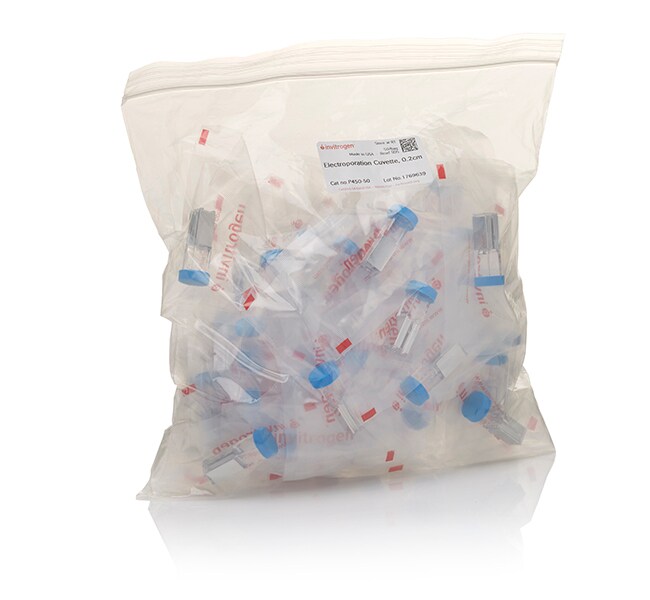
电穿孔比色皿,0.2 cm
Electroporation uses short, high-voltage electric pulses to overcome the cell membrane and introduce DNA directly into cells. These cuvettes are了解更多信息
| 货号 | 数量 |
|---|---|
| P45050 | 50 each |
货号 P45050
价格(CNY)
1,916.00
飞享价
Ends: 31-Dec-2026
2,395.00共减 479.00 (20%)
Each
数量:
50 each
价格(CNY)
1,916.00
飞享价
Ends: 31-Dec-2026
2,395.00共减 479.00 (20%)
Each
Electroporation uses short, high-voltage electric pulses to overcome the cell membrane and introduce DNA directly into cells. These cuvettes are specifically designed help achieve high DNA transformation efficiency during the introduction of DNA into bacterial, yeast, fungal, and mammalian cells.
Our electroporation cuvettes are precision manufactured from the highest quality materials to ensure optimal and reproducible transformation results.
Electroporation cuvette features
• Compatible with virtually all common electroporation devices
• Gamma-irradiated and individually packaged to ensure sterility
• Color-coded snap cap for easy identification of gap size (blue cap for 0.2 cm cuvette)
Note: Electroporation cuvettes are recommended for use with all of our electroporation competent cells.
仅供科研使用。不可用于诊断程序。
规格
直径(公制)0.2 cm
适用于(设备)电穿孔设备
产品类型电穿孔比色皿
数量50 each
运输条件室温
Unit SizeEach
内容与储存
每袋含有 50 个独立包装的无菌比色皿。室温下储存。
常见问题解答 (FAQ)
我如何才能避免在电转<i>E. coli</i>时出现电火花?
Will Invitrogen cuvettes fit my electroporator?
How can I avoid arcing during electroporation of E. coli?
What is meant by "field strength" (kV/cm) when determining settings for electroporation? What are typical settings for different cell types?
What are recommended settings for bacterial electroporation of 80 ul cells in 0.2 cm cuvettes? What is the maximum cell volume to use in a 0.2 cm cuvette?
引用和文献 (5)
引用和文献
Abstract
Expression cloning and functional characterization of human cDNA for ganglioside GM3 synthase.
Journal:J Biol Chem
PubMed ID:9822625
'Ganglioside GM3 is a major glycosphingolipid in the plasma membrane and is widely distributed in vertebrates. We describe here the isolation of a human cDNA whose protein product is responsible for the synthesis of GM3. The cloned cDNA spanned 2,359 base pairs, with an open reading frame encoding a protein
Introduction of deoxyribonucleoside triphosphates into intact cells by electroporation.
Journal:Anal Biochem
PubMed ID:3812972
A simple method, employing high-voltage electric discharge (electroporation), was developed to introduce phosphorylated nucleosides into the cytoplasm of viable cells. HL-60 leukemia cells permeabilized by this technique remained viable and incorporated deoxyribonucleoside triphosphates into nuclear DNA. Furthermore, DNA synthesis was depressed for at least 24 h in HL-60 cells made
T cell receptor (TCR) mini-gene mRNA expression regulated by nonsense codons: a nuclear-associated translation-like mechanism
Journal:J Exp Med
PubMed ID:9091590
Premature termination codons (PTCs) are known to decrease mRNA levels. Here, we report our investigation of the mechanism for this downregulation using the TCR-beta gene, which acquires PTCs as a result of programmed rearrangements that occur during normal thymic development. We found that a mini-gene version of this gene, which
Expression of a human mutant monocyte chemotactic protein 3 in Pichia pastoris and characterization as an MCP-3 receptor antagonist.
Journal:J Interferon Cytokine Res
PubMed ID:8590307
The cDNA encoding human monocyte chemotactic protein 3 (hMCP-3) was cloned in pHIL-S1, a vector designed for inducible secreted heterologous expression in the methylotrophic yeast Pichia pastoris. After transformation of P. pastoris by electroporation, several clones with the human MCP-3 gene integrated at the alcohol oxidase (AOX-1) locus were isolated.
Short technical reports. Effects of lipopolysaccharide on transfection efficiency in eukaryotic cells.
Journal:Biotechniques
PubMed ID:8747659
The suitability of different purification methods for preparation of plasmid DNA for transfection into eukaryotic cells was systematically investigated. The reporter plasmid, pRSVcat, was prepared using several methods, and residual impurities in the preparations were quantitated. Transfection with these preparations was performed with several cell lines (HeLa, Huh7, COS7 and