Search
Invitrogen
APH1 Polyclonal Antibody
{{$productOrderCtrl.translations['antibody.pdp.commerceCard.promotion.promotions']}}
{{$productOrderCtrl.translations['antibody.pdp.commerceCard.promotion.promocode']}}: {{promo.promoCode}} {{promo.promoTitle}} {{promo.promoDescription}}. {{$productOrderCtrl.translations['antibody.pdp.commerceCard.promotion.learnmore']}}
{{$ctrl.translations['antibody.pdp.skuNotes.additionalInformation']}}:
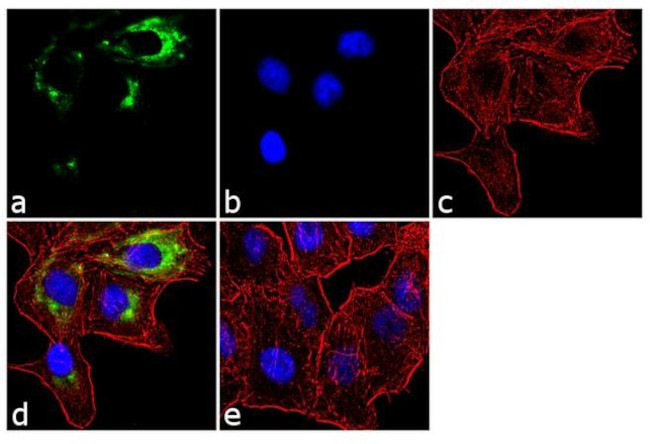
图: 1 / 7
APH1 Antibody (PA1-2010) in ICC/IF
Immunofluorescent analysis of APH-1 was performed using 70% confluent log phase A549 cells. The cells were fixed with 4% paraformaldehyde for 10 minutes, permeabilized with 0.1% Triton™ X-100 for 10 minutes, and blocked with 1% BSA for 1 hour at room temperature. The cells were labeled with APH-1 Rabbit Polyclonal Antibody (Product # PA1-2010) at 2 µg/mL in 0.1% BSA and incubated for 3 hours at room temperature and then labeled with Goat anti-Rabbit IgG (Heavy Chain) Superclonal™ Secondary Antibody, Alexa Fluor® 488 conjugate (Product # A2... View More

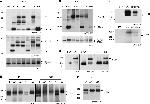

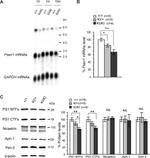
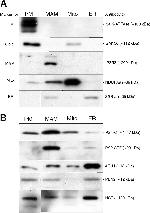
Please note: We are reviewing Western blot images included in the antibody testing data in our catalog, including those provided by third parties. Unless expressly labeled or annotated as “raw-unedited”, Western blot images included in the antibody testing data in our catalog may have been edited, optimized or otherwise adjusted for presentation.


产品信息
PA1-2010
应用
建议稀释比
已发表文章
产品规格
种属反应
Human,
Mouse
已发表种属
Hamster,
Human,
Mouse
宿主/亚型
Rabbit
/ IgG
分类
Polyclonal
类型
Antibody
抗原
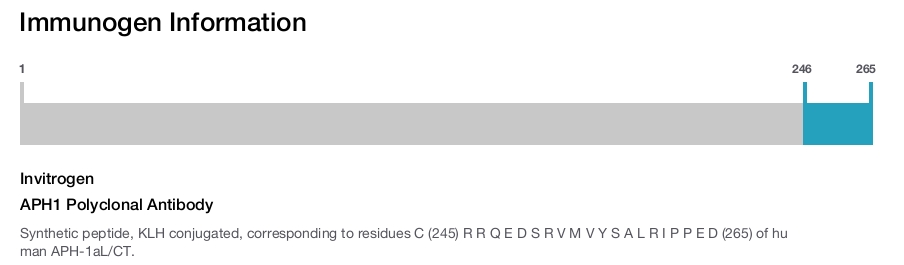
Synthetic peptide, KLH conjugated, corresponding to residues C (245) R R Q E D S R V M V Y S A L R I P P E D (265) of human APH-1aL/CT.
偶联物
Unconjugated
Unconjugated
Unconjugated
形式
Liquid
浓度
0.69 mg/mL
规格
100 µg
纯化类型
Affinity chromatography
保存液
PBS with 1mg/mL BSA
内含物
0.005% sodium azide
保存条件
-20°C, Avoid Freeze/Thaw Cycles
运输条件
Ambient (domestic); Wet ice (international)
RRID
产品详细信息
PA1-2010 detects APH-1 in human and mouse samples.
PA1-2010 has been successfully used in immunofluorescent, immunoprecipitation, and Western blot procedures. By Western blot, this antibody detects a ~28 kDa protein representing APH-1 in mouse brain and kidney extracts.
The PA1-2010 immunogen is a Synthetic peptide, KLH conjugated, corresponding to residues C (245) R R Q E D S R V M V Y S A L R I P P E D (265) of the C-Terminal domain of the long isoform of APH-1a. This polyclonal antibody has been referred to as, O2C2 in the reference listed above.
靶标信息
APH1 is an essential subunit of the gamma-secretase complex, an endoprotease complex that catalyzes the intramembrane cleavage of integral proteins such as Notch receptors and APP (beta-amyloid precursor protein). The gamma-secretase complex is minimally composed of a presenilin homodimer (PSEN1 or PSEN2), nicastrin (NCSTN), APH1 (APH1A or APH1B) and PEN2, although other components may exist. APH1 probably represents a stabilizing cofactor for the presenilin homodimer that promotes the formation of a stable complex.
仅用于科研。不用于诊断过程。未经明确授权不得转售。
生物信息学
蛋白别名: anterior pharynx defective 1 homolog A; anterior pharynx defective 1a homolog; aph-1 homolog A, gamma-secretase subunit; aph-1alpha; APH1A gamma secretase subunit; polytopic transmembrane protein; presenilin-stabilization factor; RP4-790G17.3; unnamed protein product
基因别名: 6530402N02Rik; APH-1; APH-1A; CGI-78
UniProt ID: (Human) Q96BI3, (Mouse) Q8BVF7
Entrez Gene ID: (Human) 51107, (Mouse) 226548
proteolysis
membrane protein ectodomain proteolysis
Notch signaling pathway
Notch receptor processing
protein processing
membrane protein intracellular domain proteolysis
beta-amyloid formation
amyloid precursor protein metabolic process
amyloid precursor protein catabolic process
metanephros development
Disclaimer

Clicking the images or links will redirect you to a website hosted by BenchSci that provides third-party scientific content. Neither the content nor the BenchSci technology and processes for selection have been evaluated by us; we are providing them as-is and without warranty of any kind, including for use or application of the Thermo Fisher Scientific products presented.

