Search
Invitrogen
KCNMA1 Polyclonal Antibody
{{$productOrderCtrl.translations['antibody.pdp.commerceCard.promotion.promotions']}}
{{$productOrderCtrl.translations['antibody.pdp.commerceCard.promotion.promocode']}}: {{promo.promoCode}} {{promo.promoTitle}} {{promo.promoDescription}}. {{$productOrderCtrl.translations['antibody.pdp.commerceCard.promotion.learnmore']}}
{{$ctrl.translations['antibody.pdp.skuNotes.additionalInformation']}}:
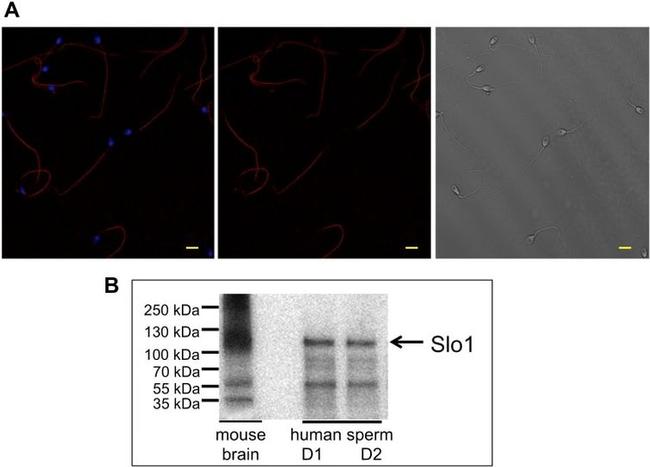
图: 1 / 1
KCNMA1 Antibody (PA1-923) in ICC/IF
eLife 2013 -
Figure 10. Slo1 protein is present in human spermatozoa. ( A ) Human sperm immunostaining with primary polyclonal anti-Slo1 antibodies and Cy3-conjugated secondary antibodies. Left and middle panels show Slo1 staining localized to the principal piece of human sperm flagellum. Left panel: nuclei are stained by DAPI. Right panel: DIC image of the same cells. Scale bar is 5 mm. ( B ) Representative immunoblot ... View More
Please note: We are reviewing Western blot images included in the antibody testing data in our catalog, including those provided by third parties. Unless expressly labeled or annotated as “raw-unedited”, Western blot images included in the antibody testing data in our catalog may have been edited, optimized or otherwise adjusted for presentation.

产品信息
PA1-923
应用
建议稀释比
已发表文章
产品规格
种属反应
Human,
Rat
已发表种属
Human,
Mouse,
Rat
宿主/亚型
Rabbit
/ IgG
分类
Polyclonal
类型
Antibody
抗原
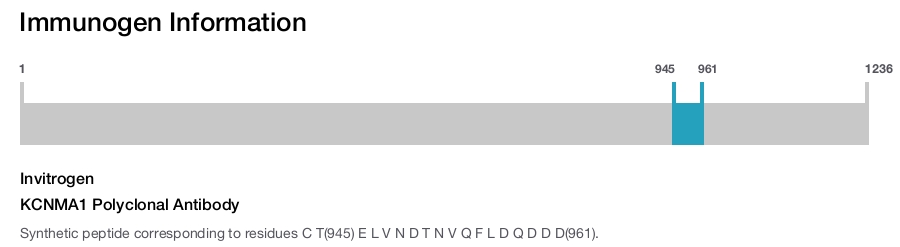
Synthetic peptide corresponding to residues C T(945) E L V N D T N V Q F L D Q D D D(961).
偶联物
Unconjugated
Unconjugated
Unconjugated
形式
Liquid
浓度
1 mg/mL
规格
100 µg
纯化类型
Antigen affinity chromatography
保存液
PBS with 1mg/mL BSA
内含物
0.05% sodium azide
保存条件
-20°C, Avoid Freeze/Thaw Cycles
运输条件
Ambient (domestic); Wet ice (international)
RRID
产品详细信息
PA1-923 detects large conductance, calcium-activated potassium channel alpha (Maxi K+ alpha) from human tissues as well as recombinant human protein and rat samples.
PA1-923 has been successfully used in Western blot and immunocytochemistry procedures. By Western blot, this antibody detects an ~110 kDa protein representing Maxi K+ alpha from human myometrial smooth muscle cell extracts. Immunocytochemical staining of Maxi K+ alpha in human coronary muscle cells with PA1-923 results in predominant staining of the plasma membrane.
PA1-923 immunizing peptide corresponds to amino acid residues 945-961 from human Maxi K+ alpha. This sequence is completely conserved across many species. PA1-923 immunizing peptide (Cat. # PEP-113) is available for use in neutralization and control experiments.
靶标信息
Potassium channels are a group of ubiquitously expressed proteins that serve numerous functions in excitable and non-excitable cells. One class of integral membrane potassium channels is the large conductance, calcium-activated potassium channel (Maxi K+). Maxi K+ differs from most other potassium channels in that its activation is controlled by both increases in intracellular calcium and by membrane depolarization. Maxi K+ dual activation is possible because of its structure. The core of the channel, which is similar to other potassium channels, is a Maxi K+ alpha homotetramer that contains both a voltage sensor and an intracellular calcium binding domain. In vascular smooth muscle, an auxiliary beta-subunit is found in a 1:1 stoichiometry. The beta-subunit exhibits its effect on the Maxi K+ channel by effectively decreasing by 5- to 10- fold the concentration of calcium required to keep the pore open.
仅用于科研。不用于诊断过程。未经明确授权不得转售。
生物信息学
蛋白别名: big potassium channel alpha subunit; BK channel; BK channel alpha subunit; BKCA alpha subunit; calcium-activated potassium channel alpha subunit; calcium-activated potassium channel, subfamily M subunit alpha-1; k(VCA)alpha; maxi K channel; maxi K channel; KCNMA1; maxi-K channel HSLO; maxi-k channel isoform; MaxiK alpha subunit; potassium channel; potassium channel, calcium activated large conductance subfamily M alpha, member 1; potassium large conductance calcium-activated channel, subfamily M, alpha member 1; slo; slo homolog; slowpoke homolog; stretch-activated Kca channel; voltage-sensitive calcium channel
基因别名: bA205K10.1; BKCa; BKCA alpha; BKTM; CADEDS; cbv1; hSlo; IEG16; k(VCA)alpha; KCa1.1; Kcnma; KCNMA1b; KCNMA1c; LIWAS; MaxiK; mSLO1; PNKD3; SAKCA; SLO; SLO-ALPHA; SLO1
UniProt ID: (Human) Q12791, (Rat) Q62976
Entrez Gene ID: (Human) 3778, (Rat) 83731
actin binding
ion channel activity
voltage-gated potassium channel activity
protein binding
calcium-activated potassium channel activity
identical protein binding
large conductance calcium-activated potassium channel activity
potassium channel activity
macromolecular complex binding
ligand-gated monoatomic ion channel activity involved in regulation of presynaptic membrane potential
response to hypoxia
ion transport
potassium ion transport
response to osmotic stress
chemical synaptic transmission
sensory perception of sound
circadian rhythm
adult walking behavior
response to pH
neuronal action potential
cellular potassium ion homeostasis
regulation of aldosterone metabolic process
response to carbon monoxide
vasodilation
regulation of membrane potential
auditory receptor cell differentiation
positive regulation of apoptotic process
positive regulation of neuron apoptotic process
response to estrogen
locomotor rhythm
negative regulation of cell volume
negative regulation of smooth muscle contraction
saliva secretion
cell maturation
neuromuscular process controlling balance
response to calcium ion
transmembrane transport
micturition
eye blink reflex
smooth muscle contraction involved in micturition
relaxation of vascular smooth muscle
potassium ion transmembrane transport
regulation of blood vessel diameter
regulation of presynaptic membrane potential
positive regulation of membrane hyperpolarization
negative regulation of small intestine smooth muscle contraction
Disclaimer

Clicking the images or links will redirect you to a website hosted by BenchSci that provides third-party scientific content. Neither the content nor the BenchSci technology and processes for selection have been evaluated by us; we are providing them as-is and without warranty of any kind, including for use or application of the Thermo Fisher Scientific products presented.

