Search
Invitrogen
PSMA1 Polyclonal Antibody
{{$productOrderCtrl.translations['antibody.pdp.commerceCard.promotion.promotions']}}
{{$productOrderCtrl.translations['antibody.pdp.commerceCard.promotion.promocode']}}: {{promo.promoCode}} {{promo.promoTitle}} {{promo.promoDescription}}. {{$productOrderCtrl.translations['antibody.pdp.commerceCard.promotion.learnmore']}}
{{$ctrl.translations['antibody.pdp.skuNotes.additionalInformation']}}:
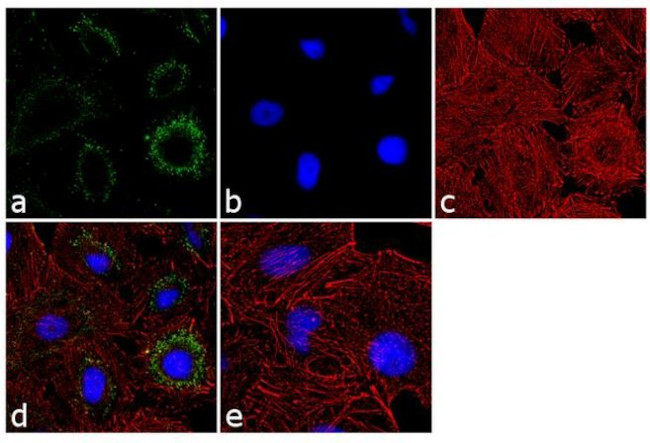
图: 1 / 7
PSMA1 Antibody (PA1-963) in ICC/IF
Immunofluorescence analysis of PSMA1 was performed using 70% confluent log phase MDA-MB-231 cells. The cells were fixed with 4% paraformaldehyde for 10 minutes, permeabilized with 0.1% Triton™ X-100 for 10 minutes, and blocked with 1% BSA for 1 hour at room temperature. The cells were labeled with PSMA1 Rabbit Polyclonal Antibody (Product # PA1-963) at 2 µg/mL in 0.1% BSA and incubated for 3 hours at room temperature and then labeled with Goat anti-Rabbit IgG (Heavy Chain) Superclonal™ Secondary Antibody, Alexa Fluor® 488 conjugate (Produc... View More

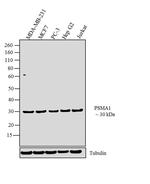
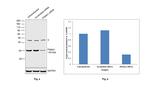
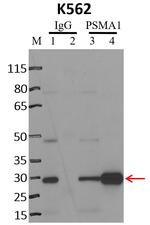
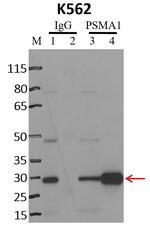
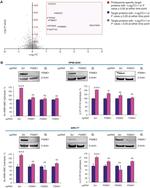
Please note: We are reviewing Western blot images included in the antibody testing data in our catalog, including those provided by third parties. Unless expressly labeled or annotated as “raw-unedited”, Western blot images included in the antibody testing data in our catalog may have been edited, optimized or otherwise adjusted for presentation.


产品信息
PA1-963
应用
建议稀释比
已发表文章
产品规格
种属反应
Dog,
Hamster,
Human,
Mouse,
Rat
已发表种属
Human
宿主/亚型
Rabbit
/ IgG
分类
Polyclonal
类型
Antibody
抗原
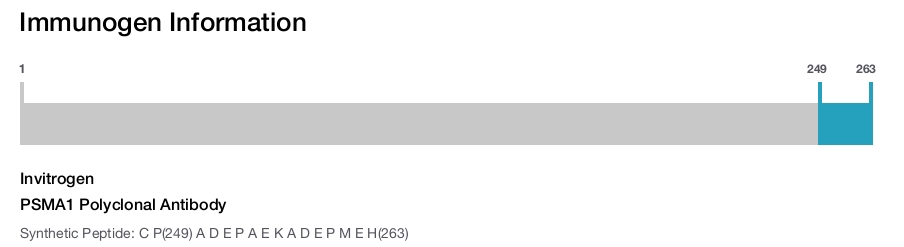
Synthetic Peptide: C P(249) A D E P A E K A D E P M E H(263)
偶联物
Unconjugated
Unconjugated
Unconjugated
形式
Liquid
浓度
1 mg/mL
规格
100 µg
纯化类型
Antigen affinity chromatography
保存液
PBS with 1mg/mL BSA
内含物
0.05% sodium azide
保存条件
-20°C, Avoid Freeze/Thaw Cycles
运输条件
Ambient (domestic); Wet ice (international)
RRID
产品详细信息
PA1-963 detects proteasome 20S C2 subunit from canine, hamster, human, mouse and rat tissues and cells.
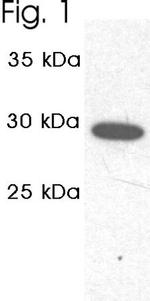
PA1-963 has been successfully used in Western blot procedures. By Western blot, this antibody detects a 29 kDa protein representing proteasome 20S C2 subunit from rat brain extract.
PA1-963 immunizing peptide corresponds to amino acid residues 249-263 from the C-terminus of human proteasome 20S C2 subunit. This sequence is 93% conserved in the rat and chicken protein and 87% conserved in the mouse protein. PA1-963 immunizing peptide (Cat. # PEP-100) is available for use in neutralization and control experiments.
靶标信息
Proteolytic degradation is critical to the maintenance of appropriate levels of short-lived and regulatory proteins as important and diverse as those involved in cellular metabolism, heat shock and stress response, antigen presentation, modulation of cell surface receptors and ion channels, cell cycle regulation, transcription, and signaling factors. The ubiquitin-proteasome pathway deconstructs most proteins in the eukaryotic cell cytosol and nucleus. Others are degraded via the vacuolar pathway which includes endosomes, lysosomes, and the endoplasmic reticulum. The 26S proteasome is an ATP-dependent, multisubunit (approximately31), barrel-shaped molecular machine with an apparent molecular weight of approximately2. 5 MDa. It consists of a 20S proteolytic core complex which is crowned at one or both ends by 19S regulatory subunit complexes. The 19S regulatory subunits recognize ubiquitinated proteins and play an essential role in unfolding and translocating targets into the lumen of the 20S subunit. An enzymatic cascade is responsible for the attachment of multiple ubiquitin molecules to lysine residues of proteins targeted for degradation. Several genetic diseases are associated with defects in the ubiquitin-proteasome pathway. Some examples of affected proteins include those linked to cystic fibrosis, Angelman's syndrome, and Liddle syndrome.
仅用于科研。不用于诊断过程。未经明确授权不得转售。
生物信息学
蛋白别名: 20S proteasome subunit C2; 30 kDa prosomal protein; alpha-6; epididymis secretory protein Li 275; macropain subunit C2; macropain subunit nu; MGC14542; MGC14575; MGC14751; MGC1667; MGC21459; MGC22853; MGC23915; multicatalytic endopeptidase complex subunit C2; PROS-30; proteasome (prosome, macropain) subunit, alpha type 1; proteasome (prosome, macropain) subunit, alpha type, 1; proteasome alpha 1 subunit; proteasome component C2; proteasome nu chain; proteasome subunit alpha 1; proteasome subunit alpha 6; Proteasome subunit alpha type-1; proteasome subunit alpha-6; proteasome subunit nu; proteasome subunit, alpha-type, 1; protein P30-33K; testicular tissue protein Li 150; unnamed protein product
基因别名: alpha-type; C2; HC2; HEL-S-275; NU; Pros-30; PROS30
UniProt ID: (Human) P25786, (Rat) P18420, (Mouse) Q9R1P4
Entrez Gene ID: (Dog) 476867, (Human) 5682, (Rat) 29668, (Mouse) 26440, (Chinese hamster) 100773907
immune system process
negative regulation of inflammatory response to antigenic stimulus
DNA repair
ubiquitin-dependent protein catabolic process
apoptotic process
cellular response to DNA damage stimulus
response to oxidative stress
spermatogenesis
proteasomal protein catabolic process
proteasomal ubiquitin-independent protein catabolic process
protein catabolic process
sperm motility
positive regulation of interferon-gamma production
positive regulation of interleukin-2 production
positive regulation of tumor necrosis factor production
response to interferon-gamma
proteasome-mediated ubiquitin-dependent protein catabolic process
CD8-positive, alpha-beta T cell differentiation
thymic T cell selection
T-helper 1 cell differentiation
negative regulation of regulatory T cell differentiation
meiotic cell cycle
regulation of proteasomal protein catabolic process
cellular response to type I interferon
T-helper 17 cell differentiation
CD8-positive, alpha-beta T cell homeostasis
regulation of G1/S transition of mitotic cell cycle
Disclaimer

Clicking the images or links will redirect you to a website hosted by BenchSci that provides third-party scientific content. Neither the content nor the BenchSci technology and processes for selection have been evaluated by us; we are providing them as-is and without warranty of any kind, including for use or application of the Thermo Fisher Scientific products presented.

