Search
Invitrogen
ITGA5 Polyclonal Antibody
{{$productOrderCtrl.translations['antibody.pdp.commerceCard.promotion.promotions']}}
{{$productOrderCtrl.translations['antibody.pdp.commerceCard.promotion.promocode']}}: {{promo.promoCode}} {{promo.promoTitle}} {{promo.promoDescription}}. {{$productOrderCtrl.translations['antibody.pdp.commerceCard.promotion.learnmore']}}
{{$ctrl.translations['antibody.pdp.skuNotes.additionalInformation']}}:
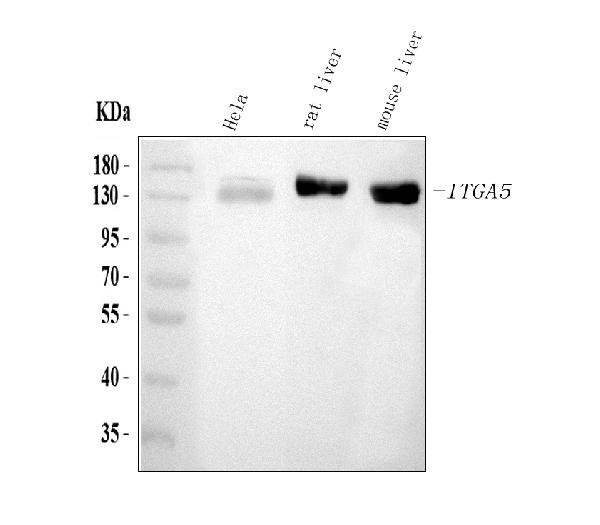
图: 1 / 1
ITGA5 Antibody (PA5-95215) in WB
Western blot analysis of CD49e (Integrin alpha 5) using ITGA5 Polyclonal Antibody (Product # PA5-95215). Electrophoresis was performed on a 5-20% SDS-PAGE gel at 70V (Stacking gel)/90V (Resolving gel) for 2-3 hours. The sample well of each lane was loaded with 30 µg of sample under reducing conditions. Lane 1: human Hela whole cell lysates. Lane 2: rat liver tissue lysates. Lane 3: mouse liver tissue lysates. After electrophoresis, proteins were transferred to a nitrocellulose membrane at 150 mA for 50-90 minutes. Blocked the membrane with... View More
Please note: We are reviewing Western blot images included in the antibody testing data in our catalog, including those provided by third parties. Unless expressly labeled or annotated as “raw-unedited”, Western blot images included in the antibody testing data in our catalog may have been edited, optimized or otherwise adjusted for presentation.

产品信息
PA5-95215
产品规格
种属反应
Human,
Mouse,
Rat
宿主/亚型
Rabbit
/ IgG
分类
Polyclonal
类型
Antibody
抗原
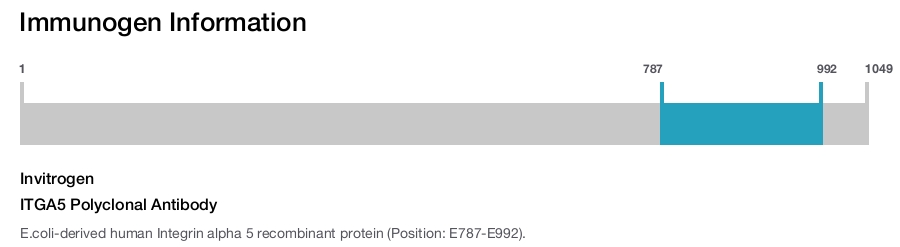
E.coli-derived human Integrin alpha 5 recombinant protein (Position: E787-E992).
偶联物
Unconjugated
Unconjugated
Unconjugated
形式
Lyophilized
浓度
500 µg/mL once reconstituted
规格
100 µg
纯化类型
Affinity chromatography
保存液
PBS with 5mg BSA
内含物
0.05mg sodium azide
保存条件
-20°C
运输条件
Ambient (domestic); Wet ice (international)
RRID
产品详细信息
Human Integrin alpha 5 shares 86% amino acid (aa) sequence identity with mouse Integrin alpha 5.
Reconstitute with 0.2 mL of distilled water to yield a concentration of 500 µg/mL.
Positive Control - WB: human Hela whole cell, rat liver tissue, mouse liver tissue.|Store at -20°C for one year from date of receipt. After reconstitution, at 4°C for one month. It can also be aliquotted and stored frozen at -20°C for six months. Avoid repeated freeze-thaw cycles.
靶标信息
The product of this gene belongs to the integrin alpha chain family. Integrins are heterodimeric integral membrane proteins composed of an alpha chain and a beta chain. This gene encodes the integrin alpha 5 chain. Alpha chain 5 undergoes post-translational cleavage in the extracellular domain to yield disulfide-linked light and heavy chains that join with beta 1 to form a fibronectin receptor. In addition to adhesion, integrins are known to participate in cell-surface mediated signalling.
仅用于科研。不用于诊断过程。未经明确授权不得转售。
篇参考文献 (0)
您是否在文献中引用过该产品?请点击下方按钮邮件告知我们。
生物信息学
蛋白别名: CD49; CD49 antigen-like family member E; fibronectin receptor alpha polypeptide; fibronectin receptor subunit alpha; fibronectin receptor, alpha polypeptide; fibronectin receptor, alpha subunit; integrin alpha 5 (fibronectin receptor alpha); integrin alpha-F; integrin, alpha 5 (fibronectin receptor, alpha polypeptide); ITGA5/SLC9B1 fusion; surface glycoprotein receptor; unnamed protein product; very late activation protein 5, alpha subunit
基因别名: CD49e; FNRA; Itga5_retired; VLA-5; VLA5; VLA5A
UniProt ID: (Human) P08648, (Mouse) P11688
Entrez Gene ID: (Human) 3678, (Rat) 315346, (Mouse) 16402
angiogenesis
formation of primary germ layer
cell adhesion
cell-matrix adhesion
integrin-mediated signaling pathway
female pregnancy
tissue development
positive regulation of cell-substrate adhesion
response to muscle activity
CD40 signaling pathway
positive regulation of cell migration
positive regulation of vascular endothelial growth factor receptor signaling pathway
cell-substrate adhesion
cell adhesion mediated by integrin
heterotypic cell-cell adhesion
wound healing, spreading of epidermal cells
endodermal cell differentiation
regulation of angiogenesis
cell-cell adhesion
positive regulation of vascular endothelial growth factor signaling pathway
positive regulation of sprouting angiogenesis
negative regulation of anoikis
cell-substrate junction assembly
heterophilic cell-cell adhesion via plasma membrane cell adhesion molecules
leukocyte cell-cell adhesion
memory
cell-cell adhesion mediated by integrin
Disclaimer

Clicking the images or links will redirect you to a website hosted by BenchSci that provides third-party scientific content. Neither the content nor the BenchSci technology and processes for selection have been evaluated by us; we are providing them as-is and without warranty of any kind, including for use or application of the Thermo Fisher Scientific products presented.

