Search
Invitrogen
M-CSF Polyclonal Antibody
{{$productOrderCtrl.translations['antibody.pdp.commerceCard.promotion.promotions']}}
{{$productOrderCtrl.translations['antibody.pdp.commerceCard.promotion.promocode']}}: {{promo.promoCode}} {{promo.promoTitle}} {{promo.promoDescription}}. {{$productOrderCtrl.translations['antibody.pdp.commerceCard.promotion.learnmore']}}
{{$ctrl.translations['antibody.pdp.skuNotes.additionalInformation']}}:
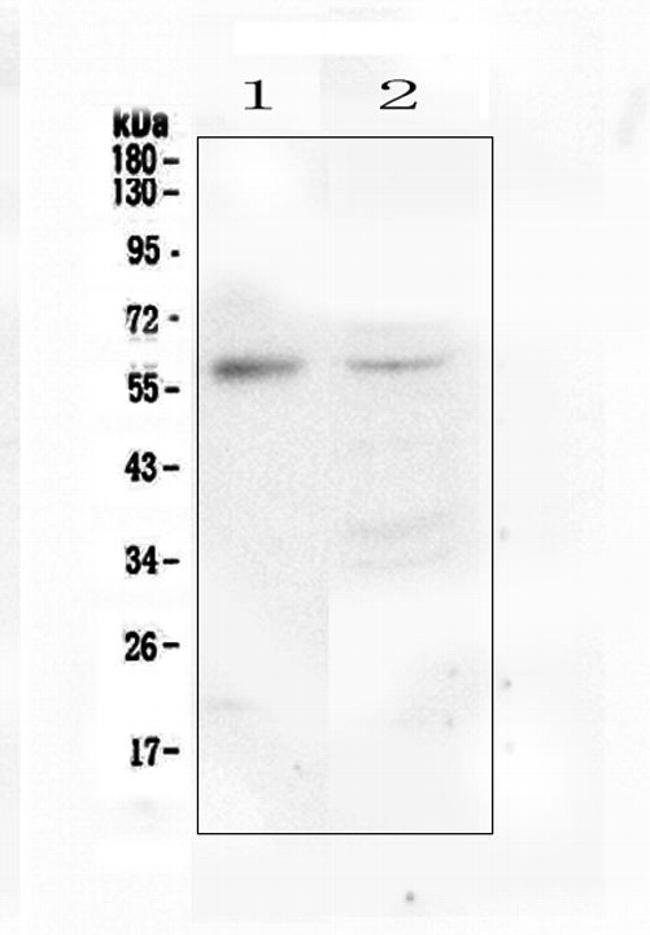
图: 1 / 2
M-CSF Antibody (PA5-95548) in WB
Western blot analysis of M-CSF in Lane 1: human placenta tissue lysates, Lane 2: human 293T whole cell lysate. Electrophoresis was performed with 5-20% SDS-PAGE gel (70V, Stacking gel; 90V Resolving gel, Time: 2-3 hours), transferred to a nitrocellulose membrane and blocked using 5% Non-fat Milk/TBS (1.5 hrs at room temperature). Samples were incubated with M-CSF polyclonal antibody (Product # PA5-95548) using a 0.5 µg/mL dilution, followed by a goat anti-rabbit IgG-HRP at a dilution of 1:10,000, and developed with enhanced chemiluminescen... View More
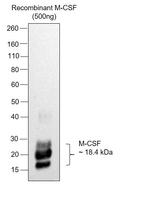
Please note: We are reviewing Western blot images included in the antibody testing data in our catalog, including those provided by third parties. Unless expressly labeled or annotated as “raw-unedited”, Western blot images included in the antibody testing data in our catalog may have been edited, optimized or otherwise adjusted for presentation.


产品信息
PA5-95548
产品规格
种属反应
Human,
Mouse
宿主/亚型
Rabbit
/ IgG
分类
Polyclonal
类型
Antibody
抗原
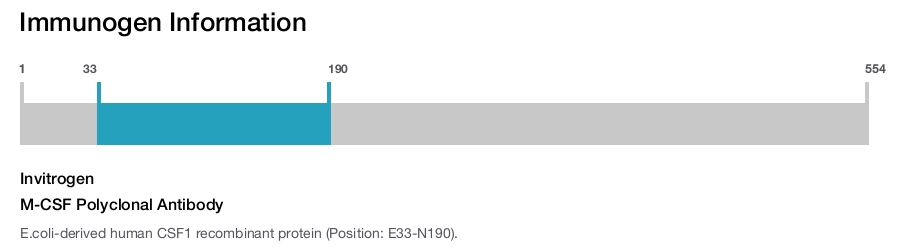
E.coli-derived human CSF1 recombinant protein (Position: E33-N190).
偶联物
Unconjugated
Unconjugated
Unconjugated
形式
Lyophilized
浓度
500 µg/mL once reconstituted
规格
100 µg
纯化类型
Affinity chromatography
保存液
PBS with 4mg trehalose
内含物
0.05mg sodium azide
保存条件
-20°C
运输条件
Ambient (domestic); Wet ice (international)
RRID
产品详细信息
Reconstitute with 0.2 mL of distilled water to yield a concentration of 500 µg/mL.
Positive Control - WB: human placenta tissue, human 293T whole cell.|Store at -20°C for one year from date of receipt. After reconstitution, at 4°C for one month. It can also be aliquotted and stored frozen at -20°C for six months. Avoid repeated freeze-thaw cycles.
靶标信息
M-CSF (Macrophage colony-stimulating factor, CSF-1) is a survival factor essential for the proliferation and development of monocytes, macrophages, and osteoclast progenitor cells. M-CSF also induces VEGF (vascular endothelial growth factor) secretion by macrophages, thereby mediating mobilization of endothelial progenitor cells and neovascularization. M-CSF is present as several bioactive isoforms that differ in potency and stability. The full-length protein is synthesized as a membrane-spanning protein that can be expressed on the cell surface or further cleaved and modified in the secretory vesicle. Further, M-CSF is a disulfide-bonded homodimer which is processed into one of two isoforms, a glycoprotein or a proteoglycan that has been modified by the addition of chondroitin sulfate to each subunit. Binding of M-CSF to its receptor, c-Fms (CSF-1R or CD115) induces dimerization of the receptor followed by internalization and degradation of the complex. Functionally, M-CSF is known to stimulate differentiation of hematopoietic stem cells to monocyte-macrophage cell populations in culture. M-CSF acts through the CSF receptor 1. Although human M-CSF shows activity on mouse cells, mouse CSF shows no activity on human cells.
仅用于科研。不用于诊断过程。未经明确授权不得转售。
篇参考文献 (0)
您是否在文献中引用过该产品?请点击下方按钮邮件告知我们。
生物信息学
蛋白别名: a secreted cytokine that influences hemopoietic stem cells to differentiate into macrophages or other related cell types; produced by eukaryotic cells in order to combat intercellular viral infection; binds to the colony-stimulating factor 1 receptor; may ; colony stimulating factor 1 (macrophage); colony-stimulating factor (CSF-1) precursor; colony-stimulating factor precursor; CSF1-hERV-LTR71B fusion protein; H-MCSF; lanimostim; M-MCSF; macrophage colony stimulating factor 1; MGC31930; osteopetrosis; premacrophage colony-stimulating factor 1; proteoglycan macrophage colony-stimulating factor; unnamed protein product
基因别名: BAP025; CSF-1; Csfm; MCSF; Mhdabap25; op; PG-M-CSF
UniProt ID: (Human) P09603, (Mouse) P07141
Entrez Gene ID: (Human) 1435, (Mouse) 12977
ossification
positive regulation of cell-matrix adhesion
osteoclast proliferation
positive regulation of immune system process
response to ischemia
developmental process involved in reproduction
transmembrane receptor protein tyrosine kinase signaling pathway
positive regulation of cell proliferation
positive regulation of gene expression
positive regulation of macrophage derived foam cell differentiation
positive regulation of macrophage chemotaxis
macrophage differentiation
regulation of ossification
osteoclast differentiation
positive regulation of cell migration
positive regulation of mononuclear cell proliferation
macrophage colony-stimulating factor signaling pathway
positive regulation of multicellular organism growth
positive regulation of odontogenesis of dentin-containing tooth
positive regulation of macrophage differentiation
positive regulation of monocyte differentiation
positive regulation of osteoclast differentiation
positive regulation of protein kinase activity
positive regulation of Ras protein signal transduction
homeostasis of number of cells within a tissue
positive regulation of protein metabolic process
branching involved in mammary gland duct morphogenesis
mammary gland fat development
mammary duct terminal end bud growth
microglial cell proliferation
positive regulation of mononuclear cell migration
positive regulation of macrophage proliferation
positive regulation of macrophage colony-stimulating factor signaling pathway
positive regulation of microglial cell migration
positive regulation of macrophage migration
regulation of macrophage derived foam cell differentiation
monocyte activation
innate immune response
Disclaimer

Clicking the images or links will redirect you to a website hosted by BenchSci that provides third-party scientific content. Neither the content nor the BenchSci technology and processes for selection have been evaluated by us; we are providing them as-is and without warranty of any kind, including for use or application of the Thermo Fisher Scientific products presented.

