Search
Invitrogen
Phospho-KIF1B (Ser1057) Polyclonal Antibody
{{$productOrderCtrl.translations['antibody.pdp.commerceCard.promotion.promotions']}}
{{$productOrderCtrl.translations['antibody.pdp.commerceCard.promotion.promocode']}}: {{promo.promoCode}} {{promo.promoTitle}} {{promo.promoDescription}}. {{$productOrderCtrl.translations['antibody.pdp.commerceCard.promotion.learnmore']}}
{{$ctrl.translations['antibody.pdp.skuNotes.additionalInformation']}}:
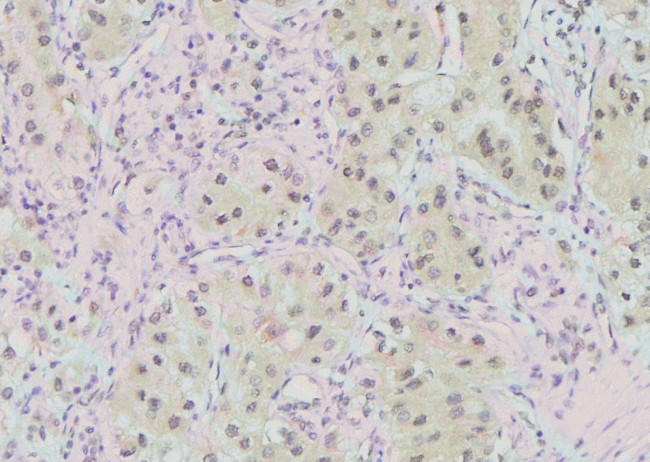
图: 1 / 4
Phospho-KIF1B (Ser1057) Antibody (PA5-105403) in IHC (P)
Immunohistochemistry analysis of paraffin-embedded Phospho-KIF1B (Ser1057) in human kidney tissue sections. Antigen retrieval was performed using citrate buffer. Samples were blocked with blocking buffer (1.5 hr, 22°C), incubated with Phospho-KIF1B (Ser1057) polyclonal antibody (Product # PA5-105403) using a dilution of 1:100 (1.5 hr, 22°C), followed by HRP conjugated goat anti-rabbit.

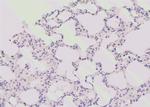
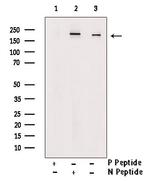
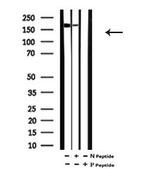
Please note: We are reviewing Western blot images included in the antibody testing data in our catalog, including those provided by third parties. Unless expressly labeled or annotated as “raw-unedited”, Western blot images included in the antibody testing data in our catalog may have been edited, optimized or otherwise adjusted for presentation.


产品信息
PA5-105403
产品规格
种属反应
Human,
Mouse,
Rat
宿主/亚型
Rabbit
/ IgG
分类
Polyclonal
类型
Antibody
抗原
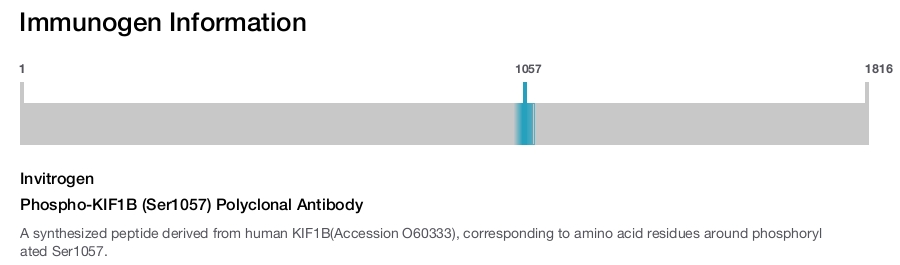
A synthesized peptide derived from human KIF1B(Accession O60333), corresponding to amino acid residues around phosphorylated Ser1057.
偶联物
Unconjugated
Unconjugated
Unconjugated
形式
Liquid
浓度
1 mg/mL
规格
100 µg
纯化类型
sequential chromatography
保存液
PBS, pH 7.4, with 50% glycerol
内含物
0.02% sodium azide
保存条件
-20°C
运输条件
Ambient (domestic); Wet ice (international)
RRID
产品详细信息
Antibody detects endogenous levels of KIF1B only when phosphorylated at Ser1057.
靶标信息
The kinesins constitute a large family of microtubule-dependent motor proteins, which are responsible for the distribution of numerous organelles, vesicles and macromolecular complexes throughout the cell. Individual kinesin members play crucial roles in cell division, intracellular transport and membrane trafficking events including endocytosis and transcytosis. KIF1B is a member of the KIF1/Unc104 family of kinesin-like proteins that are involved in the transport of mitochondria or synaptic vesicles in axons. KIF1B is an amino-terminal-type motor protein that is ubiquitously expressed, with the most abundant levels in differentiated nerve cells. The human KIF1B gene maps to chromosome 1p36. 2. Defects in axonal transport due to mutations at the KIF1B gene can underlie the human peripheral neuropathy phenotype. The mouse KIF1B gene generates an alternatively spliced transcript, which produces two isoforms.
仅用于科研。不用于诊断过程。未经明确授权不得转售。
篇参考文献 (0)
您是否在文献中引用过该产品?请点击下方按钮邮件告知我们。
生物信息学
蛋白别名: Charcot-Marie-Tooth neuropathy type II; kinesin heavy chain member 1B; kinesin heavy chain member 1B; p204; kinesin related protein; kinesin superfamily protein KIF1B; kinesin-family protein KIF1Bbeta3; N-3 kinesin; similar to kinesin; unnamed protein product
基因别名: A530096N05Rik; CMT2; CMT2A; CMT2A1; D4Mil1e; HMSNII; KIF1Bp130; KIF1Bp204; KLP; NBLST1
UniProt ID: (Human) O60333, (Rat) O88658, (Mouse) Q60575
Entrez Gene ID: (Human) 23095, (Rat) 117548, (Mouse) 16561
microtubule-based movement
neuron-neuron synaptic transmission
neuromuscular synaptic transmission
positive regulation of gene expression
transport along microtubule
vesicle-mediated transport
lysosome localization
mitochondrion transport along microtubule
anterograde synaptic vesicle transport
apoptotic process involved in development
response to rotenone
anterograde neuronal dense core vesicle transport
retrograde neuronal dense core vesicle transport
cellular response to nerve growth factor stimulus
protein localization to cell periphery
embryo development ending in birth or egg hatching
organelle transport along microtubule
Disclaimer

Clicking the images or links will redirect you to a website hosted by BenchSci that provides third-party scientific content. Neither the content nor the BenchSci technology and processes for selection have been evaluated by us; we are providing them as-is and without warranty of any kind, including for use or application of the Thermo Fisher Scientific products presented.

