Search
Invitrogen
CDK1 Polyclonal Antibody
{{$productOrderCtrl.translations['antibody.pdp.commerceCard.promotion.promotions']}}
{{$productOrderCtrl.translations['antibody.pdp.commerceCard.promotion.promocode']}}: {{promo.promoCode}} {{promo.promoTitle}} {{promo.promoDescription}}. {{$productOrderCtrl.translations['antibody.pdp.commerceCard.promotion.learnmore']}}
{{$ctrl.translations['antibody.pdp.skuNotes.additionalInformation']}}:
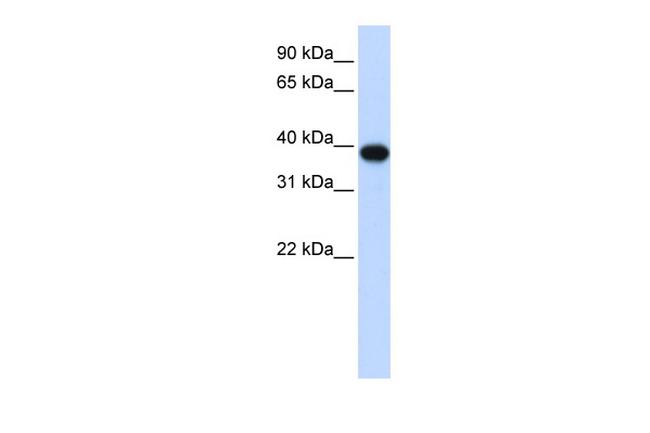
Please note: We are reviewing Western blot images included in the antibody testing data in our catalog, including those provided by third parties. Unless expressly labeled or annotated as “raw-unedited”, Western blot images included in the antibody testing data in our catalog may have been edited, optimized or otherwise adjusted for presentation.

产品信息
PA5-114135
产品规格
种属反应
Human
宿主/亚型
Rabbit
/ IgG
分类
Polyclonal
类型
Antibody
抗原
Synthetic peptide directed towards the middle region of human CDC2
偶联物
Unconjugated
Unconjugated
Unconjugated
形式
Liquid
浓度
0.5 mg/mL
规格
50 µg
纯化类型
Affinity chromatography
保存液
PBS with 2% sucrose
内含物
0.09% sodium azide
保存条件
-20°C, Avoid Freeze/Thaw Cycles
运输条件
Ambient (domestic); Wet ice (international)
RRID
产品详细信息
Immunogen sequence: CAICTLFYPY CQALQTEKEA PIASLGEGCP ATLPSKSRQK TRPLIPEMCF
For short term use, store at 2-8°C up to 1 week. For long term storage, store at -20°C in small aliquots to prevent freeze-thaw cycles.
Predicted homology: Dog: 100%; Goat: 100%; Horse: 100%; Human: 100%; Mouse: 100%; Pig: 100%; Rabbit: 100%; Rat: 100%; Sheep: 100%; Yeast: 100%
靶标信息
CDK1 or Cell Division Control protein 1 is essential for the completion of START, the controlling event in the cell cycle that is required to initiate mitosis. CDK1 is a catalytic subunit of a protein kinase complex, called the M-Phase Promoting Factor that induces entry into mitosis and is universal among eukaryotes. Phosphorylation of Bcl-2 in G2/M phase-arrested cells following photodynamic therapy with hypericin involves a CDK1-mediated signal and delays the onset of apoptosis. Therapeutic potential of CDK inhibitor NU2058 in androgen-independent prostate cancer has also been demonstrated.
仅用于科研。不用于诊断过程。未经明确授权不得转售。
篇参考文献 (0)
您是否在文献中引用过该产品?请点击下方按钮邮件告知我们。
生物信息学
蛋白别名: ABL1; cell cycle controller CDC2; cell division control protein 2 homolog; cell division cycle 2, G1 to S and G2 to M; cell division protein kinase 1; DKFZp686L20222; KCIP-1; MGC111195; MGC53829; OTTHUMP00000019660; P34 CDK1; P34 MGC111195; p34 protein kinase; Protein 1054; unnamed protein product
基因别名: CDC2; CDC28A; P34CDC2
UniProt ID: (Human) P06493
Entrez Gene ID: (Human) 983
chromatin binding
protein kinase activity
protein serine/threonine kinase activity
cyclin-dependent protein serine/threonine kinase activity
protein binding
ATP binding
RNA polymerase II carboxy-terminal domain kinase activity
kinase activity
cyclin binding
Hsp70 protein binding
histone kinase activity
cyclin-dependent protein kinase activity
protein serine kinase activity
G1/S transition of mitotic cell cycle
G2/M transition of mitotic cell cycle
microtubule cytoskeleton organization
DNA replication
DNA repair
chromatin remodeling
regulation of transcription from RNA polymerase II promoter
cellular response to DNA damage stimulus
mitotic nuclear envelope disassembly
mitotic G2 DNA damage checkpoint
centrosome cycle
pronuclear fusion
response to toxic substance
positive regulation of gene expression
positive regulation of G2/M transition of mitotic cell cycle
regulation of Schwann cell differentiation
response to amine
response to activity
cell migration
protein deubiquitination
peptidyl-threonine phosphorylation
chromosome condensation
epithelial cell differentiation
negative regulation of protein ubiquitination
protein localization to kinetochore
positive regulation of protein import into nucleus
response to hydrogen peroxide
regulation of circadian rhythm
negative regulation of apoptotic process
response to ethanol
positive regulation of DNA replication
positive regulation of smoothened signaling pathway
regulation of embryonic development
response to cadmium ion
response to copper ion
response to axon injury
ventricular cardiac muscle cell development
positive regulation of cardiac muscle cell proliferation
positive regulation of mitotic sister chromatid segregation
protein-containing complex assembly
cellular response to hydrogen peroxide
ERK1 and ERK2 cascade
Golgi disassembly
regulation of heterochromatin organization
positive regulation of protein localization to nucleus
regulation of mitotic attachment of spindle microtubules to kinetochore
microtubule cytoskeleton organization involved in mitosis
positive regulation of mitochondrial ATP synthesis coupled electron transport
positive regulation of protein ubiquitination involved in ubiquitin-dependent protein catabolic process
Disclaimer

Clicking the images or links will redirect you to a website hosted by BenchSci that provides third-party scientific content. Neither the content nor the BenchSci technology and processes for selection have been evaluated by us; we are providing them as-is and without warranty of any kind, including for use or application of the Thermo Fisher Scientific products presented.

