Search
Invitrogen
Phospho-PKA beta (Thr198) Polyclonal Antibody
{{$productOrderCtrl.translations['antibody.pdp.commerceCard.promotion.promotions']}}
{{$productOrderCtrl.translations['antibody.pdp.commerceCard.promotion.promocode']}}: {{promo.promoCode}} {{promo.promoTitle}} {{promo.promoDescription}}. {{$productOrderCtrl.translations['antibody.pdp.commerceCard.promotion.learnmore']}}
{{$ctrl.translations['antibody.pdp.skuNotes.additionalInformation']}}:
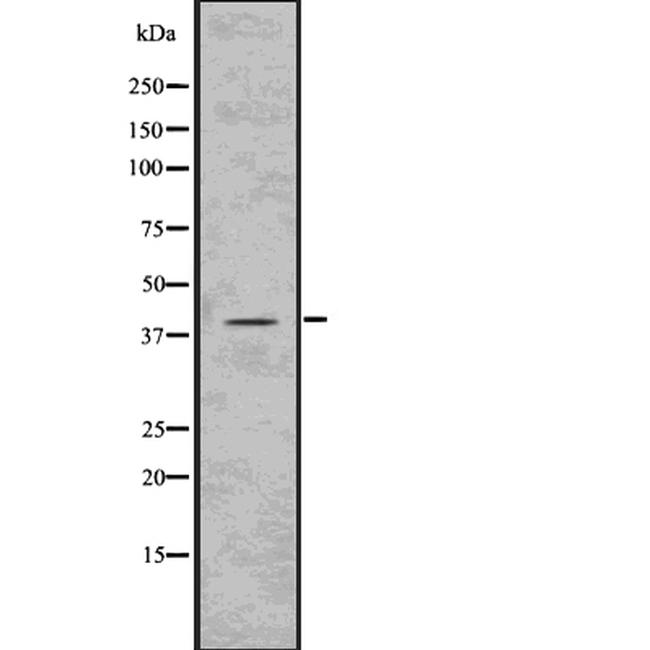
Please note: We are reviewing Western blot images included in the antibody testing data in our catalog, including those provided by third parties. Unless expressly labeled or annotated as “raw-unedited”, Western blot images included in the antibody testing data in our catalog may have been edited, optimized or otherwise adjusted for presentation.

产品信息
PA5-114622
应用
建议稀释比
已发表文章
产品规格
种属反应
Human,
Mouse,
Rat
宿主/亚型
Rabbit
/ IgG
分类
Polyclonal
类型
Antibody
抗原
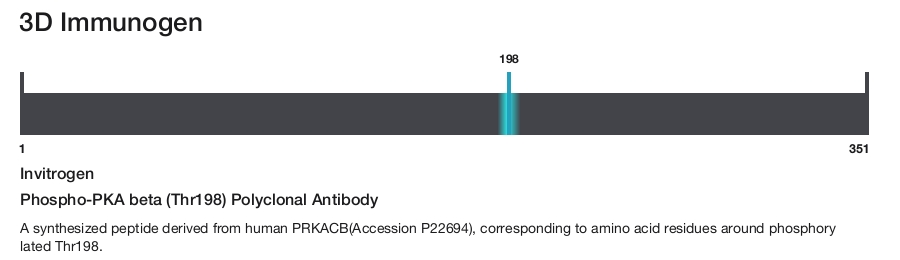
A synthesized peptide derived from human PRKACB(Accession P22694), corresponding to amino acid residues around phosphorylated Thr198.
偶联物
Unconjugated
Unconjugated
Unconjugated
形式
Liquid
浓度
1 mg/mL
规格
100 µg
纯化类型
sequential chromatography
保存液
PBS with 50% glycerol
内含物
0.02% sodium azide
保存条件
-20°C
运输条件
Ambient (domestic); Wet ice (international)
RRID
产品详细信息
Antibody detects endogenous levels of PKA beta only when phosphorylated at Thr198, which site historically referenced as Thr197.
靶标信息
The catalytic subunit C-beta of PKA (PRKACB) is a member of the Ser/Thr protein kinase family (the PKA catalytic subunit consist of three gene products: C-alpha, C-beta, and C-gamma) and has been assigned to human chromosome region 1p36.1. PRKACB is derived from a gene distinct from C-alpha and shows tissue-specific expression. At the amino acid level C-alpha and C-beta showed 93% homology. The inactive holoenzyme of AMPK is a tetramer composed of two regulatory and two catalytic subunits. cAMP causes the dissociation of the inactive holoenzyme into a dimer of regulatory subunits bound to four cAMP and two free monomeric catalytic subunits. Four different regulatory subunits and three catalytic subunits of AMPK have been identified in humans.
仅用于科研。不用于诊断过程。未经明确授权不得转售。
篇参考文献 (0)
您是否在文献中引用过该产品?请点击下方按钮邮件告知我们。
生物信息学
蛋白别名: cAMP-dependent protein kinase C beta; Cbeta2 PKA; PKA C-beta; protein kinase A catalytic subunit beta; protein kinase, cAMP dependent, catalytic, beta; protein kinase, cAMP-dependent, beta catalytic subunit; protein kinase, cAMP-dependent, catalytic, beta; unnamed protein product
基因别名: CAFD2; CbPKA; PKA C-beta; PKACB
UniProt ID: (Human) P22694, (Mouse) P68181, (Rat) P68182
Entrez Gene ID: (Human) 5567, (Mouse) 18749, (Rat) 293508
magnesium ion binding
protein kinase activity
protein serine/threonine kinase activity
cAMP-dependent protein kinase activity
protein binding
ATP binding
potassium channel inhibitor activity
protein serine kinase activity
cyclic nucleotide-dependent protein kinase activity
ubiquitin protein ligase binding
protein kinase A regulatory subunit binding
neural tube closure
protein phosphorylation
adenylate cyclase-modulating G-protein coupled receptor signaling pathway
adenylate cyclase-activating G-protein coupled receptor signaling pathway
cellular response to nutrient levels
TORC1 signaling
negative regulation of smoothened signaling pathway
negative regulation of meiotic cell cycle
regulation of protein processing
negative regulation of TORC1 signaling
renal water homeostasis
signal transduction
positive regulation of insulin secretion
high-density lipoprotein particle assembly
vascular endothelial cell response to laminar fluid shear stress
Disclaimer

Clicking the images or links will redirect you to a website hosted by BenchSci that provides third-party scientific content. Neither the content nor the BenchSci technology and processes for selection have been evaluated by us; we are providing them as-is and without warranty of any kind, including for use or application of the Thermo Fisher Scientific products presented.

