Search
Invitrogen
TAB3 Polyclonal Antibody
{{$productOrderCtrl.translations['antibody.pdp.commerceCard.promotion.promotions']}}
{{$productOrderCtrl.translations['antibody.pdp.commerceCard.promotion.promocode']}}: {{promo.promoCode}} {{promo.promoTitle}} {{promo.promoDescription}}. {{$productOrderCtrl.translations['antibody.pdp.commerceCard.promotion.learnmore']}}
{{$ctrl.translations['antibody.pdp.skuNotes.additionalInformation']}}:
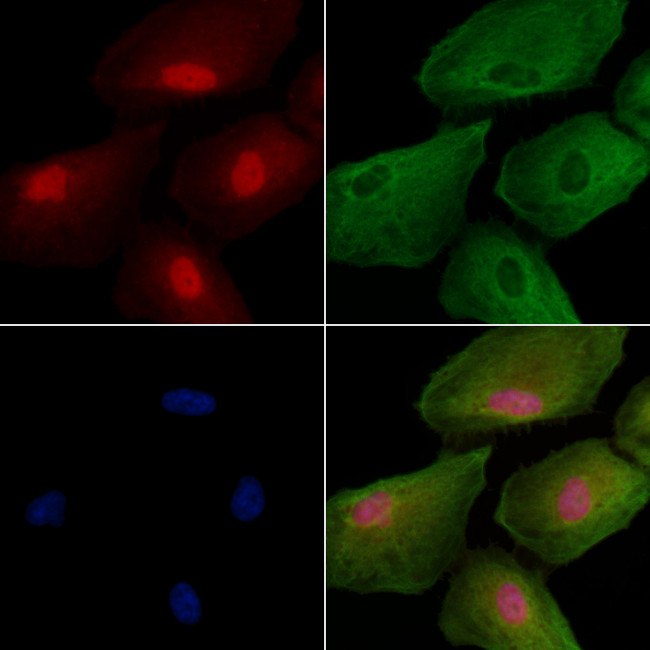
图: 1 / 2
TAB3 Antibody (PA5-114782) in ICC/IF
Immunocytochemistry analysis of TAB3 in A549 cells. Samples were treated with PFA, permeabilized in 0.1% Triton X-100, blocked in 10% serum (45 min at 25°C), and incubated with polyclonal antibody (Product # PA5-114782). Secondary staining was applied with mouse anti-beta tubulin (1 hr at 37°, AlexaFluor 594 conjugated goat anti-rabbit IgG (Red), AlexaFluor 488 conjugated goat anti-mouse IgG (Green) and DAPI.
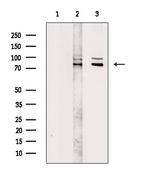
Please note: We are reviewing Western blot images included in the antibody testing data in our catalog, including those provided by third parties. Unless expressly labeled or annotated as “raw-unedited”, Western blot images included in the antibody testing data in our catalog may have been edited, optimized or otherwise adjusted for presentation.


产品信息
PA5-114782
产品规格
种属反应
Human,
Mouse
宿主/亚型
Rabbit
/ IgG
分类
Polyclonal
类型
Antibody
抗原
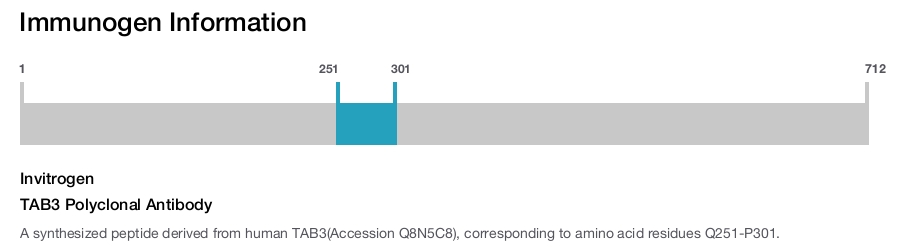
A synthesized peptide derived from human TAB3(Accession Q8N5C8), corresponding to amino acid residues Q251-P301.
偶联物
Unconjugated
Unconjugated
Unconjugated
形式
Liquid
浓度
1 mg/mL
规格
100 µg
纯化类型
Affinity chromatography
保存液
PBS with 50% glycerol
内含物
0.02% sodium azide
保存条件
-20°C
运输条件
Ambient (domestic); Wet ice (international)
RRID
产品详细信息
Antibody detects endogenous levels of total TAB3.
靶标信息
TAB3 functions in the NF-kappaB signal transduction pathway. It and the similar and functionally redundant protein TAB2, form a ternary complex with the protein kinase TAK1 and either TRAF2 or TRAF6 in response to stimulation with the pro-inflammatory cytokines TNF or IL-1. Subsequent TAK1 kinase activity triggers a signaling cascade leading to activation of the NF-kappaB transcription factor. Recent experiments have shown that TAB2 and the related protein TAB3 constitutitvely interact with the autophagy mediator Beclin-1; upon induction of autophagy, these proteins dissociate from Beclin-1 and bind TAK1. Overexpression of TAB2 and TAB3 inhibit autophagy, while their depletion triggers it, suggesting that TAB2 and TAB3 act as a control point for autophagy.
仅用于科研。不用于诊断过程。未经明确授权不得转售。
篇参考文献 (0)
您是否在文献中引用过该产品?请点击下方按钮邮件告知我们。
生物信息学
蛋白别名: mitogen-activated protein kinase kinase kinase 7 interacting protein 3; mitogen-activated protein kinase kinase kinase 7-interacting protein 3; NF-kappa-B-activating protein 1; NFkB activating protein 1; TAB-3; TAB3; TAB3; ortholog of Xenopus laevis TAB3; TAB3a; ortholog of Xenopus laevis TAB3; TAK1-binding protein 3; TGF-beta activated kinase 1 and MAP3K7 binding protein 3; TGF-beta-activated kinase 1-binding protein 3; unnamed protein product
基因别名: 4921526G09Rik; MAP3K7IP3; mKIAA4135; NAP1
UniProt ID: (Human) Q8N5C8, (Mouse) Q571K4
Entrez Gene ID: (Human) 257397, (Mouse) 66724
I-kappaB kinase/NF-kappaB signaling
response to bacterium
negative regulation of autophagy
NIK/NF-kappaB signaling
defense response to bacterium
positive regulation of I-kappaB kinase/NF-kappaB signaling
regulation of MAPK cascade
p38MAPK cascade
negative regulation of I-kappaB kinase/NF-kappaB signaling
Disclaimer

Clicking the images or links will redirect you to a website hosted by BenchSci that provides third-party scientific content. Neither the content nor the BenchSci technology and processes for selection have been evaluated by us; we are providing them as-is and without warranty of any kind, including for use or application of the Thermo Fisher Scientific products presented.

