Search
Invitrogen
Polycystin 1 Polyclonal Antibody
{{$productOrderCtrl.translations['antibody.pdp.commerceCard.promotion.promotions']}}
{{$productOrderCtrl.translations['antibody.pdp.commerceCard.promotion.promocode']}}: {{promo.promoCode}} {{promo.promoTitle}} {{promo.promoDescription}}. {{$productOrderCtrl.translations['antibody.pdp.commerceCard.promotion.learnmore']}}
{{$ctrl.translations['antibody.pdp.skuNotes.additionalInformation']}}:
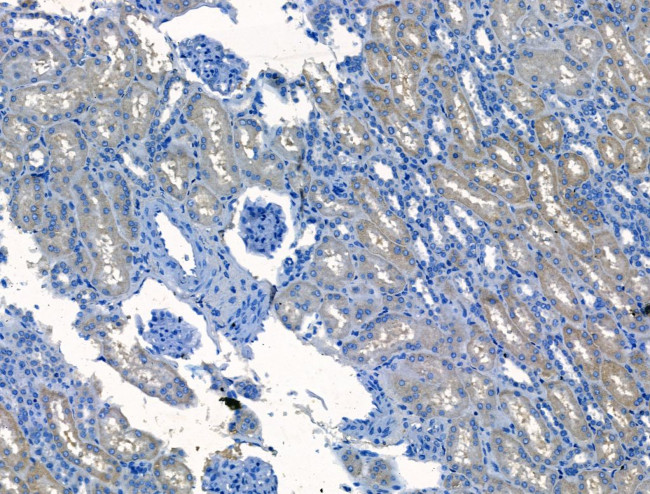
图: 1 / 3
Polycystin 1 Antibody (PA5-115779) in IHC (P)
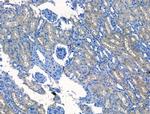
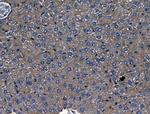
Immunohistochemistry analysis of PKD1 in human kidney cancer and adjacent normal tissues. Samples were treated with formaldehyde and treated with citrate buffer for antigen retrieval, blocked, and incubated (1.5 hours at 22°C) with polyclonal antibody (Product # PA5-115779) at a dilution of 1:100. Secondary staining was applied with HRP conjugated anti-Rabbit.
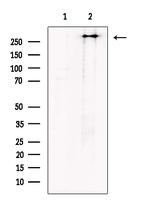
Please note: We are reviewing Western blot images included in the antibody testing data in our catalog, including those provided by third parties. Unless expressly labeled or annotated as “raw-unedited”, Western blot images included in the antibody testing data in our catalog may have been edited, optimized or otherwise adjusted for presentation.


产品信息
PA5-115779
产品规格
种属反应
Human,
Mouse,
Rat
宿主/亚型
Rabbit
/ IgG
分类
Polyclonal
类型
Antibody
抗原
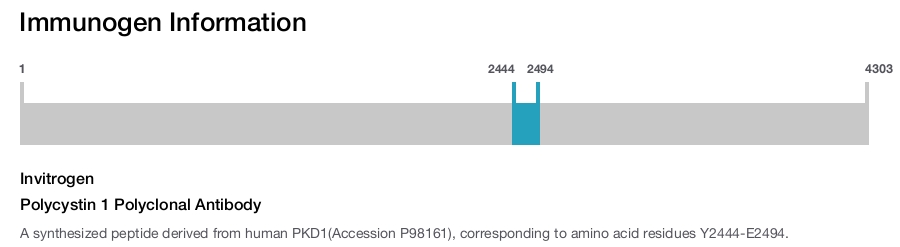
A synthesized peptide derived from human PKD1(Accession P98161), corresponding to amino acid residues Y2444-E2494.
偶联物
Unconjugated
Unconjugated
Unconjugated
形式
Liquid
浓度
1 mg/mL
规格
100 µg
纯化类型
Affinity chromatography
保存液
PBS, pH 7.4, with 50% glycerol
内含物
0.02% sodium azide
保存条件
-20°C
运输条件
Ambient (domestic); Wet ice (international)
RRID
产品详细信息
Antibody detects endogenous levels of total Polycystin 1.
靶标信息
Involved in renal tubulogenesis. Involved in fluid-flow mechanosensation by the primary cilium in renal epithelium. Acts as a regulator of cilium length, together with PKD2. The dynamic control of cilium length is essential in the regulation of mechanotransductive signaling. The cilium length response creates a negative feedback loop whereby fluid shear-mediated deflection of the primary cilium, which decreases intracellular cAMP, leads to cilium shortening and thus decreases flow-induced signaling. May be an ion-channel regulator. Involved in adhesive protein-protein and protein-carbohydrate interactions.
仅用于科研。不用于诊断过程。未经明确授权不得转售。
篇参考文献 (0)
您是否在文献中引用过该产品?请点击下方按钮邮件告知我们。
生物信息学
蛋白别名: alternative product from the HmPKD1 locus; autosomal dominant polycystic kidney disease 1 protein; autosomal dominant polycystic kidney disease 1 protein homolog; polycystic kidney disease 1 (autosomal dominant); polycystic kidney disease 1 homolog; polycystic kidney disease 1 homolog; polycystin-1; polycystic kidney disease-associated protein; polycystin 1, transient receptor poteintial channel interacting; transient receptor potential cation channel, subfamily P, member 1; unnamed protein product
基因别名: eliosin; mFLJ00285; PBP; Pc-1; PC1; TRPP1
UniProt ID: (Human) P98161, (Mouse) O08852
Entrez Gene ID: (Human) 5310, (Mouse) 18763, (Rat) 24650
cartilage condensation
blood vessel development
in utero embryonic development
kidney development
liver development
embryonic placenta development
protein export from nucleus
calcium ion transport
mitochondrion organization
cell surface receptor signaling pathway
positive regulation of cytosolic calcium ion concentration
JAK-STAT cascade
heart development
organ morphogenesis
regulation of gene expression
regulation of cell cycle process
Wnt signaling pathway
peptidyl-serine phosphorylation
spinal cord development
neural tube development
establishment of cell polarity
regulation of cell adhesion
response to fluid shear stress
lymph vessel morphogenesis
chordate embryonic development
skin development
positive regulation of transcription from RNA polymerase II promoter
digestive tract development
branching morphogenesis of an epithelial tube
genitalia development
detection of mechanical stimulus
cartilage development
protein heterotetramerization
regulation of cell cycle
regulation of mitotic spindle organization
lung epithelium development
placenta blood vessel development
patterning of lymph vessels
regulation of proteasomal protein catabolic process
calcium ion transmembrane transport
nitrogen cycle metabolic process
mesonephric tubule development
mesonephric duct development
metanephric collecting duct development
metanephric ascending thin limb development
metanephric proximal tubule development
metanephric distal tubule morphogenesis
cell-cell adhesion
mitocytosis
regulation of G1/S transition of mitotic cell cycle
homophilic cell adhesion via plasma membrane adhesion molecules
cell-matrix adhesion
calcium-independent cell-matrix adhesion
anatomical structure morphogenesis
Disclaimer

Clicking the images or links will redirect you to a website hosted by BenchSci that provides third-party scientific content. Neither the content nor the BenchSci technology and processes for selection have been evaluated by us; we are providing them as-is and without warranty of any kind, including for use or application of the Thermo Fisher Scientific products presented.

