Search
Invitrogen
WISP1 Polyclonal Antibody
{{$productOrderCtrl.translations['antibody.pdp.commerceCard.promotion.promotions']}}
{{$productOrderCtrl.translations['antibody.pdp.commerceCard.promotion.promocode']}}: {{promo.promoCode}} {{promo.promoTitle}} {{promo.promoDescription}}. {{$productOrderCtrl.translations['antibody.pdp.commerceCard.promotion.learnmore']}}
{{$ctrl.translations['antibody.pdp.skuNotes.additionalInformation']}}:
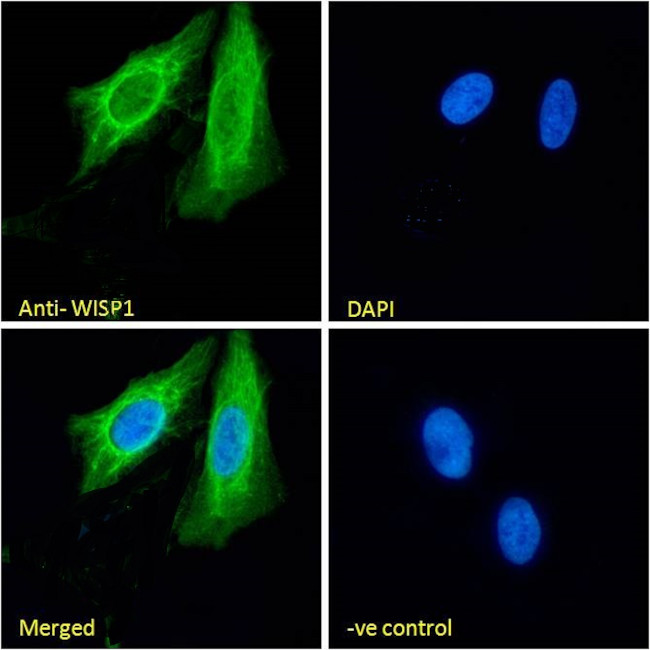
图: 1 / 5
WISP1 Antibody (PA5-18832) in ICC/IF
Immunocytochemistry analysis of WISP1 using WISP1 Polyclonal Antibody (Product # PA5-18832) in paraformaldehyde fixed U2OS cells, permeabilized with 0.15% Triton. Primary incubation 1hr (10 µg/mL) followed by Alexa Fluor 488 secondary antibody (2 µg/mL), showing cytoplasmic staining. The nuclear stain is DAPI (blue). Negative control: Unimmunized goat IgG (10 µg/mL) followed by Alexa Fluor 488 secondary antibody (2 µg/mL).
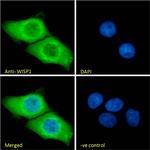
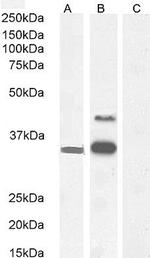
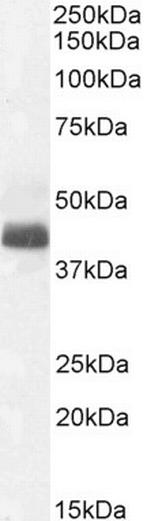
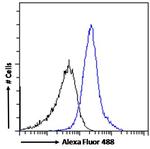
Please note: We are reviewing Western blot images included in the antibody testing data in our catalog, including those provided by third parties. Unless expressly labeled or annotated as “raw-unedited”, Western blot images included in the antibody testing data in our catalog may have been edited, optimized or otherwise adjusted for presentation.


产品信息
PA5-18832
产品规格
种属反应
Human
宿主/亚型
Goat
/ IgG
分类
Polyclonal
类型
Antibody
抗原
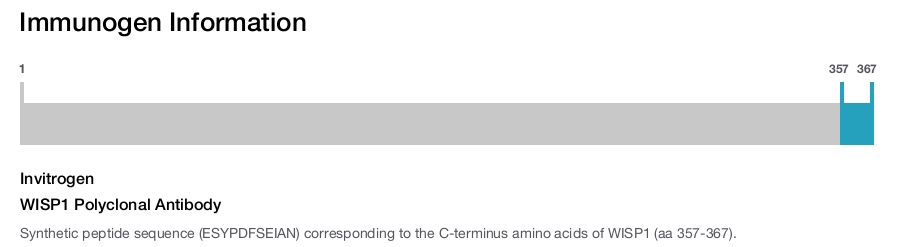
Synthetic peptide sequence (ESYPDFSEIAN) corresponding to the C-terminus amino acids of WISP1 (aa 357-367).
偶联物
Unconjugated
Unconjugated
Unconjugated
形式
Liquid
浓度
0.5 mg/mL
规格
100 µg
纯化类型
Ammonium sulfate precipitation
保存液
TBS, pH 7.3, with 0.5% BSA
内含物
0.02% sodium azide
保存条件
-20°C, Avoid Freeze/Thaw Cycles
运输条件
Ambient (domestic); Wet ice (international)
RRID
产品详细信息
This antibody is predicted to react with mouse and rat based on sequence homology.
This antibody is tested in Peptide ELISA: antibody detection limit dilution 128,000.
靶标信息
This gene encodes a member of the WNT1 inducible signaling pathway (WISP) protein subfamily, which belongs to the connective tissue growth factor (CTGF) family. WNT1 is a member of a family of cysteine-rich, glycosylated signaling proteins that mediate diverse developmental processes. The CTGF family members are characterized by four conserved cysteine-rich domains: insulin-like growth factor-binding domain, von Willebrand factor type C module, thrombospondin domain and C-terminal cystine knot-like domain. This gene may be downstream in the WNT1 signaling pathway that is relevant to malignant transformation. It is expressed at a high level in fibroblast cells, and overexpressed in colon tumors. The encoded protein binds to decorin and biglycan, two members of a family of small leucine-rich proteoglycans present in the extracellular matrix of connective tissue, and possibly prevents the inhibitory activity of decorin and biglycan in tumor cell proliferation. It also attenuates p53-mediated apoptosis in response to DNA damage through activation of the Akt kinase. It is 83% identical to the mouse protein at the amino acid level. Alternative splicing of this gene generates 2 transcript variants.
仅用于科研。不用于诊断过程。未经明确授权不得转售。
篇参考文献 (0)
您是否在文献中引用过该产品?请点击下方按钮邮件告知我们。
生物信息学
蛋白别名: unnamed protein product; WISP1 3'UTR-associated RNA 1; WISP1 overlapping transcript 1 (non-protein coding); WISP1vx; WNT1 induced secreted protein 1; WNT1 inducible signaling pathway protein 1
基因别名: WISP1; WISP1-OT1; WISP1-UT1; WISP1c; WISP1i; WISP1tc
UniProt ID: (Human) O95388
Entrez Gene ID: (Human) 8840
osteoblast differentiation
regulation of cytokine production
cell adhesion
signal transduction
cell-cell signaling
positive regulation of smooth muscle cell migration
positive regulation of Wnt signaling pathway
osteoclast differentiation
negative regulation of chondrocyte differentiation
glucose homeostasis
regulation of cell differentiation
positive regulation of cell differentiation
negative regulation of fat cell differentiation
positive regulation of osteoblast differentiation
positive regulation of smooth muscle cell proliferation
positive regulation of inflammatory response
regulation of multicellular organismal process
bone development
positive regulation of wound healing
Disclaimer

Clicking the images or links will redirect you to a website hosted by BenchSci that provides third-party scientific content. Neither the content nor the BenchSci technology and processes for selection have been evaluated by us; we are providing them as-is and without warranty of any kind, including for use or application of the Thermo Fisher Scientific products presented.

