Search
Invitrogen
CX3CL1 Polyclonal Antibody
{{$productOrderCtrl.translations['antibody.pdp.commerceCard.promotion.promotions']}}
{{$productOrderCtrl.translations['antibody.pdp.commerceCard.promotion.promocode']}}: {{promo.promoCode}} {{promo.promoTitle}} {{promo.promoDescription}}. {{$productOrderCtrl.translations['antibody.pdp.commerceCard.promotion.learnmore']}}
{{$ctrl.translations['antibody.pdp.skuNotes.additionalInformation']}}:
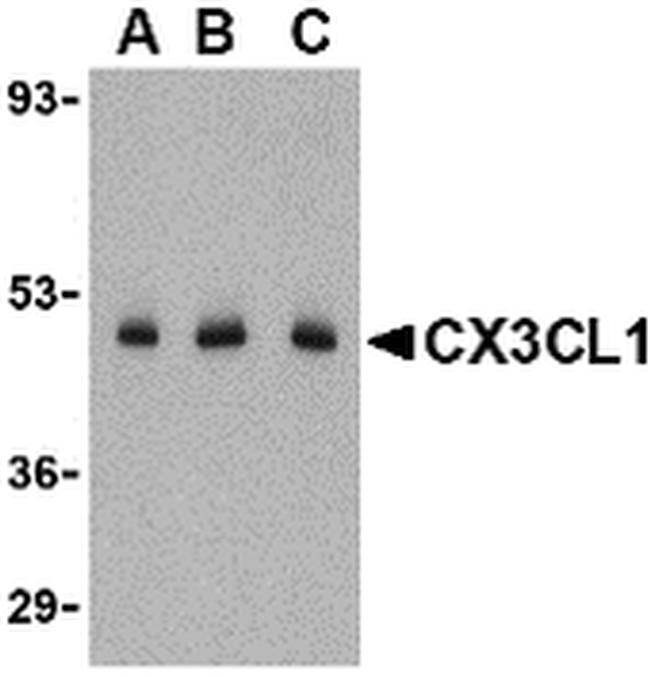
Please note: We are reviewing Western blot images included in the antibody testing data in our catalog, including those provided by third parties. Unless expressly labeled or annotated as “raw-unedited”, Western blot images included in the antibody testing data in our catalog may have been edited, optimized or otherwise adjusted for presentation.


产品信息
PA5-20296
产品规格
种属反应
Human,
Mouse
宿主/亚型
Rabbit
/ IgG
分类
Polyclonal
类型
Antibody
抗原
A peptide corresponding to 18 amino acids near the amino terminus of human CX3CL1.
偶联物
Unconjugated
Unconjugated
Unconjugated
形式
Liquid
浓度
1 mg/mL
规格
100 µg
纯化类型
Antigen affinity chromatography
保存液
PBS
内含物
0.02% sodium azide
保存条件
Maintain refrigerated at 2-8°C for up to 3 months. For long term storage store at -20°C
运输条件
Ambient (domestic); Wet ice (international)
RRID
产品详细信息
Despite the predicted molecular weight, CX3CL1 often migrates at 80-100kDa in SDS-PAGE, presumably due to post-translational modifications. A suggested positive control is C2C12 cell lysate.
PA5-20296 can be used with blocking peptide PEP-0398.
靶标信息
Chemokines are a family of proteins associated with the trafficking of leukocytes in immune surveillance and inflammatory cell recruitment. They are classified based on the positions of key cysteine residues. CX3CL1 is a CX3C chemokine known to induce adhesion and migration of leukocytes mediated by a membrane-bound and soluble form respectively. Recent experiments have shown that CX3CL1 can suppress the production of nitrous oxide, interleukin-6, and TNF-a in activated microglia and neuronal cells, suggesting that it may act as an intrinsic inhibitor against neurotoxicity by activated microglia. Its receptor, CX3CR1, also functions as a co-receptor for HIV-1 and HIV-2 envelope fusion and virus infection, which can be inhibited by CX3CL1.
仅用于科研。不用于诊断过程。未经明确授权不得转售。
篇参考文献 (0)
您是否在文献中引用过该产品?请点击下方按钮邮件告知我们。
生物信息学
蛋白别名: C-X3-C motif chemokine 1; chemokine (C-X3-C motif) ligand 1; CX3C chemokine; CX3C membrane-anchored chemokine; CX3CL1; neurotactin; small inducible cytokine subfamily D (Cys-X3-Cys), member 1 (fractalkine, neurotactin); small inducible cytokine subfamily D (Cys-X3-Cys), member-1; small inducible cytokine subfamily D, 1; small-inducible cytokine D1; unnamed protein product
基因别名: ABCD-3; C3Xkine; CX3C; CXC3; CXC3C; D8Bwg0439e; FK; fractalkine; neurotactin; NTN; NTT; SCYD1
UniProt ID: (Human) P78423, (Mouse) O35188
Entrez Gene ID: (Human) 6376, (Mouse) 20312
microglial cell activation
positive regulation of neuroblast proliferation
leukocyte migration involved in inflammatory response
response to ischemia
chemotaxis
inflammatory response
immune response
cell adhesion
G-protein coupled receptor signaling pathway
positive regulation of cell proliferation
positive regulation of macrophage chemotaxis
positive regulation of neuron projection development
cell migration
cytokine-mediated signaling pathway
positive regulation of cell migration
negative regulation of cell migration
neutrophil chemotaxis
regulation of lipopolysaccharide-mediated signaling pathway
positive regulation of actin filament bundle assembly
negative regulation of interleukin-1 alpha production
negative regulation of tumor necrosis factor production
positive regulation of transforming growth factor beta1 production
integrin activation
autocrine signaling
wound healing
negative regulation of apoptotic process
positive regulation of I-kappaB kinase/NF-kappaB signaling
positive regulation of MAPK cascade
positive regulation of angiogenesis
positive regulation of cell adhesion
negative regulation of vasoconstriction
positive regulation of transcription from RNA polymerase II promoter
eosinophil chemotaxis
macrophage chemotaxis
lymphocyte chemotaxis
positive regulation of smooth muscle cell proliferation
positive regulation of inflammatory response
positive chemotaxis
positive regulation of calcium-independent cell-cell adhesion
positive regulation of release of sequestered calcium ion into cytosol
positive regulation of protein kinase B signaling
angiogenesis involved in wound healing
inhibitory postsynaptic potential
cell chemotaxis
microglial cell proliferation
antimicrobial humoral immune response mediated by antimicrobial peptide
neuron cellular homeostasis
chemokine-mediated signaling pathway
cellular response to tumor necrosis factor
cell-cell adhesion
negative regulation of hippocampal neuron apoptotic process
negative regulation of glutamate receptor signaling pathway
negative regulation of microglial cell activation
positive regulation of microglial cell migration
negative regulation of apoptotic signaling pathway
negative regulation of extrinsic apoptotic signaling pathway in absence of ligand
positive regulation of cell-matrix adhesion
defense response
cell-cell signaling
negative regulation of cell-substrate adhesion
neuron remodeling
leukocyte chemotaxis
negative regulation of interleukin-1 beta production
negative regulation of interleukin-6 production
regulation of synaptic plasticity
regulation of neurogenesis
leukocyte adhesive activation
positive regulation of ERK1 and ERK2 cascade
synapse pruning
negative regulation of neuron migration
Disclaimer

Clicking the images or links will redirect you to a website hosted by BenchSci that provides third-party scientific content. Neither the content nor the BenchSci technology and processes for selection have been evaluated by us; we are providing them as-is and without warranty of any kind, including for use or application of the Thermo Fisher Scientific products presented.

