Search
Invitrogen
PDCD4 Polyclonal Antibody
{{$productOrderCtrl.translations['antibody.pdp.commerceCard.promotion.promotions']}}
{{$productOrderCtrl.translations['antibody.pdp.commerceCard.promotion.promocode']}}: {{promo.promoCode}} {{promo.promoTitle}} {{promo.promoDescription}}. {{$productOrderCtrl.translations['antibody.pdp.commerceCard.promotion.learnmore']}}
{{$ctrl.translations['antibody.pdp.skuNotes.additionalInformation']}}:
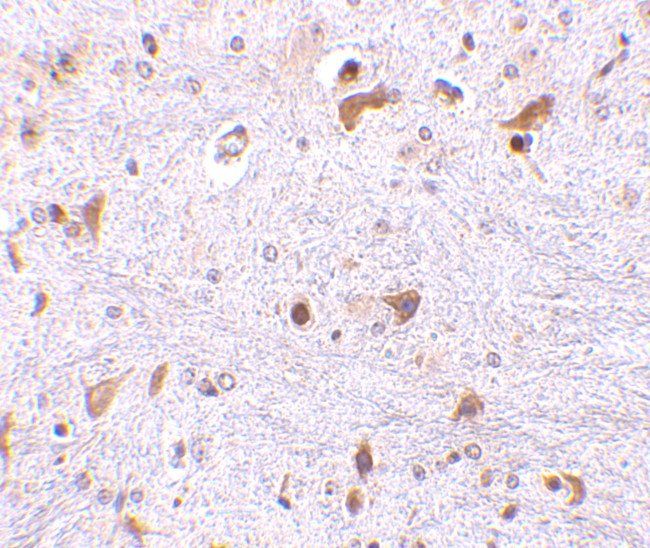
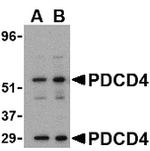
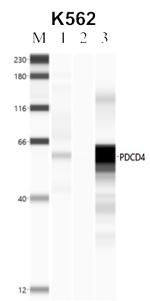
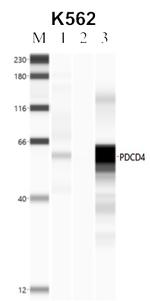
Please note: We are reviewing Western blot images included in the antibody testing data in our catalog, including those provided by third parties. Unless expressly labeled or annotated as “raw-unedited”, Western blot images included in the antibody testing data in our catalog may have been edited, optimized or otherwise adjusted for presentation.


产品信息
PA5-20309
应用
建议稀释比
已发表文章
产品规格
种属反应
Human,
Mouse,
Rat
宿主/亚型
Rabbit
/ IgG
分类
Polyclonal
类型
Antibody
抗原
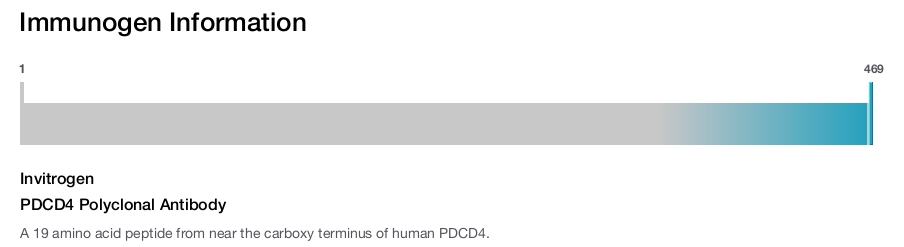
A 19 amino acid peptide from near the carboxy terminus of human PDCD4.
偶联物
Unconjugated
Unconjugated
Unconjugated
形式
Liquid
浓度
1 mg/mL
规格
100 µg
纯化类型
Antigen affinity chromatography
保存液
PBS
内含物
0.02% sodium azide
保存条件
Maintain refrigerated at 2-8°C for up to 3 months. For long term storage store at -20°C
运输条件
Ambient (domestic); Wet ice (international)
RRID
产品详细信息
A suggested positive control is A-20 cell lysate.
PA5-20309 can be used with blocking peptide PEP-0425.
靶标信息
Apoptosis, also known as programmed cell death, plays major roles in development and normal tissue turnover in addition to tumor formation. During this process, the expression patterns of numerous genes are radically altered. One such gene is the programmed cell death protein 4 (PDCD4), whose expression was found to be upregulated in all cell lines following the onset of apoptosis. PDCD4 encodes a tumor suppressor protein whose expression is lost in carcinomas of breast, colon, lung and prostate. It can bind to and inhibit the helicase activity of the eukaryotic translation initiation factor 4A and inhibit the transactivation and transformation mediated by the transcription factor AP-1. The kinase Akt regulates PDCD4 by phosphorylation, decreasing the ability of PDCD4 to interfere with the transactivation of AP-1-responsive promoter by c-Jun. There are two known isoforms of PDCD4.
仅用于科研。不用于诊断过程。未经明确授权不得转售。
篇参考文献 (0)
您是否在文献中引用过该产品?请点击下方按钮邮件告知我们。
生物信息学
蛋白别名: death up-regulated gene protein; death-upregulated; DUG; MA-3; MGC33046; MGC33047; neoplastic transformation inhibitor protein; nuclear antigen H731; Pdcd4; programmed cell death 4 (neoplastic transformation inhibitor); protein 197/15a; protein MA-3; RP11-348N5.4; TIS; topoisomerase-inhibitor suppressed protein; unnamed protein product
基因别名: D19Ucla1; Dug; H731; Ma3; Tis
UniProt ID: (Human) Q53EL6, (Rat) Q9JID1, (Mouse) Q61823
Entrez Gene ID: (Human) 27250, (Rat) 64031, (Mouse) 18569
response to hormone
BMP signaling pathway
positive regulation of smooth muscle cell apoptotic process
negative regulation of apoptotic process
response to alkaloid
negative regulation of JUN kinase activity
negative regulation of transcription, DNA-templated
positive regulation of inflammatory response
regulation of protein metabolic process
epithelial to mesenchymal transition involved in cardiac fibroblast development
cellular response to lipopolysaccharide
negative regulation of cytokine production involved in inflammatory response
positive regulation of NIK/NF-kappaB signaling
negative regulation of vascular smooth muscle cell proliferation
negative regulation of myofibroblast differentiation
negative regulation of vascular smooth muscle cell differentiation
positive regulation of vascular associated smooth muscle cell apoptotic process
positive regulation of endothelial cell apoptotic process
apoptotic process
Disclaimer

Clicking the images or links will redirect you to a website hosted by BenchSci that provides third-party scientific content. Neither the content nor the BenchSci technology and processes for selection have been evaluated by us; we are providing them as-is and without warranty of any kind, including for use or application of the Thermo Fisher Scientific products presented.

