Search
Invitrogen
Contactin 2 Polyclonal Antibody
{{$productOrderCtrl.translations['antibody.pdp.commerceCard.promotion.promotions']}}
{{$productOrderCtrl.translations['antibody.pdp.commerceCard.promotion.promocode']}}: {{promo.promoCode}} {{promo.promoTitle}} {{promo.promoDescription}}. {{$productOrderCtrl.translations['antibody.pdp.commerceCard.promotion.learnmore']}}
{{$ctrl.translations['antibody.pdp.skuNotes.additionalInformation']}}:
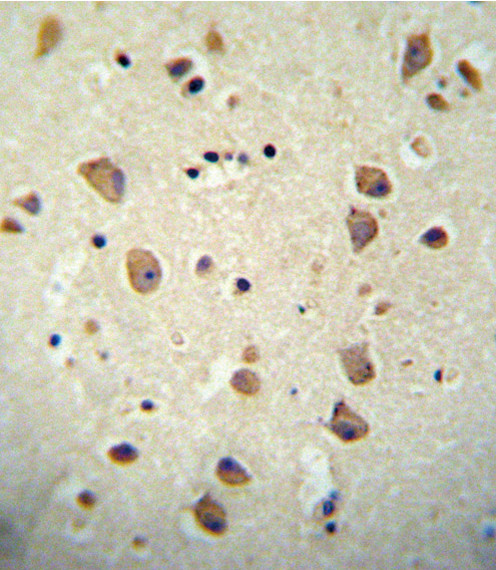
图: 1 / 2
Contactin 2 Antibody (PA5-25742) in IHC (P)
Immunohistochemistry analysis of Contactin 2 in formalin fixed and paraffin embedded human brain tissue. Samples were incubated with Contactin 2 polyclonal antibody (Product # PA5-25742) followed by peroxidase conjugation of the secondary antibody and DAB staining. This data demonstrates the use of this antibody for immunohistochemistry. Clinical relevance has not been evaluated.

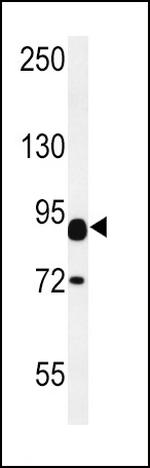
Please note: We are reviewing Western blot images included in the antibody testing data in our catalog, including those provided by third parties. Unless expressly labeled or annotated as “raw-unedited”, Western blot images included in the antibody testing data in our catalog may have been edited, optimized or otherwise adjusted for presentation.


产品信息
PA5-25742
产品规格
种属反应
Human,
Mouse
宿主/亚型
Rabbit
/ IgG
分类
Polyclonal
类型
Antibody
抗原
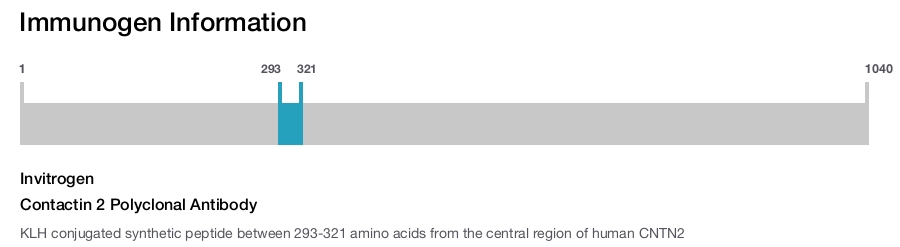
KLH conjugated synthetic peptide between 293-321 amino acids from the central region of human CNTN2
偶联物
Unconjugated
Unconjugated
Unconjugated
形式
Liquid
浓度
0.5 mg/mL
规格
200 µg
纯化类型
Protein A, Antigen affinity chromatography
保存液
PBS, pH 7.4
内含物
0.09% sodium azide
保存条件
Store at 4°C short term. For long term storage, store at -20°C, avoiding freeze/thaw cycles.
运输条件
Ambient (domestic); Wet ice (international)
RRID
产品详细信息
This antibody is predicted to react with rat based on sequence homology.
靶标信息
Contactin 2 (CNTN2, transiently-expressed axonal glycoprotein, AXT, TAX, TAX1, TAG-1, axonin 1) is a neuronal cell adhesion molecule (CAM) that influences the formation of axon connections in the developing nervous system. Contactin 2 is a member of the immunoglobulin superfamily (IgSF) and contains a glycosylphosphatidylinositol-anchor, six immunoglobulin (Ig)-like and four Fibronectin type III (FNIII)-like domains. Contactin 2 is expressed predominantly during neural development on the cell membrane of axons in nerve fiber tracts in order to guide commissural axons without promoting their growth. Contactin 2 binds with NgCAM in the plane of the same membrane (cis-binding). The Contactin 2 heterophilic (Contactin 2/NgCAM and Contactin 2/NrCAM) binding sites are localized to the first four Ig domains. The Contactin 2 homophilic (Contactin 2/Contactin 2) binding site is localized to the FNIII domain.
仅用于科研。不用于诊断过程。未经明确授权不得转售。
篇参考文献 (0)
您是否在文献中引用过该产品?请点击下方按钮邮件告知我们。
生物信息学
蛋白别名: axonal glycoprotein TAG-1; axonin; Axonin 1; axonin-1; axonin-1 cell adhesion molecule; Axonin1; contactin 2 (axonal); contactin 2 (transiently expressed); Contactin2; DKFZp781D102; MGC157722; TAX-1; transient axonal glycoprotein 1; unnamed protein product
基因别名: AXT; D130012K04Rik; EPEO5; FAME5; TAG-1; TAG1; TAX; TAX1
UniProt ID: (Human) Q02246, (Mouse) Q61330
Entrez Gene ID: (Human) 6900, (Mouse) 21367
microtubule cytoskeleton organization
neuron migration
response to dietary excess
reduction of food intake in response to dietary excess
cell-matrix adhesion
axonogenesis
axon guidance
axonal fasciculation
brain development
learning
adult walking behavior
positive regulation of protein processing
cerebral cortex GABAergic interneuron migration
central nervous system myelination
regulation of cell morphogenesis
regulation of axon diameter
neuron projection development
receptor internalization
clustering of voltage-gated potassium channels
fat cell differentiation
negative regulation of neuron differentiation
regulation of neuronal synaptic plasticity
regulation of astrocyte differentiation
positive regulation of adenosine receptor signaling pathway
protein localization to juxtaparanode region of axon
establishment of protein localization to juxtaparanode region of axon
presynaptic membrane organization
cell-cell adhesion
cell adhesion
homophilic cell adhesion via plasma membrane adhesion molecules
synapse organization
dendrite self-avoidance
Disclaimer

Clicking the images or links will redirect you to a website hosted by BenchSci that provides third-party scientific content. Neither the content nor the BenchSci technology and processes for selection have been evaluated by us; we are providing them as-is and without warranty of any kind, including for use or application of the Thermo Fisher Scientific products presented.

