Search
Invitrogen
GFI1B Polyclonal Antibody
{{$productOrderCtrl.translations['antibody.pdp.commerceCard.promotion.promotions']}}
{{$productOrderCtrl.translations['antibody.pdp.commerceCard.promotion.promocode']}}: {{promo.promoCode}} {{promo.promoTitle}} {{promo.promoDescription}}. {{$productOrderCtrl.translations['antibody.pdp.commerceCard.promotion.learnmore']}}
{{$ctrl.translations['antibody.pdp.skuNotes.additionalInformation']}}:
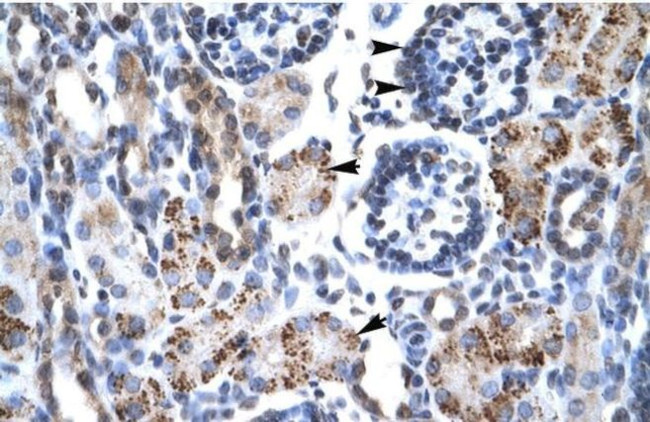

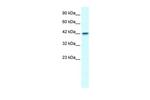
Please note: We are reviewing Western blot images included in the antibody testing data in our catalog, including those provided by third parties. Unless expressly labeled or annotated as “raw-unedited”, Western blot images included in the antibody testing data in our catalog may have been edited, optimized or otherwise adjusted for presentation.


产品信息
PA5-40328
产品规格
种属反应
Human
宿主/亚型
Rabbit
/ IgG
分类
Polyclonal
类型
Antibody
抗原
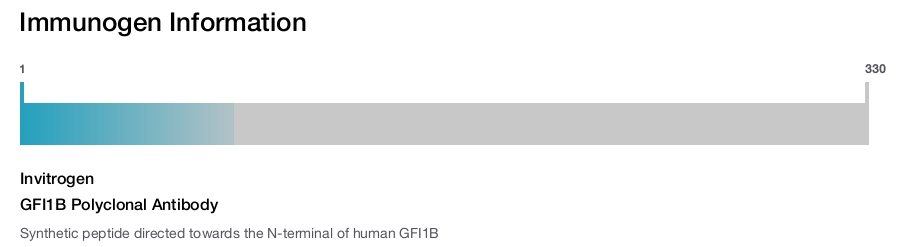
Synthetic peptide directed towards the N-terminal of human GFI1B
偶联物
Unconjugated
Unconjugated
Unconjugated
形式
Liquid
浓度
0.5 mg/mL
规格
50 µg
纯化类型
Affinity Chromatography
保存液
PBS with 2% sucrose
内含物
0.09% sodium azide
保存条件
-20°C, Avoid Freeze/Thaw Cycles
运输条件
Ambient (domestic); Wet ice (international)
RRID
产品详细信息
Peptide sequence: MPRSFLVKSK MAHTYHQPRV QEDEPLWPPA LTPVPRDQAP SNSPVLSTLF
Sequence homology: Cow: 83%; Dog: 100%; Goat: 83%; Horse: 100%; Human: 100%; Mouse: 83%; Pig: 93%; Rat: 82%
靶标信息
GFI1b (zinc finger protein GFI-1b) is an essential proto-oncogenic transcriptional regulator necessary for development and differentiation of erythroid and megakaryocytic lineages. It is also a component of a RCOR-GFI-KDM1A-HDAC complex that suppresses, via histone deacetylase (HDAC) recruitment, a number of genes implicated in multilineage blood cell development and controls hematopoietic differentiation. GFI1b also acts as a transcriptional repressor or activator depending on both promoter and cell type context; represses promoter activity of SOCS1 and SOCS3 and thus, may regulate cytokine signaling pathways. It also cooperates with GATA1 to repress target gene transcription, such as the apoptosis regulator BCL2L1; GFI1B silencing in leukemic cell lines markedly increase apoptosis rate. Mutations affecting the gene are associated with Bleeding disorder, platelet-type 17 (BDPLT17).
仅用于科研。不用于诊断过程。未经明确授权不得转售。
篇参考文献 (0)
您是否在文献中引用过该产品?请点击下方按钮邮件告知我们。
生物信息学
蛋白别名: GFI1B; growth factor independent 1B (potential regulator of CDKN1A, translocated in CML); growth factor independent 1B transcription repressor; zinc finger protein
基因别名: BDPLT17; ZNF163B
UniProt ID: (Human) Q5VTD9
Entrez Gene ID: (Human) 8328
RNA polymerase II core promoter proximal region sequence-specific DNA binding
RNA polymerase II transcription factor activity, sequence-specific DNA binding
transcriptional activator activity, RNA polymerase II transcription regulatory region sequence-specific binding
protein binding
RNA polymerase II sequence-specific DNA binding transcription factor binding
sequence-specific double-stranded DNA binding
Disclaimer

Clicking the images or links will redirect you to a website hosted by BenchSci that provides third-party scientific content. Neither the content nor the BenchSci technology and processes for selection have been evaluated by us; we are providing them as-is and without warranty of any kind, including for use or application of the Thermo Fisher Scientific products presented.

