Search
Invitrogen
HES4 Polyclonal Antibody
{{$productOrderCtrl.translations['antibody.pdp.commerceCard.promotion.promotions']}}
{{$productOrderCtrl.translations['antibody.pdp.commerceCard.promotion.promocode']}}: {{promo.promoCode}} {{promo.promoTitle}} {{promo.promoDescription}}. {{$productOrderCtrl.translations['antibody.pdp.commerceCard.promotion.learnmore']}}
{{$ctrl.translations['antibody.pdp.skuNotes.additionalInformation']}}:
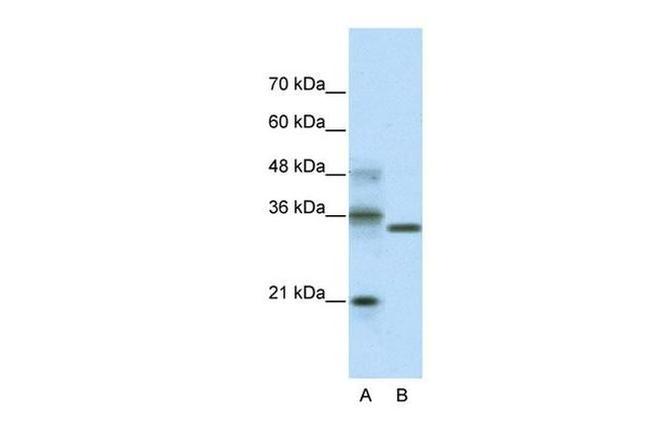
Please note: We are reviewing Western blot images included in the antibody testing data in our catalog, including those provided by third parties. Unless expressly labeled or annotated as “raw-unedited”, Western blot images included in the antibody testing data in our catalog may have been edited, optimized or otherwise adjusted for presentation.

产品信息
PA5-41167
产品规格
种属反应
Human
宿主/亚型
Rabbit
/ IgG
分类
Polyclonal
类型
Antibody
抗原
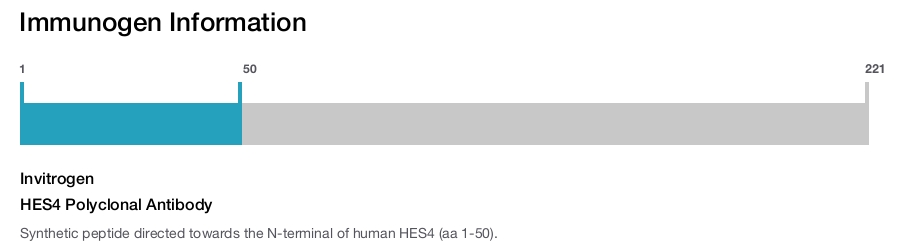
Synthetic peptide directed towards the N-terminal of human HES4 (aa 1-50).
偶联物
Unconjugated
Unconjugated
Unconjugated
形式
Liquid
浓度
1 mg/mL
规格
100 µg
纯化类型
Protein A
保存液
PBS with 2% sucrose
内含物
0.09% sodium azide
保存条件
-20°C, Avoid Freeze/Thaw Cycles
运输条件
Ambient (domestic); Wet ice (international)
RRID
产品详细信息
Peptide sequence: MAADTPGKPS ASPMAGAPAS ASRTPDKPRS AAEHRKSSKP VMEKRRRARI
Sequence homology: Cow: 86%; Dog: 93%; Human: 100%; Pig: 85%; Rat: 77%
靶标信息
HES4, or Hes Family BHLH Transcription Factor 4, is a gene located on chromosome 1p36.31, encoding a basic helix-loop-helix (bHLH) transcription factor that plays a role in the Notch signaling pathway. This pathway is integral to cell differentiation, proliferation, and apoptotic processes, especially during embryonic development and tissue homeostasis. HES4 acts as a transcriptional repressor, regulating the expression of genes responsible for maintaining stem cell populations and inhibiting premature differentiation. While its exact biological roles are still being elucidated, studies suggest HES4 influences neurogenesis and myogenesis by modulating the timing of differentiation events within progenitor cells. The dysregulation of HES4 can impact normal developmental processes, potentially contributing to pathologies such as cancer and developmental disorders due to its control over cellular growth and differentiation pathways. Research into HES4 continues to advance understanding of its functions within the context of Notch signaling and its implications for disease.
仅用于科研。不用于诊断过程。未经明确授权不得转售。
篇参考文献 (0)
您是否在文献中引用过该产品?请点击下方按钮邮件告知我们。
生物信息学
蛋白别名: bHLH factor Hes4; class B basic helix-loop-helix protein 42; hairy and enhancer of split 4; hHES4
基因别名: bHLHb42
UniProt ID: (Human) Q9HCC6
Entrez Gene ID: (Human) 57801
Disclaimer

Clicking the images or links will redirect you to a website hosted by BenchSci that provides third-party scientific content. Neither the content nor the BenchSci technology and processes for selection have been evaluated by us; we are providing them as-is and without warranty of any kind, including for use or application of the Thermo Fisher Scientific products presented.

