Search
Invitrogen
CLN3 Polyclonal Antibody
{{$productOrderCtrl.translations['antibody.pdp.commerceCard.promotion.promotions']}}
{{$productOrderCtrl.translations['antibody.pdp.commerceCard.promotion.promocode']}}: {{promo.promoCode}} {{promo.promoTitle}} {{promo.promoDescription}}. {{$productOrderCtrl.translations['antibody.pdp.commerceCard.promotion.learnmore']}}
{{$ctrl.translations['antibody.pdp.skuNotes.additionalInformation']}}:
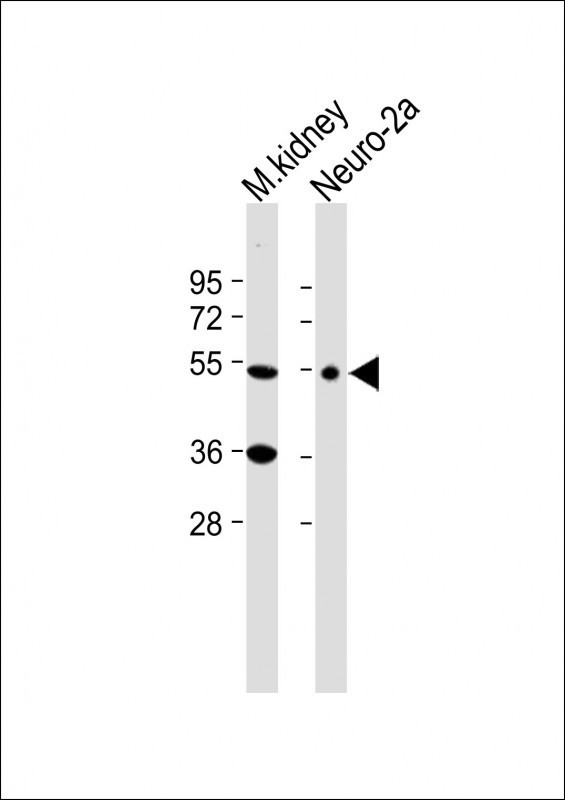
图: 1 / 4
CLN3 Antibody (PA5-49382) in WB
Western blot analysis of CLN3 in various lysates. Samples were incubated with CLN3 polyclonal antibody (Product # PA5-49382) using a dilution of 1:500 followed by Goat Anti-Rabbit IgG, (H+L), Peroxidase conjugated at a dilution of 1:10,000. Lysates/proteins: 20 µg per lane. Lane 1: Mouse kidney lysate; Lane 2: Neuro-2a whole cell lysate. Predicted band size: 48 kDa. Blocking/Dilution buffer: 5% NFDM/TBST.
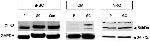
Please note: We are reviewing Western blot images included in the antibody testing data in our catalog, including those provided by third parties. Unless expressly labeled or annotated as “raw-unedited”, Western blot images included in the antibody testing data in our catalog may have been edited, optimized or otherwise adjusted for presentation.


产品信息
PA5-49382
应用
建议稀释比
已发表文章
产品规格
种属反应
Human,
Mouse
已发表种属
Human
宿主/亚型
Rabbit
/ IgG
分类
Polyclonal
类型
Antibody
抗原
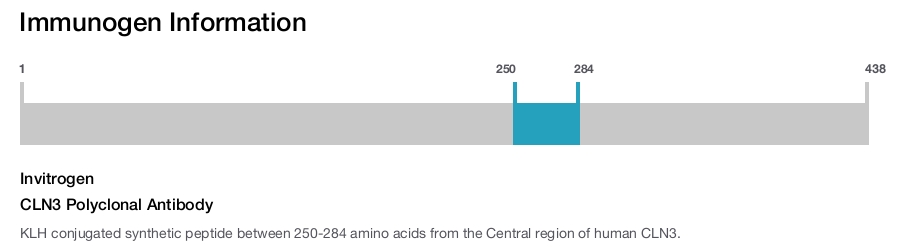
KLH conjugated synthetic peptide between 250-284 amino acids from the Central region of human CLN3.
偶联物
Unconjugated
Unconjugated
Unconjugated
形式
Liquid
浓度
0.5 mg/mL
规格
200 µg
纯化类型
Protein A, Antigen affinity chromatography
保存液
PBS, pH 7.4
内含物
0.09% sodium azide
保存条件
Store at 4°C short term. For long term storage, store at -20°C, avoiding freeze/thaw cycles.
运输条件
Ambient (domestic); Wet ice (international)
RRID
产品详细信息
Predicted to react with monkey based on sequence homology.
靶标信息
CLN3 is a highly glycosylated, hydrophobic, 438-amino acid protein with 6 transmembrane domains. The CLN3 protein localizes to the lysosomal membrane and plays a role in lysosomal function. It may act as a chaperone involved in the folding and unfolding of other proteins, namely subunit C of the ATP synthase complex. Mutations in the CLN3 gene cause Batten disease, a recessively inherited neurodegenerative disorder of childhood caused by lysosomal accumulation of hydrophobic material, mainly ATP synthase subunit C. Batten disease is the most common form of a group of disorders known as neuronal ceroid lipofuscinoses (NCLs). Symptoms of Batten disease include progressive loss of vision, seizures, and psychomotor disturbances.
仅用于科研。不用于诊断过程。未经明确授权不得转售。
生物信息学
蛋白别名: Batten disease; batten disease protein; ceroid lipofuscinosis, neuronal 3, juvenile (Batten, Spielmeyer-Vogt disease); ceroid-lipofuscinosis, neuronal 3; CLN 3; CLN3; CLN3, battenin; homolog of human gene underlying Batten disease (juvenile neuronal ceroid lipofuscinosis); MGC102840; unnamed protein product
基因别名: BTN1; BTS; JNCL; RP101; SLC29B1
UniProt ID: (Human) Q13286, (Mouse) Q61124
Entrez Gene ID: (Human) 1201, (Mouse) 12752
action potential
amino acid transport
endocytosis
receptor-mediated endocytosis
lysosome organization
lysosomal lumen acidification
learning or memory
associative learning
cellular water homeostasis
regulation of autophagy
regulation of fibroblast migration
regulation of autophagosome size
protein processing
cellular cation homeostasis
regulation of proteolysis
regulation of synaptic transmission, GABAergic
ionotropic glutamate receptor signaling pathway
ceramide transport
lysosomal lumen pH elevation
renal potassium excretion
amyloid precursor protein catabolic process
positive regulation of Golgi to plasma membrane protein transport
negative regulation of apoptotic process
negative regulation of neuron apoptotic process
plasma membrane raft organization
negative regulation of proteolysis
glycerophospholipid biosynthetic process
glycolipid transport
vesicle transport along microtubule
regulation of short-term neuronal synaptic plasticity
positive regulation of pinocytosis
neuromuscular process controlling balance
regulation of cytosolic calcium ion concentration
regulation of cytoskeleton organization
regulation of synaptic transmission, glutamatergic
membrane organization
autophagosome-lysosome fusion
regulation of protein processing
Golgi to lysosome transport
phagosome-lysosome fusion
autophagosome maturation
regulation of cellular response to osmotic stress
regulation of arginine biosynthetic process
regulation of autophagosome maturation
regulation of protein localization to plasma membrane
arginine transmembrane transport
lysosomal protein catabolic process
regulation of phagosome maturation
regulation of modification of synaptic structure
positive regulation of caveolin-mediated endocytosis
positive regulation of protein phosphorylation
regulation of gene expression
macroautophagy
cell migration
actin cytoskeleton organization
negative regulation of catalytic activity
regulation of filopodium assembly
protein localization to membrane
protein localization to plasma membrane
Disclaimer

Clicking the images or links will redirect you to a website hosted by BenchSci that provides third-party scientific content. Neither the content nor the BenchSci technology and processes for selection have been evaluated by us; we are providing them as-is and without warranty of any kind, including for use or application of the Thermo Fisher Scientific products presented.

