Search
Invitrogen
Selenoprotein W Polyclonal Antibody
{{$productOrderCtrl.translations['antibody.pdp.commerceCard.promotion.promotions']}}
{{$productOrderCtrl.translations['antibody.pdp.commerceCard.promotion.promocode']}}: {{promo.promoCode}} {{promo.promoTitle}} {{promo.promoDescription}}. {{$productOrderCtrl.translations['antibody.pdp.commerceCard.promotion.learnmore']}}
{{$ctrl.translations['antibody.pdp.skuNotes.additionalInformation']}}:
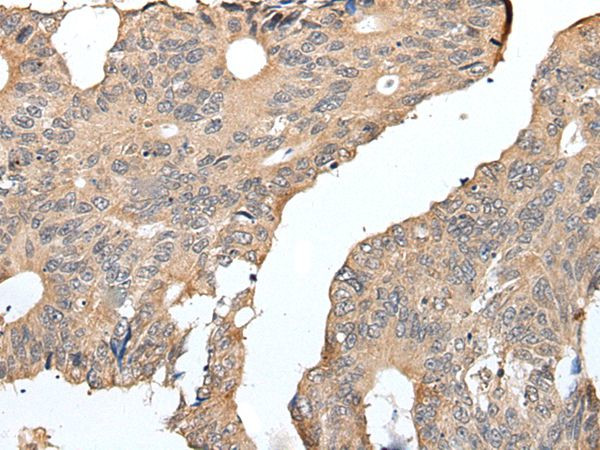
图: 1 / 1
Selenoprotein W Antibody (PA5-67614) in IHC (P)
Immunohistochemical analysis of Selenoprotein W in paraffin-embedded Human colorectal cancer tissue using (left) Selenoprotein W Polyclonal Antibody (Product # PA5-67614) at a 1:25 dilution and (right) is treated with synthetic peptide. (Original magnification: x200).
Please note: We are reviewing Western blot images included in the antibody testing data in our catalog, including those provided by third parties. Unless expressly labeled or annotated as “raw-unedited”, Western blot images included in the antibody testing data in our catalog may have been edited, optimized or otherwise adjusted for presentation.

产品信息
PA5-67614
产品规格
种属反应
Human
宿主/亚型
Rabbit
/ IgG
分类
Polyclonal
类型
Antibody
抗原
Synthesized peptide derived from human Selenoprotein W.
偶联物
Unconjugated
Unconjugated
Unconjugated
形式
Liquid
浓度
0.8 mg/mL
规格
80 µg
纯化类型
Antigen affinity chromatography
保存液
PBS, pH 7.4, with 40% glycerol
内含物
0.05% sodium azide
保存条件
-20°C
运输条件
Ambient (domestic); Wet ice (international)
RRID
靶标信息
This gene encodes a selenoprotein containing a selenocysteine (Sec) residue, which is encoded by the UGA codon that normally signals translation termination. The 3' UTRs of selenoprotein mRNAs contain a conserved stem-loop structure, the Sec insertion sequence (SECIS) element that is necessary for the recognition of UGA as a Sec codon rather than as a stop signal. This protein is highly expressed in skeletal muscle, heart and brain. It belongs to the SelWTH family, which possesses a thioredoxin-like fold and a conserved CxxU (C is cysteine, U is Sec) motif, suggesting a redox function for this gene. Studies in mouse show that this selenoprotein is involved in muscle growth and differentiation, and in the protection of neurons from oxidative stress during neuronal development. A retroprocessed pseudogene for this locus has been identified on chromosome 1.
仅用于科研。不用于诊断过程。未经明确授权不得转售。
篇参考文献 (0)
您是否在文献中引用过该产品?请点击下方按钮邮件告知我们。
生物信息学
Disclaimer

Clicking the images or links will redirect you to a website hosted by BenchSci that provides third-party scientific content. Neither the content nor the BenchSci technology and processes for selection have been evaluated by us; we are providing them as-is and without warranty of any kind, including for use or application of the Thermo Fisher Scientific products presented.

