Search
Invitrogen
HuD Polyclonal Antibody
{{$productOrderCtrl.translations['antibody.pdp.commerceCard.promotion.promotions']}}
{{$productOrderCtrl.translations['antibody.pdp.commerceCard.promotion.promocode']}}: {{promo.promoCode}} {{promo.promoTitle}} {{promo.promoDescription}}. {{$productOrderCtrl.translations['antibody.pdp.commerceCard.promotion.learnmore']}}
{{$ctrl.translations['antibody.pdp.skuNotes.additionalInformation']}}:
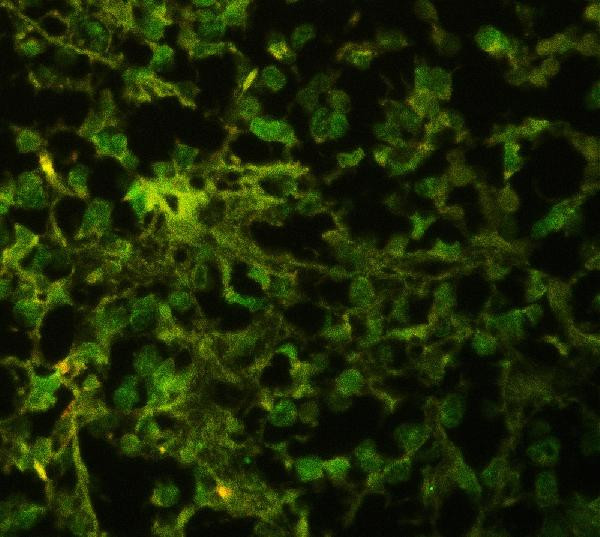
图: 1 / 8
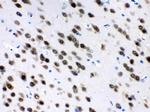
HuD Antibody (PA5-79199) in IHC (P)
Immunohistochemical analysis of ELAVL4 in paraffin-embedded section of human glioma tissues. Heat mediated antigen retrieval was performed in citrate buffer (pH6, epitope retrieval solution ) for 20 mins. The tissue section was blocked with 10% goat serum. The tissue section was then incubated with 1μg/mL rabbit anti-ELAVL4 antibody (Product # PA5-79199) overnight at 4°C. DyLight®488 Conjugated Goat Anti-Ra... View More
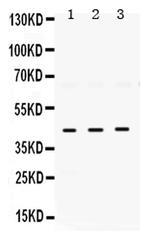
Please note: We are reviewing Western blot images included in the antibody testing data in our catalog, including those provided by third parties. Unless expressly labeled or annotated as “raw-unedited”, Western blot images included in the antibody testing data in our catalog may have been edited, optimized or otherwise adjusted for presentation.


产品信息
PA5-79199
应用
建议稀释比
已发表文章
产品规格
种属反应
Human,
Mouse,
Rat
已发表种属
Mouse,
Rat
宿主/亚型
Rabbit
/ IgG
分类
Polyclonal
类型
Antibody
抗原
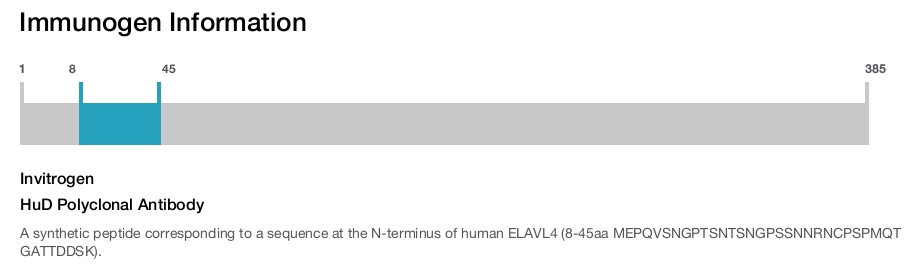
A synthetic peptide corresponding to a sequence at the N-terminus of human ELAVL4 (8-45aa MEPQVSNGPTSNTSNGPSSNNRNCPSPMQTGATTDDSK).
偶联物
Unconjugated
Unconjugated
Unconjugated
形式
Lyophilized
浓度
500 µg/mL once reconstituted
规格
100 µg
纯化类型
Antigen affinity chromatography
保存液
PBS with 5mg BSA
内含物
0.05mg sodium azide
保存条件
-20°C
运输条件
Ambient (domestic); Wet ice (international)
RRID
产品详细信息
Reconstitute with 0.2 mL of distilled water to yield a concentration of 500 µg/mL.
Positive Control - WB: rat brain tissue, mouse brain tissue, U87-MG whole cell. IHC: mouse brain tissue, rat brain tissue, human meningeoma tissue.
靶标信息
HuD, otherwise known as ELAV-like protein 4 or PNEM, is a protein that in humans is encoded by the ELAVL4 gene. This human gene is located at 1p34 by in situ hybridization. The HuD/ELAVL4 protein is an RNA-binding protein. ELAVL4 has specificity for 3-prime uridylate-rich untranslated regions of growth factor mRNAs. HuD is expressed only in neurons and it binds to AU-rich element-containing mRNAs. As a result of this interaction the, half-life of the transcript is increased. Additionally, HuD is important in neurons during brain development and plasticity.
仅用于科研。不用于诊断过程。未经明确授权不得转售。
生物信息学
蛋白别名: ELAV; ELAV (embryonic lethal, abnormal vision, Drosophila)-like 4 (Hu antigen D); ELAV like neuron-specific RNA binding protein 4; Hu antigen D; HU-antigen D; HuD; neurospecific RNA binding protein; paraneoplastic encephalomyelitis antigen; paraneoplastic encephalomyelitis antigen HuD; RNA-binding protein HUD3; RNA-binding protein predominantly expressed in neurons; unnamed protein product
基因别名: Elav; HUD; PNEM
UniProt ID: (Human) P26378, (Rat) O09032, (Mouse) Q61701
Entrez Gene ID: (Human) 1996, (Rat) 432358, (Mouse) 15572
RNA processing
nervous system development
learning
locomotory behavior
associative learning
cerebral cortex neuron differentiation
neuron differentiation
regeneration
response to endoplasmic reticulum stress
response to cocaine
regulation of mRNA stability
dendrite morphogenesis
3'-UTR-mediated mRNA stabilization
regulation of translation at postsynapse
positive regulation of dendrite development
positive regulation of 3'-UTR-mediated mRNA stabilization
cellular response to nerve growth factor stimulus
mRNA processing
Disclaimer

Clicking the images or links will redirect you to a website hosted by BenchSci that provides third-party scientific content. Neither the content nor the BenchSci technology and processes for selection have been evaluated by us; we are providing them as-is and without warranty of any kind, including for use or application of the Thermo Fisher Scientific products presented.

