Search
Invitrogen
FMRP Polyclonal Antibody
{{$productOrderCtrl.translations['antibody.pdp.commerceCard.promotion.promotions']}}
{{$productOrderCtrl.translations['antibody.pdp.commerceCard.promotion.promocode']}}: {{promo.promoCode}} {{promo.promoTitle}} {{promo.promoDescription}}. {{$productOrderCtrl.translations['antibody.pdp.commerceCard.promotion.learnmore']}}
{{$ctrl.translations['antibody.pdp.skuNotes.additionalInformation']}}:
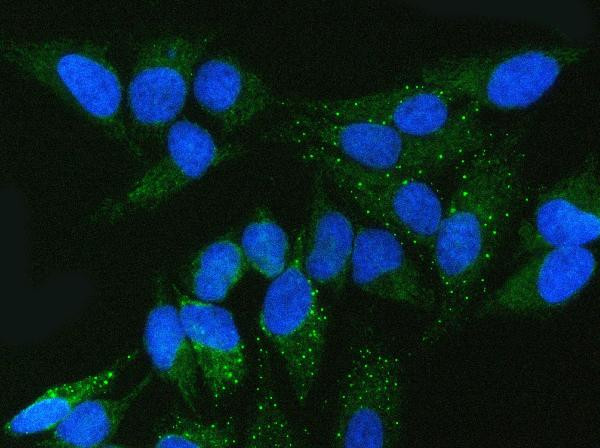
图: 1 / 3
FMRP Antibody (PA5-79278) in ICC/IF
Immunocytochemistry analysis of FMRP/FMR1 using anti-FMRP/FMR1 antibody (Product # PA5-79278) . FMRP/FMR1 was detected in an immunocytochemical section of HeLa cells. Enzyme antigen retrieval was performed using IHC enzyme antigen retrieval reagent for 15 mins. The cells were blocked with 10% goat serum and then incubated with 5 μg/mL rabbit anti-FMRP/FMR1 antibody (Product # PA5-79278) overnight at 4°C. DyLight®488 Conjugated Goat Anti-Rabbit IgG was used as secondary antibody at 1:100 dilution and incubated for 30 minutes at 37°C. The se... View More
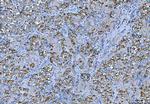
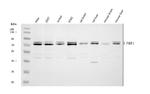
Please note: We are reviewing Western blot images included in the antibody testing data in our catalog, including those provided by third parties. Unless expressly labeled or annotated as “raw-unedited”, Western blot images included in the antibody testing data in our catalog may have been edited, optimized or otherwise adjusted for presentation.


产品信息
PA5-79278
产品规格
种属反应
Human,
Mouse,
Rat
宿主/亚型
Rabbit
/ IgG
分类
Polyclonal
类型
Antibody
抗原
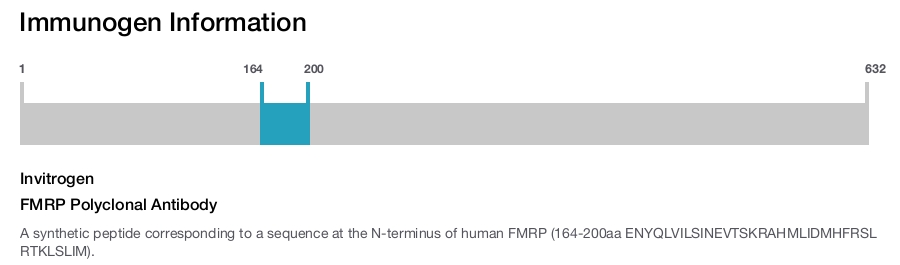
A synthetic peptide corresponding to a sequence at the N-terminus of human FMRP (164-200aa ENYQLVILSINEVTSKRAHMLIDMHFRSLRTKLSLIM).
偶联物
Unconjugated
Unconjugated
Unconjugated
形式
Lyophilized
浓度
500 µg/mL once reconstituted
规格
100 µg
纯化类型
Antigen affinity chromatography
保存液
PBS with 5mg BSA
内含物
0.05mg sodium azide
保存条件
-20°C
运输条件
Ambient (domestic); Wet ice (international)
RRID
产品详细信息
Reconstitute with 0.2 mL of distilled water to yield a concentration of 500 µg/mL.
Positive Control - WB: human Hela whole cell, human 293T whole cell, human Jurkat whole cell, human K562 whole cell, rat brain tissue, rat liver tissue, mouse brain tissue, mouse liver tissue. IHC: human seminoma testis tissue. ICC/IF: Hela cell.
靶标信息
FMR1 binds RNA and is associated with polysomes. The protein may be involved in mRNA trafficking from the nucleus to the cytoplasm. A trinucleotide repeat in the 5' UTR is normally found at 6-53 copies, but an expansion to 55-230 repeats is the cause of fragile X syndrome. Expansion of the trinucleotide repeat may also cause one form of premature ovarian failure. Multiple alternatively spliced transcript variants that encode different protein isoforms and which are located in different cellular locations have been described for this gene.
仅用于科研。不用于诊断过程。未经明确授权不得转售。
篇参考文献 (0)
您是否在文献中引用过该产品?请点击下方按钮邮件告知我们。
生物信息学
蛋白别名: alternative splicing of exon 15; exons 15, 16 and 17; FMRP; FMRP translational regulator 1; FMRP; contains neo-disrupted exon 5; alternatively spliced; MGC87458; protein FMR-1; RNA-binding protein; similar to fragile X mental retardation protein.; synaptic functional regulator FMR1; translational regulator; synaptic functional regulator; unnamed protein product; with exon 12; without exon 12
基因别名: Fmr-1; FMRP; FRAXA; POF; POF1
UniProt ID: (Human) Q06787, (Rat) Q80WE1, (Mouse) P35922
Entrez Gene ID: (Human) 2332, (Rat) 24948, (Mouse) 14265
G-quadruplex RNA binding
nucleic acid binding
chromatin binding
RNA binding
mRNA binding
mRNA 3'-UTR binding
protein binding
microtubule binding
poly(U) RNA binding
translation repressor activity
translation initiation factor binding
RNA strand annealing activity
poly(G) binding
siRNA binding
miRNA binding
signaling adaptor activity
RNA stem-loop binding
identical protein binding
protein homodimerization activity
ribosome binding
ion channel binding
macromolecular complex binding
translation regulator activity
protein heterodimerization activity
mRNA 5'-UTR binding
dynein complex binding
histone H3 reader activity
molecular condensate scaffold activity
N6-methyladenosine-containing RNA binding
sequence-specific mRNA binding
RNA 7-methylguanosine cap binding
poly(A) binding
protein kinase binding
protein phosphatase binding
protein domain specific binding
regulation of alternative mRNA splicing, via spliceosome
ovarian follicle development
positive regulation of protein phosphorylation
negative regulation of receptor internalization
positive regulation of receptor internalization
DNA repair
chromatin organization
mRNA export from nucleus
regulation of translation
glutamate receptor signaling pathway
central nervous system development
response to light stimulus
positive regulation of gene expression
negative regulation of gene expression
negative regulation of protein processing
response to activity
negative regulation of translation
transmission of nerve impulse
regulation of proteolysis
stress granule assembly
response to gonadotropin
social behavior
gene silencing by miRNA
locomotory exploration behavior
cellular response to potassium ion
response to cocaine
regulation of mRNA stability
negative regulation of neuron apoptotic process
modulation by host of viral RNA genome replication
negative regulation of neuron differentiation
positive regulation of translation
negative regulation of translational initiation
regulation of neurotransmitter secretion
positive regulation of long-term neuronal synaptic plasticity
animal organ development
regulation of developmental process
positive regulation of synaptic transmission
detection of mechanical stimulus involved in sensory perception
mRNA transport
negative regulation of protein metabolic process
regulation of filopodium assembly
positive regulation of filopodium assembly
response to electrical stimulus
skeletal muscle organ development
negative regulation of gene silencing by miRNA
dendritic spine development
regulation of dendritic spine development
positive regulation of dendritic spine development
response to interleukin-1
glutamate homeostasis
response to interleukin-17
cellular response to virus
evoked excitatory postsynaptic potential
regulation of neuronal action potential
excitatory chemical synaptic transmission
inhibitory chemical synaptic transmission
regulation of translation at synapse, modulating synaptic transmission
regulation of translation at presynapse, modulating synaptic transmission
regulation of translation at postsynapse, modulating synaptic transmission
membraneless organelle assembly
positive regulation of long-term synaptic potentiation
regulation of long term synaptic depression
negative regulation of long term synaptic depression
positive regulation of long term synaptic depression
positive regulation of intracellular transport of viral material
negative regulation of voltage-gated calcium channel activity
positive regulation of proteasomal protein catabolic process
cellular response to L-glutamate
negative regulation of synaptic vesicle exocytosis
positive regulation of gene silencing by miRNA
negative regulation of cytoplasmic translation
regulation of cell communication
positive regulation of cellular component organization
regulation of mRNA metabolic process
deadenylation-dependent decapping of nuclear-transcribed mRNA
Disclaimer

Clicking the images or links will redirect you to a website hosted by BenchSci that provides third-party scientific content. Neither the content nor the BenchSci technology and processes for selection have been evaluated by us; we are providing them as-is and without warranty of any kind, including for use or application of the Thermo Fisher Scientific products presented.

