Search
Invitrogen
ISG15 Polyclonal Antibody
{{$productOrderCtrl.translations['antibody.pdp.commerceCard.promotion.promotions']}}
{{$productOrderCtrl.translations['antibody.pdp.commerceCard.promotion.promocode']}}: {{promo.promoCode}} {{promo.promoTitle}} {{promo.promoDescription}}. {{$productOrderCtrl.translations['antibody.pdp.commerceCard.promotion.learnmore']}}
{{$ctrl.translations['antibody.pdp.skuNotes.additionalInformation']}}:
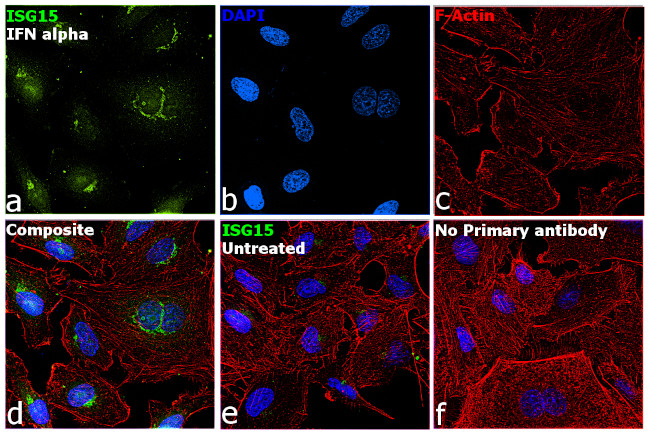
图: 1 / 7
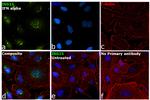
ISG15 Antibody (PA5-79523) in ICC/IF
Immunofluorescence analysis of ISG15 was performed using 70% confluent log phase A549 cells treated with IFN alpha (1000U/mL for 48h). The cells were fixed with 4% paraformaldehyde for 10 minutes, permeabilized with 0.1% Triton™ X-100 for 15 minutes, and blocked with 1% BSA for 1 hour at room temperature. The cells were labeled with ISG15 Rabbit Polyclonal Antibody (Product # PA5-79523) at 1:100 dilution in 0.1% BSA, incubated at 4 degree Celsius overnight and then labeled with Goat anti-Rabbit IgG (Heavy Chain) Superclonal™ Recombinant Se... View More

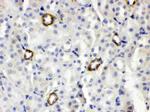
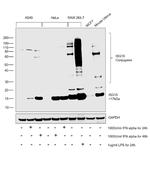
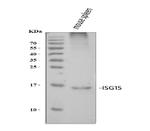
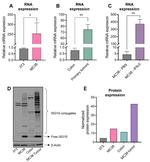
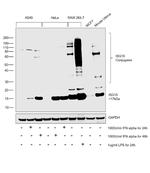
Please note: We are reviewing Western blot images included in the antibody testing data in our catalog, including those provided by third parties. Unless expressly labeled or annotated as “raw-unedited”, Western blot images included in the antibody testing data in our catalog may have been edited, optimized or otherwise adjusted for presentation.


产品信息
PA5-79523
应用
建议稀释比
已发表文章
产品规格
种属反应
Mouse
已发表种属
Mouse
宿主/亚型
Rabbit
/ IgG
分类
Polyclonal
类型
Antibody
抗原
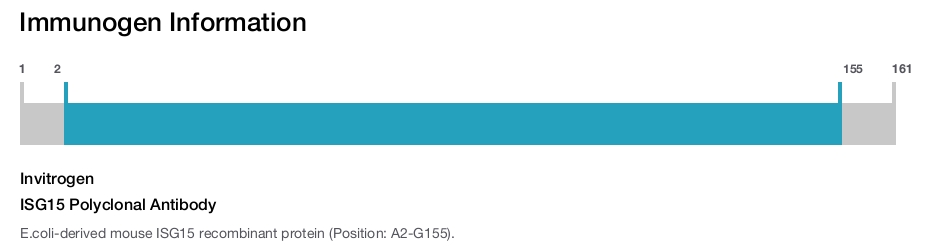
E.coli-derived mouse ISG15 recombinant protein (Position: A2-G155).
偶联物
Unconjugated
Unconjugated
Unconjugated
形式
Lyophilized
浓度
500 µg/mL once reconstituted
规格
100 µg
纯化类型
Antigen affinity chromatography
保存液
PBS with 5mg BSA
内含物
0.05mg sodium azide
保存条件
-20°C
运输条件
Ambient (domestic); Wet ice (international)
RRID
产品详细信息
Reconstitute with 0.2 mL of distilled water to yield a concentration of 500 µg/mL.
Positive Control - WB: mouse spleen tissue. IHC: mouse kidney tissue.
靶标信息
Ubiquitin-like protein ISG15 plays a key role in the innate immune response to viral infection either via its conjugation to a target protein (ISGylation) or via its action as a free or unconjugated protein. It is secreted from monocytes in response to type I interferons and causes natural killer (NK)-cell proliferation and an augmentation of non-MCH (major histocompatibility complex)-restricted cytotoxicity. Synthesis is stimulated by IFN-alpha or IFN-beta or IFN-omega, but not IFN-gamma. ISG15 expression is also induced by overexpression of interferon regulatory factors that participate in transcriptional regulation of IFN genes, and by influenza B virus. ISG15 is secreted by cell lines of monocyte, T-lymphocyte, B-lymphocyte, human fibroblasts, and epithelial origins. Enhancement of NK cell proliferation, augmentation of non-major histocompatibility complex-restricted cytotoxicity, and induction of IFN-gamma from T cells identify ISG15 as a member of the cytokine cascade and suggest that it may be responsible for amplifying and directing some of the immunomodulatory effects of IFN-alpha or IFN-beta. ISG15 has has also been shown to function intracellularly as a ubiquitin homolog. Mutations affecting the gene can result in Immunodeficiency 38, with basal ganglia calcification (IMD38).
仅用于科研。不用于诊断过程。未经明确授权不得转售。
生物信息学
蛋白别名: G1p2; interferon, alpha-inducible protein; interferon-induced 15 kDa protein; interferon-induced 15-KDa protein; interferon-induced 17 kDa protein; interferon-stimulated protein (15 kDa); interferon-stimulated protein 15; ubiquitin cross-reactive protein; unnamed protein product
基因别名: G1p2; IGI15; IP17; Irfp; UCRP
UniProt ID: (Mouse) Q64339
Entrez Gene ID: (Mouse) 100038882
regulation of immune system process
integrin-mediated signaling pathway
response to virus
response to bacterium
modification-dependent protein catabolic process
positive regulation of bone mineralization
negative regulation of protein ubiquitination
ISG15-protein conjugation
positive regulation of protein oligomerization
regulation of interferon-gamma production
positive regulation of interferon-beta production
positive regulation of interferon-gamma production
positive regulation of interleukin-10 production
response to type I interferon
defense response to bacterium
negative regulation of viral genome replication
innate immune response
positive regulation of erythrocyte differentiation
positive regulation of multicellular organismal process
defense response to virus
negative regulation of type I interferon-mediated signaling pathway
protein localization to mitochondrion
Disclaimer

Clicking the images or links will redirect you to a website hosted by BenchSci that provides third-party scientific content. Neither the content nor the BenchSci technology and processes for selection have been evaluated by us; we are providing them as-is and without warranty of any kind, including for use or application of the Thermo Fisher Scientific products presented.

