Search
Invitrogen
SAPK4 Polyclonal Antibody
{{$productOrderCtrl.translations['antibody.pdp.commerceCard.promotion.promotions']}}
{{$productOrderCtrl.translations['antibody.pdp.commerceCard.promotion.promocode']}}: {{promo.promoCode}} {{promo.promoTitle}} {{promo.promoDescription}}. {{$productOrderCtrl.translations['antibody.pdp.commerceCard.promotion.learnmore']}}
{{$ctrl.translations['antibody.pdp.skuNotes.additionalInformation']}}:
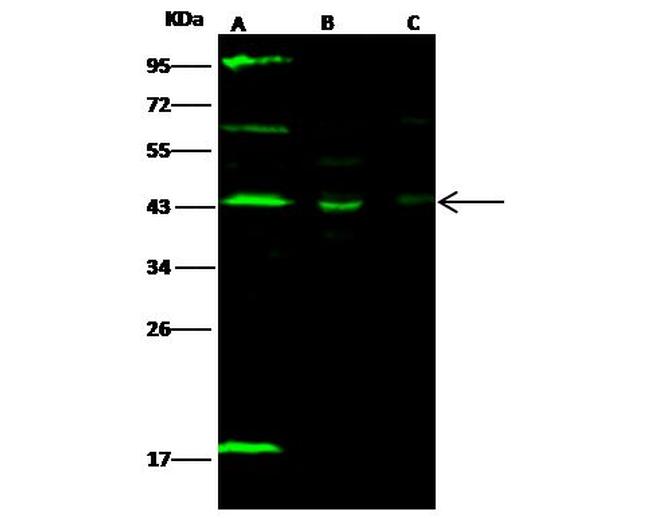
图: 1 / 2
SAPK4 Antibody (PA5-80793) in WB
Western Blot using SAPK4 Polyclonal Antibody (Product # PA5-80793) at 1:500 dilution. Lane A: 293 Whole Cell Lysate, Lane B: MCF7 Whole Cell Lysate, Lane C: HepG2 Whole Cell Lysate. Lysates/proteins at 30 μg per lane. Secondary Goat Anti- RabbitIgG H&L (DyLight™ 800) at 1:10,000 dilution. Developed using the Odyssey technique. Performed under reducing conditions. Predicted band size: 42 kDa. Observed band size: 44 kDa. (We are unsure of the identity of these extra bands).
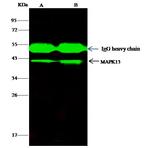
Please note: We are reviewing Western blot images included in the antibody testing data in our catalog, including those provided by third parties. Unless expressly labeled or annotated as “raw-unedited”, Western blot images included in the antibody testing data in our catalog may have been edited, optimized or otherwise adjusted for presentation.


产品信息
PA5-80793
应用
建议稀释比
已发表文章
产品规格
种属反应
Human
宿主/亚型
Rabbit
/ IgG
分类
Polyclonal
类型
Antibody
抗原
Recombinant Human p38 delta/MAPK13 Protein (Met1-Leu365)
偶联物
Unconjugated
Unconjugated
Unconjugated
形式
Liquid
浓度
1 mg/mL
规格
100 µg
纯化类型
Protein A, Antigen affinity chromatography
保存液
PBS
内含物
no preservative
保存条件
Store at 4°C short term. For long term storage, store at -20°C, avoiding freeze/thaw cycles.
运输条件
Ambient (domestic); Wet ice (international)
RRID
产品详细信息
This product is preservative free. It is recommended to add sodium azide to avoid contamination (final concentration 0.05%-0.1%).
This antibody has specificity for Human p38 delta/MAPK13.
靶标信息
MAPK13 (p38 delta) is a serine/threonine kinase that transduces a variety of extracellular signals, including cytokine and environmental stress responses. MAPK13 also regulates the differentiation of keratinocytes. This kinase is activated by various environmental stresses and proinflammatory cytokines. The activation requires its phosphorylation by MAP kinase kinases, or its autophosphorylation triggered by the interaction of MAP3K7IP1/TAB1 protein with this kinase. The substrates of this kinase include transcription regulator ATF2, MEF2C, and MAX, cell cycle regulator CDC25B, and tumor suppressor p53, which suggest the roles of this kinase in stress related transcription and cell cycle regulation, as well as in genotoxic stress response. Four alternatively spliced transcript variants of SAPK4 encoding distinct isoforms have been reported.
仅用于科研。不用于诊断过程。未经明确授权不得转售。
篇参考文献 (0)
您是否在文献中引用过该产品?请点击下方按钮邮件告知我们。
生物信息学
蛋白别名: MAP kinase 13; MAP kinase p38 delta; MAPK13; mitogen-activated protein kinase p38 delta; p38-delta MAPK; SAPK4; stress-activated protein kinase 4
基因别名: MAPK 13; MAPK-13; p38delta; PRKM13; SAPK4
UniProt ID: (Human) O15264
Entrez Gene ID: (Human) 5603
MAPK cascade
response to osmotic stress
positive regulation of interleukin-6 production
cellular response to stress
cellular response to UV
intracellular signal transduction
positive regulation of inflammatory response
stress-activated MAPK cascade
cellular response to hydrogen peroxide
cellular response to interleukin-1
cellular response to sorbitol
cellular response to anisomycin
cellular response to sodium arsenite
Disclaimer

Clicking the images or links will redirect you to a website hosted by BenchSci that provides third-party scientific content. Neither the content nor the BenchSci technology and processes for selection have been evaluated by us; we are providing them as-is and without warranty of any kind, including for use or application of the Thermo Fisher Scientific products presented.

