Search
Invitrogen
Dynactin 2 Polyclonal Antibody
{{$productOrderCtrl.translations['antibody.pdp.commerceCard.promotion.promotions']}}
{{$productOrderCtrl.translations['antibody.pdp.commerceCard.promotion.promocode']}}: {{promo.promoCode}} {{promo.promoTitle}} {{promo.promoDescription}}. {{$productOrderCtrl.translations['antibody.pdp.commerceCard.promotion.learnmore']}}
{{$ctrl.translations['antibody.pdp.skuNotes.additionalInformation']}}:
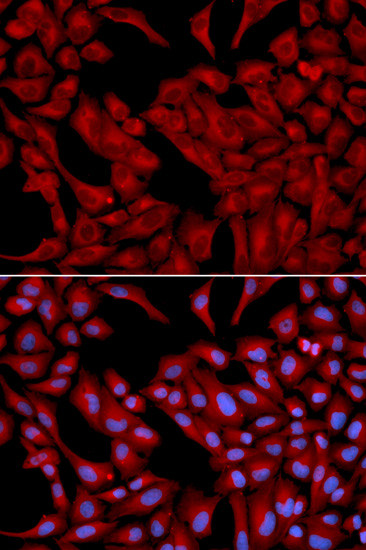
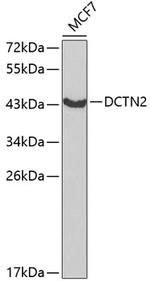
Please note: We are reviewing Western blot images included in the antibody testing data in our catalog, including those provided by third parties. Unless expressly labeled or annotated as “raw-unedited”, Western blot images included in the antibody testing data in our catalog may have been edited, optimized or otherwise adjusted for presentation.


产品信息
PA5-96095
产品规格
种属反应
Human,
Rat
宿主/亚型
Rabbit
/ IgG
分类
Polyclonal
类型
Antibody
抗原
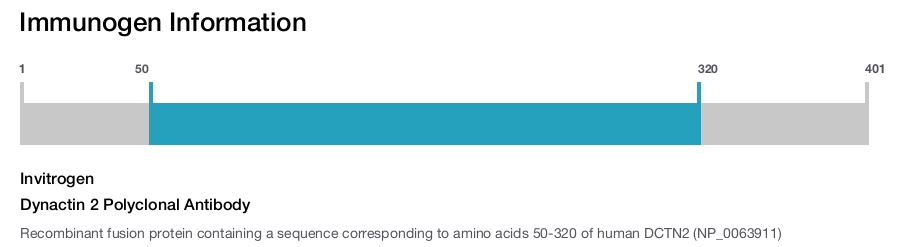
Recombinant fusion protein containing a sequence corresponding to amino acids 50-320 of human DCTN2 (NP_0063911)
偶联物
Unconjugated
Unconjugated
Unconjugated
形式
Liquid
浓度
0.55 mg/mL
规格
55 µg
纯化类型
Affinity Chromatography
保存液
PBS, pH 7.3, with 50% glycerol
内含物
0.02% sodium azide
保存条件
-20°C, Avoid Freeze/Thaw Cycles
运输条件
Ambient (domestic); Wet ice (international)
RRID
产品详细信息
Immunogen sequence: HIIVNPNAAY DKFKDKRVGT KGLDFSDRIG KTKRTGYESG EYEMLGEGLG VKETPQQKYQ RLLHEVQELT TEVEKIKTTV KESATEEKLT PVLLAKQLAA LKQQLVASHL EKLLGPDAAI NLTDPDGALA KRLLLQLEAT KNSKGGSGGK TTGTPPDSSL VTYELHSRPE QDKFSQAAKV AELEKRLTEL ETAVRCDQDA QNPLSAGLQG ACLMETVELL QAKVSALDLA VLDQVEARLQ SVLGKVNEIA KHKASVEDAD TQSKVHQLYE T; Positive Samples: MCF7; Cellular Location: Cytoplasm, Membrane, Peripheral membrane protein, centrosome, cytoskeleton, microtubule organizing center
靶标信息
This gene encodes a 50-kD subunit of dynactin, a macromolecular complex consisting of 10-11 subunits ranging in size from 22 to 150 kDa. Dynactin binds to both microtubules and cytoplasmic dynein. It is involved in a diverse array of cellular functions, including ER-to-Golgi transport, the centripetal movement of lysosomes and endosomes, spindle formation, chromosome movement, nuclear positioning, and axonogenesis. This subunit is present in 4-5 copies per dynactin molecule. It contains three short alpha-helical coiled-coil domains that may mediate association with self or other dynactin subunits. It may interact directly with the largest subunit (p150) of dynactin and may affix p150 in place.
仅用于科研。不用于诊断过程。未经明确授权不得转售。
篇参考文献 (0)
您是否在文献中引用过该产品?请点击下方按钮邮件告知我们。
生物信息学
蛋白别名: 50 kD dynactin subunit; 50 kDa dynein-associated polypeptide; dynactin 2 (p50); dynactin complex 50 kDa subunit; epididymis secretory protein Li 77; epididymis secretory sperm binding protein; p50 dynamitin; unnamed protein product
基因别名: DCTN50; DYNAMITIN; HEL-S-77; RBP50
UniProt ID: (Human) Q13561, (Rat) Q6AYH5
Entrez Gene ID: (Human) 10540, (Rat) 299850
Disclaimer

Clicking the images or links will redirect you to a website hosted by BenchSci that provides third-party scientific content. Neither the content nor the BenchSci technology and processes for selection have been evaluated by us; we are providing them as-is and without warranty of any kind, including for use or application of the Thermo Fisher Scientific products presented.

