Search
Invitrogen
IL-33 Polyclonal Antibody
{{$productOrderCtrl.translations['antibody.pdp.commerceCard.promotion.promotions']}}
{{$productOrderCtrl.translations['antibody.pdp.commerceCard.promotion.promocode']}}: {{promo.promoCode}} {{promo.promoTitle}} {{promo.promoDescription}}. {{$productOrderCtrl.translations['antibody.pdp.commerceCard.promotion.learnmore']}}
{{$ctrl.translations['antibody.pdp.skuNotes.additionalInformation']}}:
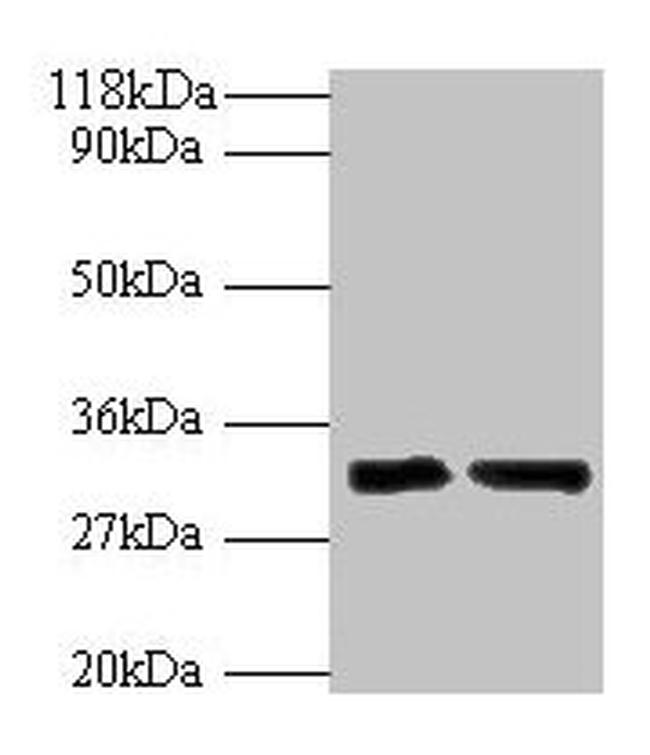
图: 1 / 1
IL-33 Antibody (PA5-97869) in WB
Western Blot analysis of IL-33 using a IL-33 Polyclonal antibody (Product # PA5-97869) at a concentration of 2 µg/mL. Lane 1: Hela whole cell lysate. Lane 2: Mouse lung tissue. A secondary Goat polyclonal antibody to rabbit IgG was applied at a 1:10,000 dilution. Observed band size: 32 kDa.
Please note: We are reviewing Western blot images included in the antibody testing data in our catalog, including those provided by third parties. Unless expressly labeled or annotated as “raw-unedited”, Western blot images included in the antibody testing data in our catalog may have been edited, optimized or otherwise adjusted for presentation.

产品信息
PA5-97869
产品规格
种属反应
Human,
Mouse,
Pig
宿主/亚型
Rabbit
/ IgG
分类
Polyclonal
类型
Antibody
抗原
Recombinant Pig Interleukin-33 protein (123-276AA)
偶联物
Unconjugated
Unconjugated
Unconjugated
形式
Liquid
浓度
4.5 mg/mL
规格
100 µg
纯化类型
Protein G
保存液
PBS, pH 7.4, with 50% glycerol
内含物
0.03% ProClin 300
保存条件
-20°C or -80°C if preferred
运输条件
Ambient (domestic); Wet ice (international)
RRID
靶标信息
IL-33 (Interleukin-33) is a 270 amino acid, highly divergent protein belonging to the IL-1 family with an IL-1-like C-terminal domain. IL-33 is a dual function protein that may function both as a proinflammatory cytokine and an intracellular nuclear factor with transcriptional regulatory properties. IL-33 binds to and signals through IL1RL1/ST2 and its stimulation recruits MYD88, IRAK1, IRAK4, and TRAF6. IL-33 activates NF-kappaB and MAP kinases, and drives production of TH2-associated cytokines from in vitro polarized TH2 cells. In vivo, IL-33 induces the expression of IL-4, IL-5, and IL-13 and leads to severe pathological changes in mucosal organs. IL-33 is proteolytically converted to a mature form by CASP1 and is highly expressed in high endothelial venules found in tonsils, Peyer's patches and mesenteric lymph nodes and is almost undetectable in placenta. Prolonged IL-33 treatment of mice led to the development of eosinophilia, splenomegaly, and severe pathological changes in mucosal organs such as lungs, esophagus and small intestine. Recent experiments have shown that IL-33 can also co-localize with heterochromatin and possesses transcriptional repressor activities, indicating that IL-33 may function as both a proinflammatory cytokine and an intracellular nuclear factor with transcriptional regulatory properties. Despite its predicted molecular weight, IL-33 will often run at higher molecular weight in SDS-PAGE. Studies have shown that IL-33 can also co-localize with heterochromatin and possesses transcriptional repressor activities, indicating that IL-33 may function as both a proinflammatory cytokine, and an intracellular nuclear factor with transcriptional regulatory properties.
仅用于科研。不用于诊断过程。未经明确授权不得转售。
篇参考文献 (0)
您是否在文献中引用过该产品?请点击下方按钮邮件告知我们。
生物信息学
蛋白别名: C9orf26; cytokine; DVS27-related protein; growth stimulation-expressed; H-IL-33; homolog of mouse growth stimulation-expressed; ILN; Interleukin; interleukin 1 receptor-related protein; interleukin-1 family member 11; interleukin-33 receptor alpha chain; Interleukin33; lacks exon 3 and the first 18bp of exon 5; lacks exons 3 and 4, and the first 18bp of exon 5; lymphocyte antigen 84; nuclear factor for high endothelial venules; nuclear factor from high endothelial venules; RP11-575C20.2; soluble protein receptor; suppressor of tumorigenicity 2; T1 protein precursor; unnamed protein product
基因别名: 9230117N10Rik; C9orf26; DER4; DVS27; FIT-1; IL-33; IL1F11; IL33R; Ly84; NF-HEV; NFEHEV; ST2; St2-rs1; ST2L; ST2V; T1; T1/ST2
UniProt ID: (Human) Q01638, (Human) O95760, (Mouse) P14719, (Mouse) Q8BVZ5
Entrez Gene ID: (Human) 9173, (Pig) 100127134, (Human) 90865, (Pig) 100518643, (Mouse) 17082, (Mouse) 77125
negative regulation of T-helper 1 type immune response
inflammatory response
immune response
signal transduction
macrophage differentiation
negative regulation of interferon-gamma production
positive regulation of chemokine production
positive regulation of interleukin-5 production
interleukin-33-mediated signaling pathway
positive regulation of macrophage activation
positive regulation of inflammatory response
negative regulation of transcription from RNA polymerase II promoter
positive regulation of cytokine production
macrophage activation involved in immune response
microglial cell activation involved in immune response
negative regulation of immunoglobulin production
positive regulation of immunoglobulin production
negative regulation of leukocyte migration
protein import into nucleus
positive regulation of cellular defense response
gene expression
positive regulation of glycoprotein biosynthetic process
positive regulation of gene expression
positive regulation of interleukin-13 production
positive regulation of interleukin-4 production
positive regulation of interleukin-6 production
positive regulation of tumor necrosis factor production
positive regulation of transcription from RNA polymerase II promoter
positive regulation of multicellular organismal process
microglial cell proliferation
negative regulation of inflammatory response to wounding
negative regulation of macrophage proliferation
antibacterial innate immune response
positive regulation of neuroinflammatory response
positive regulation of immune system process
negative regulation of cell proliferation
response to wounding
negative regulation of I-kappaB kinase/NF-kappaB signaling
regulation of inflammatory response
cellular response to cytokine stimulus
positive regulation of type 2 immune response
positive regulation of proteasomal ubiquitin-dependent protein catabolic process
protein kinase B signaling
positive regulation of MHC class I biosynthetic process
positive regulation of MHC class II biosynthetic process
positive regulation of oligodendrocyte differentiation
defense response to virus
positive regulation of protein kinase B signaling
inflammatory response to wounding
extrinsic apoptotic signaling pathway
positive regulation of cytokine production involved in inflammatory response
Disclaimer

Clicking the images or links will redirect you to a website hosted by BenchSci that provides third-party scientific content. Neither the content nor the BenchSci technology and processes for selection have been evaluated by us; we are providing them as-is and without warranty of any kind, including for use or application of the Thermo Fisher Scientific products presented.

