Search
Invitrogen
VASN Polyclonal Antibody
{{$productOrderCtrl.translations['antibody.pdp.commerceCard.promotion.promotions']}}
{{$productOrderCtrl.translations['antibody.pdp.commerceCard.promotion.promocode']}}: {{promo.promoCode}} {{promo.promoTitle}} {{promo.promoDescription}}. {{$productOrderCtrl.translations['antibody.pdp.commerceCard.promotion.learnmore']}}
{{$ctrl.translations['antibody.pdp.skuNotes.additionalInformation']}}:
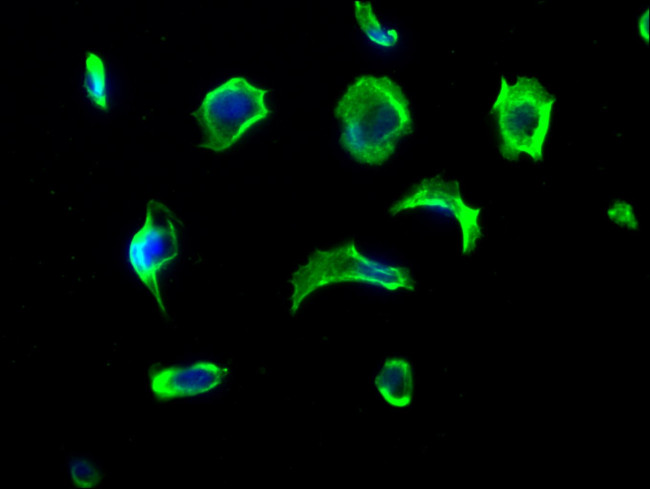
图: 1 / 3
VASN Antibody (PA5-98236) in ICC/IF
Immunofluorescent analysis of VASN in MCF-7 cells using a VASN polyclonal antibody (Product # PA5-98236) at a dilution of 1:213. The cells were fixed in 4% formaldehyde, permeabilized using 0.2% Triton X-100 and blocked in 10% normal Goat Serum. The cells were then incubated with the antibody overnight at 4°C. The secondary antibody was Alexa Fluor 488-congugated Goat Anti-Rabbit IgG(H+L). Cells were counter-stained with DAPI.
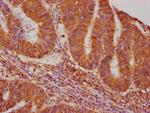
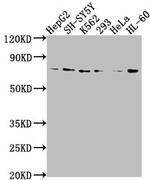
Please note: We are reviewing Western blot images included in the antibody testing data in our catalog, including those provided by third parties. Unless expressly labeled or annotated as “raw-unedited”, Western blot images included in the antibody testing data in our catalog may have been edited, optimized or otherwise adjusted for presentation.


产品信息
PA5-98236
应用
建议稀释比
已发表文章
产品规格
种属反应
Human
已发表种属
Human
宿主/亚型
Rabbit
/ IgG
分类
Polyclonal
类型
Antibody
抗原
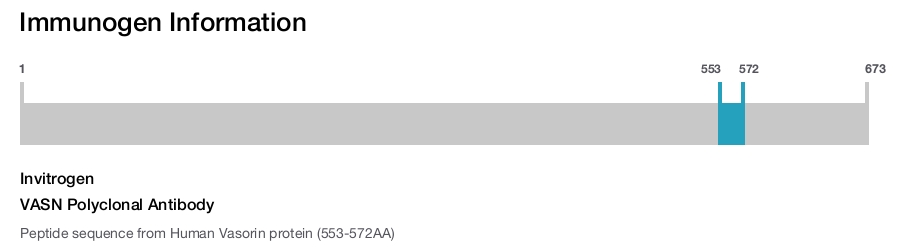
Peptide sequence from Human Vasorin protein (553-572AA)
偶联物
Unconjugated
Unconjugated
Unconjugated
形式
Liquid
浓度
1 mg/mL
规格
100 µg
纯化类型
Protein G
保存液
PBS, pH 7.4, with 50% glycerol, 0.5% BSA
内含物
0.02% sodium azide
保存条件
-20°C or -80°C if preferred
运输条件
Ambient (domestic); Wet ice (international)
RRID
靶标信息
The VASN gene encodes the protein vasorin, a type I transmembrane protein involved in cellular signaling, vascular development, and tissue repair. Vasorin is characterized by its expression in various tissues, including vascular endothelial cells and smooth muscle cells, where it functions to modulate cell proliferation and differentiation. It plays a significant role in the regulation of vascular remodeling and homeostasis by interacting with signaling molecules like transforming growth factor-beta (TGF-β), thereby influencing processes such as angiogenesis and wound healing. Vasorin is implicated in inhibiting TGF-β signaling pathways, which are crucial for maintaining vascular integrity and preventing excessive fibrosis during tissue repair. Dysregulation of VASN expression can contribute to pathological conditions, including cardiovascular diseases and cancer, where abnormal vascular remodeling and cell proliferation are evident. Research into vasorin continues to explore its functional mechanisms and potential therapeutic applications in diseases characterized by vascular dysregulation and tissue remodeling.
仅用于科研。不用于诊断过程。未经明确授权不得转售。
生物信息学
蛋白别名: protein slit-like 2; slit-like 2
基因别名: SLITL2
UniProt ID: (Human) Q6EMK4
Entrez Gene ID: (Human) 114990
Disclaimer

Clicking the images or links will redirect you to a website hosted by BenchSci that provides third-party scientific content. Neither the content nor the BenchSci technology and processes for selection have been evaluated by us; we are providing them as-is and without warranty of any kind, including for use or application of the Thermo Fisher Scientific products presented.

