Search
Invitrogen
HYD Polyclonal Antibody
{{$productOrderCtrl.translations['antibody.pdp.commerceCard.promotion.promotions']}}
{{$productOrderCtrl.translations['antibody.pdp.commerceCard.promotion.promocode']}}: {{promo.promoCode}} {{promo.promoTitle}} {{promo.promoDescription}}. {{$productOrderCtrl.translations['antibody.pdp.commerceCard.promotion.learnmore']}}
{{$ctrl.translations['antibody.pdp.skuNotes.additionalInformation']}}:

图: 1 / 2
HYD Antibody (PA5-99188) in IHC (P)
Immunohistochemistry analysis of paraffin-embedded HYD in human brain tissue sections. Antigen retrieval was performed using citrate buffer. Samples were blocked with blocking buffer (1.5 hr, 22°C), incubated with HYD polyclonal antibody (Product # PA5-99188) using a dilution of 1:100 (1.5 hr, 22°C), followed by HRP conjugated goat anti-rabbit.

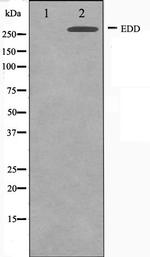
Please note: We are reviewing Western blot images included in the antibody testing data in our catalog, including those provided by third parties. Unless expressly labeled or annotated as “raw-unedited”, Western blot images included in the antibody testing data in our catalog may have been edited, optimized or otherwise adjusted for presentation.


产品信息
PA5-99188
应用
建议稀释比
已发表文章
产品规格
种属反应
Human,
Mouse
宿主/亚型
Rabbit
/ IgG
分类
Polyclonal
类型
Antibody
抗原
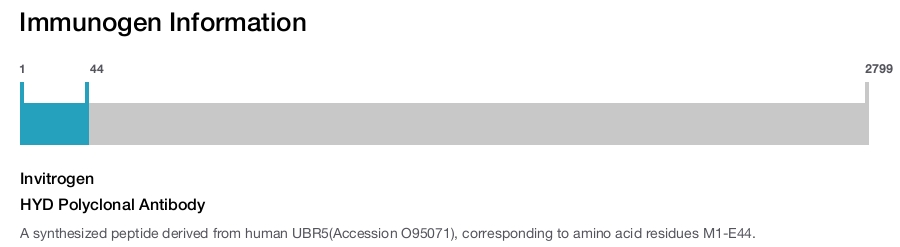
A synthesized peptide derived from human UBR5(Accession O95071), corresponding to amino acid residues M1-E44.
偶联物
Unconjugated
Unconjugated
Unconjugated
形式
Liquid
浓度
1 mg/mL
规格
100 µg
纯化类型
Affinity chromatography
保存液
PBS, pH 7.4, with 50% glycerol
内含物
0.02% sodium azide
保存条件
-20°C
运输条件
Ambient (domestic); Wet ice (international)
RRID
产品详细信息
Antibody detects endogenous levels of total EDD.
靶标信息
EDD (for E3 identified by Differential Display) is a progestin-regulated gene that was isolated from T-47D human breast cancer cells. Based on sequence homology, EDD appears to be a human homolog of the Drosophila hyperplastic discs (hyd) gene, a tumor suppressor gene that is required for control of imaginal disc growth. EDD contains a HECT domain in the carboxy terminus. HECT domain-containing proteins function as ubiquitin-protein ligases, or E3 enzymes. EDD has been shown to bind to ubiquitin, and like other HECT family proteins, may function as an E3 ubiquitin-protein ligase.
仅用于科研。不用于诊断过程。未经明确授权不得转售。
篇参考文献 (0)
您是否在文献中引用过该产品?请点击下方按钮邮件告知我们。
生物信息学
蛋白别名: CH D1S3362; E3 identified by differential display; E3 ubiquitin-protein ligase, HECT domain-containing 1; ECGF1; EDG-1; EDG1; extraembryonic development; HECT E3; ubiquitin-protein ligase; HECT-type E3 ubiquitin transferase UBR5; hyperplastic discs protein homolog; progestin-induced protein; S1P receptor 1; S1P receptor Edg-1; S1P1; S1PR1; unnamed protein product
基因别名: DD5; EDD; EDD1; HYD; NEDSBH
UniProt ID: (Human) O95071, (Mouse) Q80TP3
Entrez Gene ID: (Human) 51366, (Mouse) 70790
protein polyubiquitination
cellular response to DNA damage stimulus
response to oxidative stress
proteasomal protein catabolic process
positive regulation of gene expression
protein ubiquitination
intracellular estrogen receptor signaling pathway
regulation of protein stability
negative regulation of interleukin-17 production
negative regulation of extent of heterochromatin assembly
protein K29-linked ubiquitination
positive regulation of protein import into nucleus
proteasome-mediated ubiquitin-dependent protein catabolic process
negative regulation of smoothened signaling pathway
retinoic acid receptor signaling pathway
progesterone receptor signaling pathway
vitamin D receptor signaling pathway
protein K48-linked ubiquitination
protein K11-linked ubiquitination
ubiquitin-dependent protein catabolic process via the N-end rule pathway
cytoplasm-associated proteasomal ubiquitin-dependent protein catabolic process
nucleus-associated proteasomal ubiquitin-dependent protein catabolic process
positive regulation of canonical Wnt signaling pathway
cytoplasm protein quality control
DNA repair-dependent chromatin remodeling
protein branched polyubiquitination
Disclaimer

Clicking the images or links will redirect you to a website hosted by BenchSci that provides third-party scientific content. Neither the content nor the BenchSci technology and processes for selection have been evaluated by us; we are providing them as-is and without warranty of any kind, including for use or application of the Thermo Fisher Scientific products presented.

