Search


引用和文献 (8)
Invitrogen™
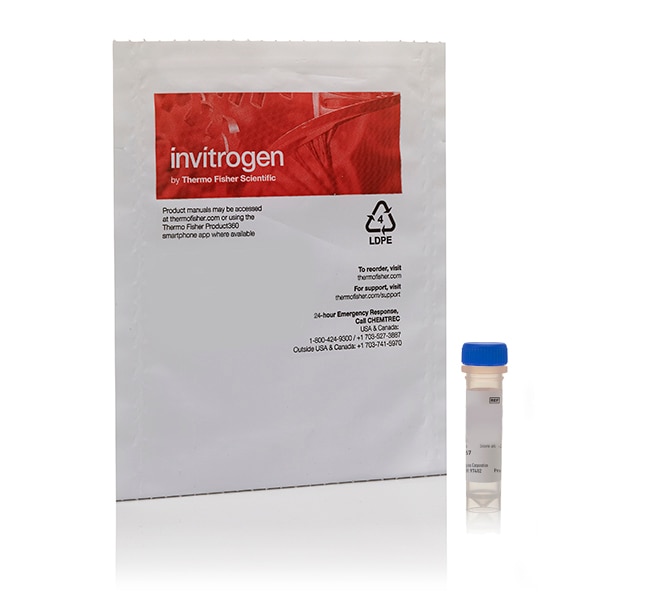
Qdot™ 705 ITK™ 氨基 (PEG) 量子点
Qdot™ 705 ITK™ 氨基 (PEG) 量子点是制备超亮和光稳定性荧光标记蛋白或其他生物聚合物的定制偶联物的理想起始材料。这些探针添加胺衍生 PEG 官能团,可防止非特异性相互作用并提供方便的偶联操作。氨基量子点与异硫氰酸盐和琥珀酰亚胺酯高效反应,或使用水溶性碳二亚胺了解更多信息
| 货号 | 数量 |
|---|---|
| Q21561MP | 250 µL |
货号 Q21561MP
价格(CNY)
13,126.00
Each
数量:
250 µL
价格(CNY)
13,126.00
Each
Qdot™ 705 ITK™ 氨基 (PEG) 量子点是制备超亮和光稳定性荧光标记蛋白或其他生物聚合物的定制偶联物的理想起始材料。这些探针添加胺衍生 PEG 官能团,可防止非特异性相互作用并提供方便的偶联操作。氨基量子点与异硫氰酸盐和琥珀酰亚胺酯高效反应,或使用水溶性碳二亚胺(如 EDC)与天然羧酸反应。此类衍生物可用于需要超亮和稳定荧光的各种标记和示踪应用。Qdot™ ITK™ 氨基量子点以8 µM 溶液形式提供,提供8种颜色的 Qdot™ 探针。
Qdot™ ITK™ 氨基量子点的重要特点:
• Qdot™ 705 ITK™ 氨基量子点的最大发射波长 ∼705 nm
• 具有极高的光稳定性且荧光明亮
• 可使用单线激发源高效激发
• 发射谱较窄,斯托克斯位移较大
• 具有多种颜色
• 适用于多种标记和示踪应用
Qdot™ 纳米晶体的特性
Qdot™ 探针适用于需要明亮荧光信号和/或实时示踪的成像和标记应用。与其他荧光试剂不同的是,Qdot™ 探针的所有 9 种可用颜色均可以用单一(紫外或蓝绿色)光源同时激发。这一特性使这些试剂非常适合经济且用户友好的多重应用。Qdot™ 标记基于半导体纳米技术,大小与中等分子量的蛋白相似。
关于 Innovator 的工具试剂盒 Qdot™ ITK™ 试剂
这些 Qdot™ ITK™ 探针适用于希望针对其应用制备特异性(无现货)偶联物并且需要可定制偶联功能的研究人员。
可提供其他形式的 Qdot™ 纳米晶体
除胺衍生形式外,我们还提供具有羧基和脂肪族碳氢化合物修饰的 Qdot™ ITK™ 量子点。我们还开发了多种 Qdot™ 纳米晶体偶联物和标记试剂盒。研究 Qdot™ 纳米晶体的特性或阅读 Molecular Probes™ 手册第 6.6 节—Qdot™ 纳米晶体获取更多信息。
仅供科研使用。不得用于任何动物或人类的治疗或诊断。
Qdot™ ITK™ 氨基量子点的重要特点:
• Qdot™ 705 ITK™ 氨基量子点的最大发射波长 ∼705 nm
• 具有极高的光稳定性且荧光明亮
• 可使用单线激发源高效激发
• 发射谱较窄,斯托克斯位移较大
• 具有多种颜色
• 适用于多种标记和示踪应用
Qdot™ 纳米晶体的特性
Qdot™ 探针适用于需要明亮荧光信号和/或实时示踪的成像和标记应用。与其他荧光试剂不同的是,Qdot™ 探针的所有 9 种可用颜色均可以用单一(紫外或蓝绿色)光源同时激发。这一特性使这些试剂非常适合经济且用户友好的多重应用。Qdot™ 标记基于半导体纳米技术,大小与中等分子量的蛋白相似。
关于 Innovator 的工具试剂盒 Qdot™ ITK™ 试剂
这些 Qdot™ ITK™ 探针适用于希望针对其应用制备特异性(无现货)偶联物并且需要可定制偶联功能的研究人员。
可提供其他形式的 Qdot™ 纳米晶体
除胺衍生形式外,我们还提供具有羧基和脂肪族碳氢化合物修饰的 Qdot™ ITK™ 量子点。我们还开发了多种 Qdot™ 纳米晶体偶联物和标记试剂盒。研究 Qdot™ 纳米晶体的特性或阅读 Molecular Probes™ 手册第 6.6 节—Qdot™ 纳米晶体获取更多信息。
仅供科研使用。不得用于任何动物或人类的治疗或诊断。
仅供科研使用。不可用于诊断程序。
规格
化学反应性羧酸、酮、醛
最大浓度8 μM
发射705
标签或染料Qdot™ 705
产品类型量子点
数量250 µL
反应一部分胺、伯胺
运输条件室温
标签类型Qdot 纳米晶体
产品线 Qdot, ITK
Unit SizeEach
内容与储存
在冷藏冰箱 (2–8°C) 中储存。
常见问题解答 (FAQ)
有什么好办法可以从ITK Qdot纳米晶中去除白色沉淀?
我在ITK Qdot纳米晶中发现白色沉淀,是否应该引起注意?
为什么我的Qdot纳米晶似乎在闪烁?
Qdot纳米晶在封固样品前荧光很亮,但现在我只能观测到少量的荧光,为什么会发生荧光衰减?
为什么不能冷冻Qdot纳米晶溶液?
引用和文献 (8)
引用和文献
Abstract
Targeted quantum dot conjugates for siRNA delivery.
Journal:Bioconjug Chem
PubMed ID:17630789
'Treatment of human diseases such as cancer generally involves the sequential use of diagnostic tools and therapeutic modalities. Multifunctional platforms combining therapeutic and diagnostic imaging functions in a single vehicle promise to change this paradigm. in particular, nanoparticle-based multifunctional platforms offer the potential to improve the pharmacokinetics of drug formulations,
Quantum dots are phagocytized by macrophages and colocalize with experimental gliomas.
Journal:Neurosurgery
PubMed ID:17327798
'OBJECTIVE: The identification of neoplastic tissue within normal brain during biopsy and tumor resection remains a problem in the operative management of gliomas. A variety of nanoparticles are phagocytized by macrophages in vivo. This feature may allow optical nanoparticles, such as quantum dots, to colocalize with brain tumors and serve
In vivo imaging of quantum dots.
Journal:Methods Mol Biol
PubMed ID:19488714
'Noninvasive whole-body near-infrared fluorescence imaging is now acknowledged as a powerful method for the molecular mapping of biological events in live small animals such as mouse models. With outstanding optical properties such as high fluorescence quantum yields and low photobleaching rates, quantum dots (QDs) are labels of choice in the
Quantum dot targeting with lipoic acid ligase and HaloTag for single-molecule imaging on living cells.
Journal:ACS Nano
PubMed ID:23181687
'We present a methodology for targeting quantum dots to specific proteins on living cells in two steps. In the first step, Escherichia coli lipoic acid ligase (LplA) site-specifically attaches 10-bromodecanoic acid onto a 13 amino acid recognition sequence that is genetically fused to a protein of interest. In the second
Preparation of peptide-conjugated quantum dots for tumor vasculature-targeted imaging.
Journal:Nat Protoc
PubMed ID:18193025
'To take full advantage of the unique optical properties of quantum dots (QDs) and expedite future near-infrared fluorescence (NIRF) imaging applications, QDs need to be effectively, specifically and reliably directed to a specific organ or disease site after systemic administration. Recently, we reported the use of peptide-conjugated QDs for non-invasive