Search


引用和文献 (5)
Invitrogen™
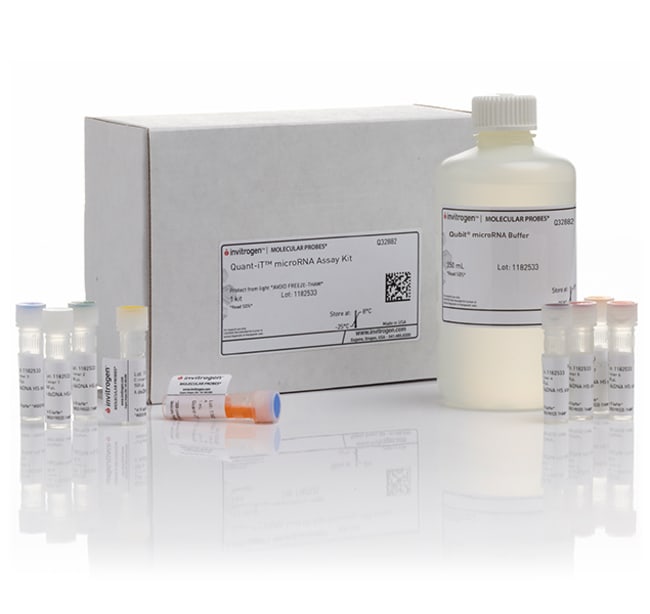
Quant-iT™ microRNA 检测试剂盒
使用 Quant-iT microRNA 测定试剂盒可轻松准确地定量测定 microRNA,该试剂盒是一种 microRNA (miRNA) 测定试剂盒,即使存在常见污染物(如盐、游离核苷酸了解更多信息
| 货号 | 数量 |
|---|---|
| Q32882 | 1 kit |
货号 Q32882
价格(CNY)
3,370.00
飞享价
4,493.00共减 1,123.00 (25%)
Each
数量:
1 kit
价格(CNY)
3,370.00
飞享价
4,493.00共减 1,123.00 (25%)
Each
使用 Quant-iT microRNA 测定试剂盒可轻松准确地定量测定 microRNA,该试剂盒是一种 microRNA (miRNA) 测定试剂盒,即使存在常见污染物(如盐、游离核苷酸、溶剂、去污剂和蛋白),也能检测 miRNA。相较于 rRNA 或较大的 mRNA (>1000 bp),该测定试剂盒对 microRNA 有高度选择性。
尽管该检测试剂并非专门对 miRNA 具有选择性,但我们可以根据提供的方案,甚至在存在 mRNA 的情况下,在低至 0.5 ng 的水平下重复定量测定纯样品中的 miRNA。
Quant-iT microRNA 测定试剂盒的特点包括:
• 灵敏检测微孔板孔中低至 0.5 ng 的 miRNA。
•5-500 ng/mL 的核心动态范围。
•在 50 ng/mL 至 100 µg/mL 的样品浓度范围内获得准确读数。
Quant-iT microRNA 测定试剂盒提供浓缩的测定试剂、稀释缓冲液和预稀释的 miRNA 标准品。只需按 1:200 的比例稀释试剂,将 200 µL 试剂上样至微孔板的孔中,加入 1-20 µL 样品,混合,然后读取荧光信号。该测定在室温下进行,信号可保持稳定约三小时。因为该测定试剂盒能够在 200 µL 的测定体积下承受 1–20 µL 的样品,所以在 50 ng/mL–100 µg/mL 的初始样品浓度内可获得准确结果。
尽管该检测试剂并非专门对 miRNA 具有选择性,但我们可以根据提供的方案,甚至在存在 mRNA 的情况下,在低至 0.5 ng 的水平下重复定量测定纯样品中的 miRNA。
Quant-iT microRNA 测定试剂盒的特点包括:
• 灵敏检测微孔板孔中低至 0.5 ng 的 miRNA。
•5-500 ng/mL 的核心动态范围。
•在 50 ng/mL 至 100 µg/mL 的样品浓度范围内获得准确读数。
Quant-iT microRNA 测定试剂盒提供浓缩的测定试剂、稀释缓冲液和预稀释的 miRNA 标准品。只需按 1:200 的比例稀释试剂,将 200 µL 试剂上样至微孔板的孔中,加入 1-20 µL 样品,混合,然后读取荧光信号。该测定在室温下进行,信号可保持稳定约三小时。因为该测定试剂盒能够在 200 µL 的测定体积下承受 1–20 µL 的样品,所以在 50 ng/mL–100 µg/mL 的初始样品浓度内可获得准确结果。
仅供科研使用。不可用于诊断程序。
规格
检测microRNA 定量
激发/发射498/518
适用于(设备)荧光计、微孔板读数仪
反应次数1000(200 μL 测定体积)
产品线Quant-iT
定量范围1 至 100 ng
数量1 kit
检测方法荧光
Unit SizeEach
常见问题解答 (FAQ)
为什么我用Qubit Assay检测时会得到负的荧光值?
Why am I getting negative fluorescence values with my Qubit Assays?
引用和文献 (5)
引用和文献
Abstract
MicroRNA detection based on duplex-specific nuclease-assisted target recycling and gold nanoparticle/graphene oxide nanocomposite-mediated electrocatalytic amplification.
Journal:Biosens Bioelectron
PubMed ID:30611105
DNA technology based bio-responsive nanomaterials have been widely studied as promising tools for biomedical applications. Gold nanoparticles (AuNPs) and graphene oxide (GO) sheets are representative zero- and two-dimensional nanomaterials that have long been combined with DNA technology for point-of-care diagnostics. Herein, a cascade amplification system based on duplex-specific nuclease (DSN)-assisted
Differences in the miRNA signatures of chronic musculoskeletal pain patients from neuropathic or nociceptive origins.
Journal:PLoS One
PubMed ID:31276478
The quality of life for millions of people worldwide is affected by chronic pain. In addition to the effect of chronic pain on well-being, chronic pain has also been associated with poor health conditions and increased mortality. Due to its multifactorial origin, the classification of pain types remains challenging. MicroRNAs
A universal fluorescence-based toolkit for real-time quantification of DNA and RNA nuclease activity.
Journal:Sci Rep
PubMed ID:31222049
DNA and RNA nucleases play a critical role in a growing number of cellular processes ranging from DNA repair to immune surveillance. Nevertheless, many nucleases have unknown or poorly characterized activities. Elucidating nuclease substrate specificities and co-factors can support a more definitive understanding of cellular mechanisms in physiology and disease.
Multifunctional hybrid nanoparticles as magnetic delivery systems for siRNA targeting the HER2 gene in breast cancer cells.
Journal:Mater Sci Eng C Mater Biol Appl
PubMed ID:32228895
Breast cancer is a major cause of death among women worldwide. Resistance to conventional therapies has been observed in HER2-positive breast cancer patients, indicating the need for more effective treatments. Small interfering RNA (siRNA) therapy is an attractive strategy against HER2-positive tumors, but its success depends largely on the efficient
Identification and Validation of MicroRNA Profiles in Fecal Samples for Detection of Colorectal Cancer.
Journal:Gastroenterology
PubMed ID:31622624
Screening for colorectal cancer (CRC) is effective in the population at average risk. The most extended strategy in organized programs involves the fecal immunochemical test, which is limited by low sensitivity for the detection of advanced adenomas (AAs). We aimed to identify microRNA (miRNA) signatures in fecal samples that identify