Search


引用和文献 (7)
Invitrogen™
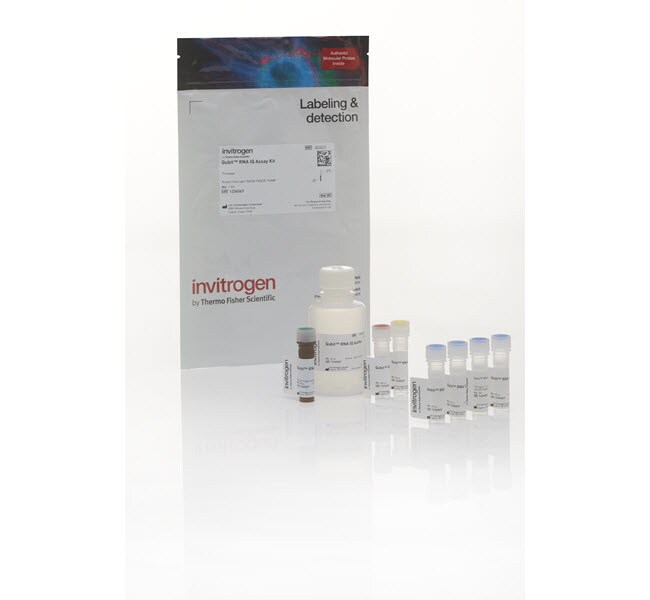
Qubit™ RNA IQ 检测试剂盒
Qubit RNA IQ 检测试剂盒提供了一种快速、简便的方法,通过使用 Qubit 4 或 Qubit Flex了解更多信息
Have Questions?
更改视图

| 货号 | 数量 |
|---|---|
| Q33221 | 75 assays |
| Q33222 | 275 assays |
货号 Q33221
价格(CNY)
926.00
飞享价
1,728.00共减 802.00 (46%)
Each
数量:
75 assays
价格(CNY)
926.00
飞享价
1,728.00共减 802.00 (46%)
Each
Qubit RNA IQ 检测试剂盒提供了一种快速、简便的方法,通过使用 Qubit 4 或 Qubit Flex 荧光计可检测 RNA 样品是否已降解。该检测试剂盒使用了两种独特的染料:一种染料可与大的、完整的和/或高度结构化的 RNA(mRNA、tRNA、rRNA)结合,另一种染料可选择性地与小 RNA 和/或降解的 RNA 结合。结合使用两种染料,便可对 RNA 样品的质量和完整性进行快速评估。
使用过程中,仅需将样品加入到 RNA IQ 工作液中,即可在 Qubit 4 或 Qubit Flex 荧光计上完成测量。检测结果将提供一个 RNA IQ 编号 (RNA IQ#),表明 RNA 样品的完整性和质量,并计算样品中的大 RNA 及小 RNA 的百分比。与其他 RNA 质量评分类似,RNA IQ# 数值为 1 至 10,其中小数表示样品主要由小 RNA 组成,而大数则表明样品主要由大 RNA 或具有三级结构的 RNA 组成。
基于溶液与电泳方法之间的比较
RNA IQ 检测结果与电泳方法之间的相关性良好。基于溶液的 RNA IQ 检测与传统电泳方法之间的主要差异在于,确定 RNA 样品是否已降解所需的检测时间不同。认为凝胶方法相对简单,但检测过程仍需更多时间。基于微流体的方法不仅需要更长的等待时间来获取结果,通常也需要较长的样品制备时间。如需获取更为具体的 RNA 样品片段大小及分布信息,我们依然推荐您使用基于凝胶或微流体的电泳方法。
注:
1.Qubit RNA IQ 检测将仅适用于 Qubit 4 或 Qubit Flex 荧光计。该检测并非设计用于与 Qubit、Qubit 2.0 或 Qubit 3 荧光计配合使用。
2.薄壁、透明、0.5 mL PCR 管(货号 Q32856)用于 Qubit 4 荧光计,8 x 200 µL 联管(货号 Q33252)用于 Qubit Flex 荧光计。
使用过程中,仅需将样品加入到 RNA IQ 工作液中,即可在 Qubit 4 或 Qubit Flex 荧光计上完成测量。检测结果将提供一个 RNA IQ 编号 (RNA IQ#),表明 RNA 样品的完整性和质量,并计算样品中的大 RNA 及小 RNA 的百分比。与其他 RNA 质量评分类似,RNA IQ# 数值为 1 至 10,其中小数表示样品主要由小 RNA 组成,而大数则表明样品主要由大 RNA 或具有三级结构的 RNA 组成。
基于溶液与电泳方法之间的比较
RNA IQ 检测结果与电泳方法之间的相关性良好。基于溶液的 RNA IQ 检测与传统电泳方法之间的主要差异在于,确定 RNA 样品是否已降解所需的检测时间不同。认为凝胶方法相对简单,但检测过程仍需更多时间。基于微流体的方法不仅需要更长的等待时间来获取结果,通常也需要较长的样品制备时间。如需获取更为具体的 RNA 样品片段大小及分布信息,我们依然推荐您使用基于凝胶或微流体的电泳方法。
注:
1.Qubit RNA IQ 检测将仅适用于 Qubit 4 或 Qubit Flex 荧光计。该检测并非设计用于与 Qubit、Qubit 2.0 或 Qubit 3 荧光计配合使用。
2.薄壁、透明、0.5 mL PCR 管(货号 Q32856)用于 Qubit 4 荧光计,8 x 200 µL 联管(货号 Q33252)用于 Qubit Flex 荧光计。
仅供科研使用。不可用于诊断程序。
规格
检测Qubit RNA 完整性和质量 (IQ) 检测试剂盒
适用于(设备)Qubit 4 荧光计、Qubit Flex 荧光计
反应次数75 次检测
产品线Qubit
数量75 assays
运输条件干冰
产品规格试剂盒
样品类型RNA
Unit SizeEach
常见问题解答 (FAQ)
Can the Qubit RNA IQ Assay Kits (Cat. No. Q33221, Q33222) be run on a plate reader for high throughput screening of RNA integrity?
I am using the Qubit RNA IQ Assay Kit (Cat. No. Q33221, Q33222). How do I convert the RNA IQ score to the RIN score?
Does the Qubit RNA IQ Assay detect free nucleotides/bases?
Do you offer a Qubit assay to detect purity of the RNA or DNA samples (level of protein contamination)?
Does the Qubit RNA IQ Assay detect the purity of the RNA sample, similar to using the 260/280 absorbance method?
引用和文献 (7)
引用和文献
Abstract
Anti-Inflammatory Effects of 5a,8a-Epidioxycholest-6-en-3ß-ol, a Steroidal Endoperoxide Isolated from Aplysia depilans, Based on Bioguided Fractionation and NMR Analysis.
Journal:Mar Drugs
PubMed ID:31163615
'Sea hares of Aplysia genus are recognized as a source of a diverse range of metabolites. 5a,8a-Endoperoxides belong to a group of oxidized sterols commonly found in marine organisms and display several bioactivities, including antimicrobial, anti-tumor, and immunomodulatory properties. Herein we report the isolation of 5a,8a-epidioxycholest-6-en-3ß-ol (EnP(5,8)) from Aplysia depilans
An Immune-Responsive Cytoskeletal-Plasma Membrane Feedback Loop in Plants.
Journal:Curr Biol
PubMed ID:29937351
'Cell wall appositions (CWAs) are produced reactively by the plant immune system to arrest microbial invasion through the local inversion of plant cell growth. This process requires the controlled invagination of the plasma membrane (PM) in coordination with the export of barrier material to the volume between the plant PM
Circular RNA circ-PRMT5 facilitates non-small cell lung cancer proliferation through upregulating EZH2 via sponging miR-377/382/498.
Journal:Gene
PubMed ID:31479715
'Emerging evidence demonstrates that circular RNA (circRNA) is a novel class of non-coding RNA that plays a pivotal role in cancer. Recently, circ-PRMT5 was identified as an oncogene in bladder cancer. Nevertheless, its contribution to non-small cell lung cancer (NSCLC) is unknown. Herein, we aimed to clarify the biological role
Microarray-Based Multivariate Analysis of the Effectiveness of Sublingual Immunotherapy for Cedar Pollinosis.
Journal:Allergy Asthma Immunol Res
PubMed ID:30088375
Sublingual immunotherapy (SLIT) is an effective treatment for allergic diseases. However, the mechanism by which this therapy exhibits its efficacy has not been fully delineated. To elucidate the mechanisms of SLIT in the treatment of cedar pollinosis (CP), we performed a multivariate analysis of microarray data on mRNA expression in
Porcine Circovirus Type 2 Induces Single Immunoglobulin Interleukin-1 Related Receptor (SIGIRR) Downregulation to Promote Interleukin-1ß Upregulation in Porcine Alveolar Macrophage.
Journal:Viruses
PubMed ID:31684202
Multisystemic inflammation in pigs affected by porcine circovirus type 2 (PCV2) indicates the disordered expression of inflammatory cytokines. However, the PCV2-induced expression profile of inflammation cytokines and its regulating mechanism remain poorly understood. In this study, inflammatory cytokines and receptors in porcine alveolar macrophages (PAMs) after PCV2 infection were profiled