Search


引用和文献 (17)
Invitrogen™
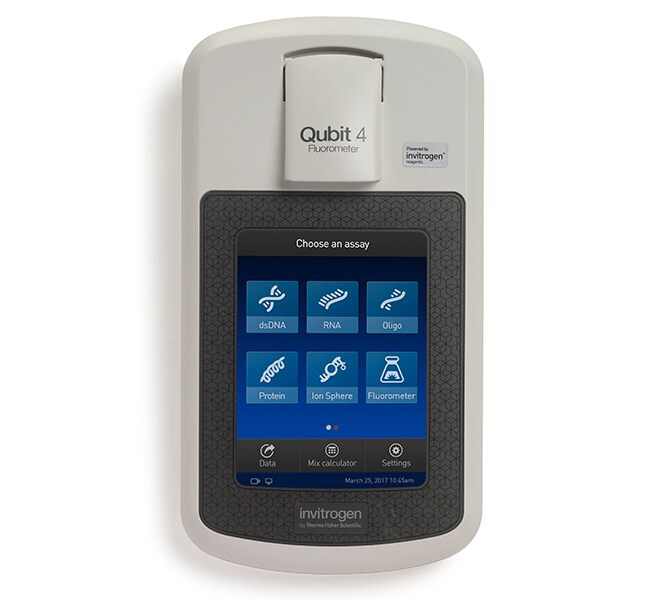
Qubit™ 4 Fluorometer
The Qubit 4 Fluorometer is the latest version of the popular Qubit fluorometer designed to accurately measure DNA, RNA, and了解更多信息
| 货号 | 类型 |
|---|---|
| Q33226 | Fluorometer |
货号 Q33226
价格(CNY)
-
类型:
Fluorometer
The Qubit 4 Fluorometer is the latest version of the popular Qubit fluorometer designed to accurately measure DNA, RNA, and protein quantity, and now also RNA integrity and quality, using the highly sensitive Qubit assays. The Qubit 4 Fluorometer was re-engineered to run the Qubit RNA IQ (integrity & quality) assay. The Qubit 4 Fluorometer and RNA IQ Assay Kit work together to accurately distinguish intact from degraded RNA in just two easy steps.
For all Qubit assays, the concentration or quality of the target molecule in the sample is reported by a fluorescent dye that emits a signal only when bound to the target, which minimizes the effects of contaminants on the result. The easy-to-use touch-screen menus make it easy to select and run the assays you need, with results displayed in just a few seconds.
Key features of the Qubit 4 Fluorometer include:
• Fast and highly accurate quantitation of DNA, RNA, and protein in less than three seconds per sample
• Measures intact RNA in less than 5 seconds per sample
• High levels of accuracy using only 1–20 μL of sample, even with very dilute samples
• On-board Reagent Calculator quickly generates Qubit working solution preparation instructions
• Stores results from up to 1000 samples
• Large 5.7-inch, state-of-the-art color touch screen for easy workflow navigation
• Graphical display indicates when samples are in the extended range or out of range
• Small footprint saves space on your bench
• Exports data to a USB drive or directly to your computer via a USB cable
• Ability to personalize your Qubit fluorometer with the assays you run most, add new assays, or even create your own assays with the MyQubit software and web tool
• Language of your choice including English, French, Spanish, Italian, German, simplified Chinese, and Japanese
Learn more about the Qubit Fluorometer ›
The Qubit 4 Fluorometer can also be used to directly measure the fluorescence of samples using Fluorometer mode. Additionally, Ion Sphere Particle quality can be evaluated on the Qubit 4 Fluorometer using the Ion Sphere Quality Control Kit prior to performing a sequencing run on the Ion PGM sequencer.
Enables more accurate results than with UV absorbance at low concentrations
The Qubit 4 Fluorometer is far more sensitive than UV absorbance, which measures anything absorbing at 260 nm, including DNA, RNA, protein, free nucleotides, or excess salts. Moreover, UV spectrophotometry is often not sensitive enough to accurately measure low concentrations of DNA and RNA. With the Qubit fluorometer, your research is enhanced by more accurate measurements because the dyes in the Qubit assay kits fluoresce only when bound to the selected molecule (DNA, RNA or protein) in your sample. This allows you to avoid repeating work due to inaccurate measurements.
Fast, simple, and accurate measurement of RNA quality
The Qubit RNA IQ assay provides a fast, simple method to check whether an RNA sample has degraded. The assay utilizes two unique dyes: one that binds to large, intact RNA, and another that selectively binds to small, degraded RNA. Together they enable you to quickly assess the quality and integrity of an RNA sample. To use, simply add your samples to the RNA IQ working solution, then measure on the Qubit 4 Fluorometer.
Save samples and bench space
The thoughtfully designed Qubit 4 Fluorometer requires samples of only 1–20 μL. It is intended for use at room temperature and occupies only a small amount of bench space. The Qubit 4 Fluorometer features advanced optics and data analysis algorithms, and comes equipped with a USB thumb drive and cable for data transfer to Excel™ software and for software downloads, as well as a universal power supply, four plug adapters, and electromagnetic CE certification.
Single sample measurements are a breeze
This user-friendly fluorometer is combined with quick and simple assay procedures. Calculations and settings are automatically performed by the instrument. The Qubit assays for use with the Qubit 4 Fluorometer are all performed using the same general protocol, which uses a simple mix-and-read format with incubation times of only two minutes for the DNA and RNA assays. 500 L thin-walled PCR tubes (Cat. No. Q32856) are required.
For all Qubit assays, the concentration or quality of the target molecule in the sample is reported by a fluorescent dye that emits a signal only when bound to the target, which minimizes the effects of contaminants on the result. The easy-to-use touch-screen menus make it easy to select and run the assays you need, with results displayed in just a few seconds.
Key features of the Qubit 4 Fluorometer include:
• Fast and highly accurate quantitation of DNA, RNA, and protein in less than three seconds per sample
• Measures intact RNA in less than 5 seconds per sample
• High levels of accuracy using only 1–20 μL of sample, even with very dilute samples
• On-board Reagent Calculator quickly generates Qubit working solution preparation instructions
• Stores results from up to 1000 samples
• Large 5.7-inch, state-of-the-art color touch screen for easy workflow navigation
• Graphical display indicates when samples are in the extended range or out of range
• Small footprint saves space on your bench
• Exports data to a USB drive or directly to your computer via a USB cable
• Ability to personalize your Qubit fluorometer with the assays you run most, add new assays, or even create your own assays with the MyQubit software and web tool
• Language of your choice including English, French, Spanish, Italian, German, simplified Chinese, and Japanese
Learn more about the Qubit Fluorometer ›
The Qubit 4 Fluorometer can also be used to directly measure the fluorescence of samples using Fluorometer mode. Additionally, Ion Sphere Particle quality can be evaluated on the Qubit 4 Fluorometer using the Ion Sphere Quality Control Kit prior to performing a sequencing run on the Ion PGM sequencer.
Enables more accurate results than with UV absorbance at low concentrations
The Qubit 4 Fluorometer is far more sensitive than UV absorbance, which measures anything absorbing at 260 nm, including DNA, RNA, protein, free nucleotides, or excess salts. Moreover, UV spectrophotometry is often not sensitive enough to accurately measure low concentrations of DNA and RNA. With the Qubit fluorometer, your research is enhanced by more accurate measurements because the dyes in the Qubit assay kits fluoresce only when bound to the selected molecule (DNA, RNA or protein) in your sample. This allows you to avoid repeating work due to inaccurate measurements.
Fast, simple, and accurate measurement of RNA quality
The Qubit RNA IQ assay provides a fast, simple method to check whether an RNA sample has degraded. The assay utilizes two unique dyes: one that binds to large, intact RNA, and another that selectively binds to small, degraded RNA. Together they enable you to quickly assess the quality and integrity of an RNA sample. To use, simply add your samples to the RNA IQ working solution, then measure on the Qubit 4 Fluorometer.
Save samples and bench space
The thoughtfully designed Qubit 4 Fluorometer requires samples of only 1–20 μL. It is intended for use at room temperature and occupies only a small amount of bench space. The Qubit 4 Fluorometer features advanced optics and data analysis algorithms, and comes equipped with a USB thumb drive and cable for data transfer to Excel™ software and for software downloads, as well as a universal power supply, four plug adapters, and electromagnetic CE certification.
Single sample measurements are a breeze
This user-friendly fluorometer is combined with quick and simple assay procedures. Calculations and settings are automatically performed by the instrument. The Qubit assays for use with the Qubit 4 Fluorometer are all performed using the same general protocol, which uses a simple mix-and-read format with incubation times of only two minutes for the DNA and RNA assays. 500 L thin-walled PCR tubes (Cat. No. Q32856) are required.
For Research Use Only. Not for use in diagnostic procedures.
规格
尺寸(长 x 宽 x 高)10 x 5.4 x 2.2 in. (25 x 13.6 x 5.5 cm)
动态范围5 orders of magnitude
适用于(应用)DNA Quantification, RNA Quantification, Protein Quantification
存储4 GB USB flash drive
光学Emission filters: green (510-580 nm), red (665-720 nm), Excitation filters: blue (430-495 nm), red (600-645 nm), LED light sources: blue (max ∼470 nm), red (max ∼635 nm), Photodiode detectors: 300-1,000 nm range
处理时间Seconds per sample
运输条件Room Temperature
热机时间<35 sec.
重量(公制)743 g
激发波长470 nm (Blue LED), 635 nm (Red LED)
产品线Qubit
类型Fluorometer
Unit Size1 fluorometer
常见问题解答 (FAQ)
为什么我的NanoDrop分光光度计或A260/A280值比Qubit荧光计显示的浓度高?
我的Qubit荧光计遇到了固件相关问题。我应当如何做?
我的Qubit荧光计屏幕冻结,或者仪器不能打开。我应当如何做?
Qubit荧光计屏幕显示我的样本“超出范围”(数值过低)。我应当如何做?
Qubit荧光计屏幕显示我的样本“超出范围”(数值过高)。我应当如何做?
引用和文献 (17)
引用和文献
Abstract
Amelioration of hepatic steatosis is associated with modulation of gut microbiota and suppression of hepatic miR-34a in Gynostemma pentaphylla (Thunb.) Makino treated mice.
Journal:Nutr Metab (Lond)
PubMed ID:30555521
'Non-alcoholic fatty liver disease (NAFLD) is a chronic and progressive liver disease with an increased risk of morbidity and mortality. However, so far no specific pharmacotherapy has been approved. Gynostemma pentaphylla (Thunb.) Makino (GP) is a traditional Chinese medicine that is widely used against hyperlipemia as well as hyperglycemia. This study
Genome Analysis of Hypomyces perniciosus, the Causal Agent of Wet Bubble Disease of Button Mushroom (Agaricus bisporus).
Journal:Genes (Basel)
PubMed ID:31146507
'The mycoparasitic fungus Hypomyces perniciosus causes wet bubble disease of mushrooms, particularly Agaricus bisporus. The genome of a highly virulent strain of H. perniciosus HP10 was sequenced and compared to three other fungi from the order Hypocreales that cause disease on A. bisporus. H. perniciosus genome is ~44 Mb, encodes
Genome Sequencing of Cladobotryum protrusum Provides Insights into the Evolution and Pathogenic Mechanisms of the Cobweb Disease Pathogen on Cultivated Mushroom.
Journal:Genes (Basel)
PubMed ID:30744046
'Cladobotryum protrusum is one of the mycoparasites that cause cobweb disease on cultivated edible mushrooms. However, the molecular mechanisms of evolution and pathogenesis of C. protrusum on mushrooms are largely unknown. Here, we report a high-quality genome sequence of C. protrusum using the single-molecule, real-time sequencing platform of PacBio and
Anti-Inflammatory Effects of 5a,8a-Epidioxycholest-6-en-3ß-ol, a Steroidal Endoperoxide Isolated from Aplysia depilans, Based on Bioguided Fractionation and NMR Analysis.
Journal:Mar Drugs
PubMed ID:31163615
'Sea hares of Aplysia genus are recognized as a source of a diverse range of metabolites. 5a,8a-Endoperoxides belong to a group of oxidized sterols commonly found in marine organisms and display several bioactivities, including antimicrobial, anti-tumor, and immunomodulatory properties. Herein we report the isolation of 5a,8a-epidioxycholest-6-en-3ß-ol (EnP(5,8)) from Aplysia depilans
TF-ChIP Method for Tissue-Specific Gene Targets.
Journal:Front Cell Neurosci
PubMed ID:30941015
'Chromatin immunoprecipitation (ChIP) is an assay developed in order to define the dynamic nature of transcription processes. This method has been widely employed to identify methylated and acetylated DNA sequences in a variety of organs both in animals and humans. Nevertheless, this technique is significantly less employed to study transcriptional