Search


引用和文献 (26)
Invitrogen™
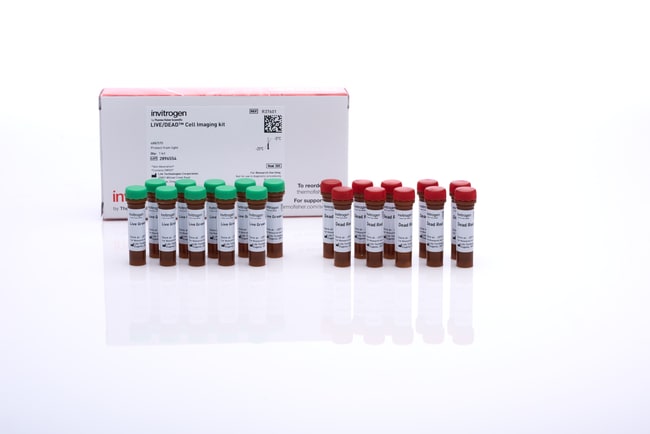
LIVE/DEAD™ 细胞成像试剂盒 (488/570)
LIVE/DEAD® 细胞成像试剂盒是一种针对 FITC 和 Texas Red™ 滤光片优化的灵敏的双色荧光细胞活力检测方法。该试剂盒快速易用,能够利用检测公认参数(细胞毒性和细胞活力 —了解更多信息
| 货号 | 数量 |
|---|---|
| R37601 | 1 mL |
货号 R37601
价格(CNY)
2,410.00
飞享价
Ends: 31-Dec-2026
3,347.00共减 937.00 (28%)
Each
数量:
1 mL
价格(CNY)
2,410.00
飞享价
Ends: 31-Dec-2026
3,347.00共减 937.00 (28%)
Each
LIVE/DEAD® 细胞成像试剂盒是一种针对 FITC 和 Texas Red™ 滤光片优化的灵敏的双色荧光细胞活力检测方法。该试剂盒快速易用,能够利用检测公认参数(细胞毒性和细胞活力 — 细胞内酯酶活性和细胞膜完整性)的两种探针鉴别活细胞和死亡细胞。
含有可指示活细胞的钙黄绿素 AM 可渗透细胞染料以及可指示死亡细胞的 BOBO-3 碘化物。
查看其他即用型探针成像试剂及附件 ›
LIVE/DEAD® 细胞成像试剂盒 *488/570* 可提供:
快速、简便地测定活细胞和死亡细胞
• 便捷、精确
• 适用于 FITC 和 Texas Red 滤光片的理想、灵敏的探针
适用于多种平台的双探针检测
如同我们广受欢迎的 LIVE/DEAD® 细胞活力/细胞毒性检测,新型 LIVE/DEAD® 细胞成像试剂盒基于适合活细胞染色的细胞透过性染料,以及适合死亡和即将死亡细胞(以细胞膜受损为特征)的非细胞透过性染料。为使这一重要的检测方法适用于各种成像平台,LIVE/DEAD® 细胞成像试剂盒组分针对配合 FITC 和 Texas Red 使用的常见绿色和红色成像滤光片进行了优化。活细胞组分会在活细胞中产生强烈且均匀的绿色荧光(激发/发射波长为 488 nm/515 nm)。死细胞组分主要在细胞膜受损的细胞中产生核红色荧光(激发/发射波长为 570 nm/602 nm),作为细胞死亡和细胞毒性的强烈指示(图1)。
快速、精确地测定细胞活力和细胞毒性
LIVE/DEAD® 细胞成像试剂盒可较灵敏地检测细胞健康的关键指标:细胞活力、活细胞/死亡细胞比和细胞毒性。LIVE/DEAD® 细胞成像试剂盒组分配置易于使用、只需较低稀释度。
检测原理
利用 LIVE/DEAD® 细胞成像试剂盒,可通过在活细胞内保存完好的几乎不发荧光的细胞透过性钙黄绿素 AM 和高强度荧光钙黄绿素的酶催化转化,确定细胞内普遍存在的酯酶活性,从而区分活细胞。LIVE/DEAD® 细胞成像试剂盒中的红色组分是细胞不透过性的,因此只能进入具有受损细胞膜的细胞。在即将死亡的和死亡细胞中与 DNA 结合后,会产生明亮的红色荧光。该检测技术本身的背景荧光水平较低,因为染料在与细胞相互作用前几乎不发荧光。基于其中荧光基团的亮度、光谱特性(FITC 和 Texas Red 滤光片)和易用性而选择 LIVE/DEAD® 细胞成像试剂盒。由于其针对工作流程便利性的包装,可轻松快速地测定细胞群中的活细胞和死亡细胞组分。
查看其他 Molecular Probes 成像工具和试剂
含有可指示活细胞的钙黄绿素 AM 可渗透细胞染料以及可指示死亡细胞的 BOBO-3 碘化物。
查看其他即用型探针成像试剂及附件 ›
LIVE/DEAD® 细胞成像试剂盒 *488/570* 可提供:
快速、简便地测定活细胞和死亡细胞
• 便捷、精确
• 适用于 FITC 和 Texas Red 滤光片的理想、灵敏的探针
适用于多种平台的双探针检测
如同我们广受欢迎的 LIVE/DEAD® 细胞活力/细胞毒性检测,新型 LIVE/DEAD® 细胞成像试剂盒基于适合活细胞染色的细胞透过性染料,以及适合死亡和即将死亡细胞(以细胞膜受损为特征)的非细胞透过性染料。为使这一重要的检测方法适用于各种成像平台,LIVE/DEAD® 细胞成像试剂盒组分针对配合 FITC 和 Texas Red 使用的常见绿色和红色成像滤光片进行了优化。活细胞组分会在活细胞中产生强烈且均匀的绿色荧光(激发/发射波长为 488 nm/515 nm)。死细胞组分主要在细胞膜受损的细胞中产生核红色荧光(激发/发射波长为 570 nm/602 nm),作为细胞死亡和细胞毒性的强烈指示(图1)。
快速、精确地测定细胞活力和细胞毒性
LIVE/DEAD® 细胞成像试剂盒可较灵敏地检测细胞健康的关键指标:细胞活力、活细胞/死亡细胞比和细胞毒性。LIVE/DEAD® 细胞成像试剂盒组分配置易于使用、只需较低稀释度。
检测原理
利用 LIVE/DEAD® 细胞成像试剂盒,可通过在活细胞内保存完好的几乎不发荧光的细胞透过性钙黄绿素 AM 和高强度荧光钙黄绿素的酶催化转化,确定细胞内普遍存在的酯酶活性,从而区分活细胞。LIVE/DEAD® 细胞成像试剂盒中的红色组分是细胞不透过性的,因此只能进入具有受损细胞膜的细胞。在即将死亡的和死亡细胞中与 DNA 结合后,会产生明亮的红色荧光。该检测技术本身的背景荧光水平较低,因为染料在与细胞相互作用前几乎不发荧光。基于其中荧光基团的亮度、光谱特性(FITC 和 Texas Red 滤光片)和易用性而选择 LIVE/DEAD® 细胞成像试剂盒。由于其针对工作流程便利性的包装,可轻松快速地测定细胞群中的活细胞和死亡细胞组分。
查看其他 Molecular Probes 成像工具和试剂
规格
细胞类型哺乳动物细胞
描述LIVE/DEAD™ 细胞成像试剂盒 (488/570)
检测方法荧光
染料类型其他标记或染料
形式冰冻
产品规格管
孵育时间15 min
数量1 mL
运输条件干冰
颜色红色,绿色
发射波长范围515、602 nm
Excitation Wavelength Range488、570 nm
适用于(应用)活力测定试剂盒
适用于(设备)Floid™ 细胞成像系统, 荧光显微镜
产品线LIVE/DEAD、Molecular Probes
产品类型细胞成像试剂盒
Unit SizeEach
内容与储存
• 组分 A:10 x 1 mL 小瓶
• 组分 B:1 x 10 小瓶(干燥)
在 -20°C 下储存
• 组分 B:1 x 10 小瓶(干燥)
在 -20°C 下储存
常见问题解答 (FAQ)
我如何为LIVE/DEAD细胞活力实验准备死细胞对照?
我希望我的细胞活力实验持续好几天。我能使用你们的LIVE/DEAD成像试剂盒做这个实验么?
I need to use a dead cell control for my viability assay. Do you have a protocol for killing cells for this?
Can I use the LIVE/DEAD Cell Imaging Kit (488/570) (Cat. No. R37601) with fixed cells?
What is the composition of the Live Green (Component A) of the LIVE/DEAD Cell Imaging Kit (488/570) (Cat. No. R37601)?
引用和文献 (26)
引用和文献
Abstract
A novel microfluidic platform for high-resolution imaging of a three-dimensional cell culture under a controlled hypoxic environment.
Journal:Lab Chip
PubMed ID:23023115
'Low oxygen tensions experienced in various pathological and physiological conditions are a major stimulus for angiogenesis. Hypoxic conditions play a critical role in regulating cellular behaviour including migration, proliferation and differentiation. This study introduces the use of a microfluidic device that allows for the control of oxygen tension for the
Saikosaponin-d Enhances the Anticancer Potency of TNF-a via Overcoming Its Undesirable Response of Activating NF-Kappa B Signalling in Cancer Cells.
Journal:Evid Based Complement Alternat Med
PubMed ID:23573150
'Tumor necrosis factor-alpha (TNF- a ) was reported as anticancer therapy due to its cytotoxic effect against an array of tumor cells. However, its undesirable responses of TNF- a on activating NF- ? B signaling and pro-metastatic property limit its clinical application in treating cancers. Therefore, sensitizing agents capable of
Aryl hydrocarbon receptor protects against bacterial infection by promoting macrophage survival and reactive oxygen species production.
Journal:
PubMed ID:24343818
'Aryl hydrocarbon receptor (AhR) is crucial for various immune responses. The relationship between AhR and infection with the intracellular bacteria Listeria monocytogenes (LM) is poorly understood. Here, we show that in response to LM infection, AhR is required for bacterial clearance by promoting macrophage survival and reactive oxygen species (ROS)
Circulating fibrocytes stabilize blood vessels during angiogenesis in a paracrine manner.
Journal:
PubMed ID:24300950
'Accumulating evidence supports that circulating fibrocytes play important roles in angiogenesis. However, the specific role of fibrocytes in angiogenesis and the underlying mechanisms remain unclear. In this study, we found that fibrocytes stabilized newly formed blood vessels in a mouse wound-healing model by inhibiting angiogenesis during the proliferative phase and
Characterizing natural hydrogel for reconstruction of three-dimensional lymphoid stromal network to model T-cell interactions.
Journal:
PubMed ID:25649205
'Hydrogels have been used in regenerative medicine because they provide a three-dimensional environment similar to soft tissues, allow diffusion of nutrients, present critical biological signals, and degrade via endogenous enzymatic mechanisms. Herein, we developed in vitro system mimicking cell-cell and cell-matrix interactions in secondary lymphoid organs (SLOs). Existing in vitro