Search
Invitrogen
CTGF Recombinant Protein
{{$productOrderCtrl.translations['antibody.pdp.commerceCard.promotion.promotions']}}
{{$productOrderCtrl.translations['antibody.pdp.commerceCard.promotion.promocode']}}: {{promo.promoCode}} {{promo.promoTitle}} {{promo.promoDescription}}. {{$productOrderCtrl.translations['antibody.pdp.commerceCard.promotion.learnmore']}}
{{$ctrl.translations['antibody.pdp.skuNotes.additionalInformation']}}:

产品信息
RP-8618
产品规格
Expression System
E. coli
分类
Recombinant
类型
Protein
偶联物
Unconjugated
Unconjugated
Unconjugated
形式
Lyophilized
浓度
0.1 mg/mL once reconstituted
Amount
20 µg
保存条件
-20°C, Avoid Freeze/Thaw Cycles
运输条件
Wet ice
产品详细信息
Recombinant human CTGF is a non-glycosylated protein, containing 98 amino acids, with a molecular weight of 11.2 kDa. Purity is typically greater than 98% and endotoxin level less than 1 EU/ug.
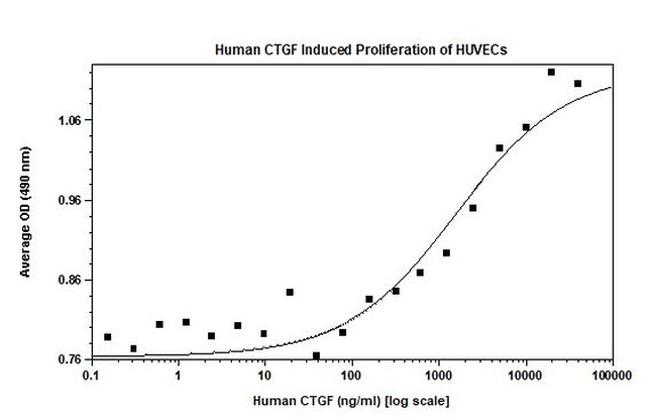
The expected biological activity (ED50) is determined by the dose-dependent stimulation of HUVEC proliferation and is typically 1-2 µg/mL. The specific activity of this protein is 6.7x10^2 units/mg.
Reconstitute using sterile 5mM sodium acetate, pH 6.0 at 0.1 mg/mL and centrifuge prior to opening vial. Gently pipet solution down the sides of the vial. DO NOT VORTEX sample. Store reconstituted material at -20°C and add 0.1% BSA for additional stability.
Amino acid sequence: MGKKCIRTPK ISKPIKFELS GCTSMKTYRA KFCGVCTDGR CCTPHRTTTL PVEFKCPDGE VMKKNMMFIK TCACHYNCPG DNDIFESLYY RKMYGDMA.
靶标信息
Connective Tissue Growth Factor (CTGF), also called CCN2, is a member of the CCN family. CTGF is a secreted protein produced by umbilical veins and vascular endothelial cells. CTGF possesses an Insulin-like Growth Factor (IGF)-binding domain, a thrombospondin type 1 domain, and a cysteine knot region. CTGF plays important roles in the proliferation and differentiation of chondrocytes, induces angiogenesis, and promotes cell adhesion in fibroblasts, endothelial, and epithelial cells.
仅用于科研。不用于诊断过程。未经明确授权不得转售。
篇参考文献 (0)
您是否在文献中引用过该产品?请点击下方按钮邮件告知我们。
Disclaimer

Clicking the images or links will redirect you to a website hosted by BenchSci that provides third-party scientific content. Neither the content nor the BenchSci technology and processes for selection have been evaluated by us; we are providing them as-is and without warranty of any kind, including for use or application of the Thermo Fisher Scientific products presented.
