这些染料如何与DNA结合?
SYTO核酸染料的结合方式尚不清楚。但是,SYTO以及相关的核酸染料具有以下结合特性:
1.它们与一些溶剂结合(通过对盐、二价阳离子的敏感性,特别是SDS),因此,它们可能结合到DNA沟槽处。
2.所有SYTO染料都表现出一些碱基选择性,因此,它们可能结合到DNA小沟处。
3.通过乙醇沉淀可从核酸中去除SYTO染料;溴化乙锭和其他嵌入剂不具有此特性。同样,丁醇和氯仿提取不能从核酸中去除SYTO染料,但能够去除溴化乙锭。
4.SYTO 结合不受非离子去垢剂的影响。
5.SYTO染料不会被BrdU淬灭,因此,SYTO染料与核酸的结合方式不同于Hoechst 33342和DAPI(4',6-二脒基-2-苯基吲哚)。
SYBR Green I对移码指示菌几乎没有致突变性,证明其不大可能是强嵌入剂。
我的细胞周期数据显示单一峰而非正确的细胞周期曲线,该如何解决这个问题?
许多因素影响着细胞周期曲线的质量。细胞数、染料浓度、孵育温度、孵育时间、流速(在利用流体动力学聚焦的传统流式细胞仪上处理时)、获得细胞的总数、死细胞排除以及从数据分析中除去聚集体等,都需要在分析细胞周期时考虑到。
How do SYTO dyes bind to DNA?
The binding mode of SYTO nucleic acid stains is unknown. However, the behavior of these and related nucleic acid dyes suggests the following binding properties:
1.They appear to contact the solvent (suggested by sensitivity to salt, divalent cations, and in particular, SDS) and thus are likely to have contacts in the grooves.
2.All SYTO dyes appear to show some base selectivity and are thus likely to have minor groove contacts.
3.They can be removed from nucleic acid via ethanol precipitation; this characteristic is not shared by ethidium bromide and other intercalators. Likewise, the dyes are not removed from nucleic acid via butanol or chloroform extraction. These extraction methods do remove ethidium bromide from nucleic acid.
4. SYTO binding is not affected by nonionic detergents.
5. SYTO dyes are not quenched by BrdU, so they do not bind nucleic acids in precisely the same way as Hoechst 33342 and DAPI ((4′,6-diamidino-2-phenylindole).
SYBR Green I has shown little mutagenicity on frameshift indicator strains, indicating that it isn't likely to strongly intercalate.
Find additional tips, troubleshooting help, and resources within our Cell Analysis Support Center.
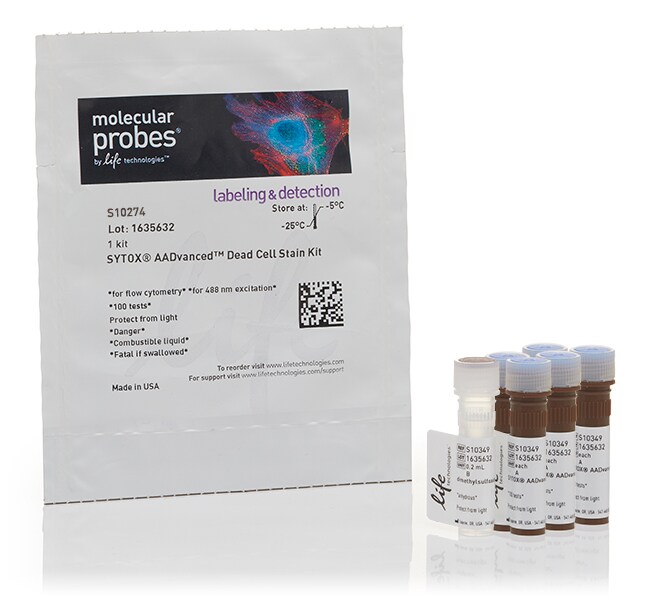
I am using SYTOX AAdvanced as a dead cell stain, but all of my cells are labeling even though I am certain that they are supposed to be alive. These are adherent cells that I have trypsinized. Why am I getting false-dead signals?
SYTOX AAdvanced labels only dead cells because it is a cell impermeant dye. The dye can only enter cells that have a compromised plasma membrane. Trypsinization may cause temporary disruption of the plasma membrane, sufficient to allow staining with a cell impermeant dye. You can reduce the “false-dead” problem by either reducing the amount of trypsin and/or reduce the incubation time for trypsinization or use a gentler dissociation reagent such as TrypLE Express, TrypLESelect reagents, or Versene. After trypsinization, wash well, and if possible, allow a recovery time in normal culture media before staining with any of the SYTOX dyes.
Find additional tips, troubleshooting help, and resources within our Cell Analysis Support Center.
My cell cycle data show a single peak, not a proper cell cycle profile. How can I fix this?
There are several factors that contribute to the quality of the cell cycle profile. Cell number, dye concentration, incubation temperature, incubation time, flow rate (on a traditional flow cytometer utilizing hydrodynamic focusing), total number of cells acquired, elimination of dead cells, and removal of aggregates from data analysis should all be considered when analyzing the cell cycle.
Find additional tips, troubleshooting help, and resources within our Cell Analysis Support Center.