Search


引用和文献 (1)
Invitrogen™
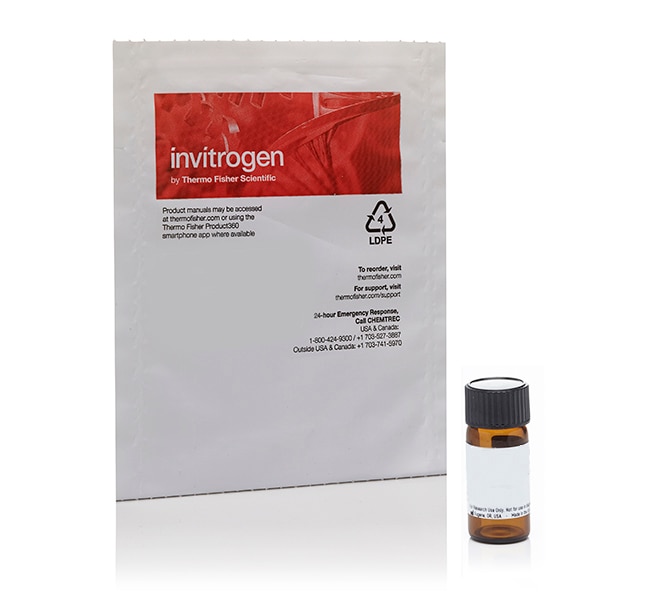
金黄色葡萄球菌 BioParticles™ 调理试剂
金黄色葡萄球菌(Wood 菌株,不含蛋白 A)BioParticles™ 调理剂源自高度纯化的兔多克隆 IgG 抗体,专门用于增强对金黄色葡萄球菌 BioParticles™ 偶联物的摄取了解更多信息
| 货号 | 数量 |
|---|---|
| S2860 又称 S-2860 | 1 unit |
货号 S2860
又称 S-2860
价格(CNY)
3,988.00
Each
数量:
1 unit
价格(CNY)
3,988.00
Each
金黄色葡萄球菌(Wood 菌株,不含蛋白 A)BioParticles™ 调理剂源自高度纯化的兔多克隆 IgG 抗体,专门用于增强对金黄色葡萄球菌 BioParticles™ 偶联物的摄取。
仅供科研使用。不可用于诊断程序。
规格
适用于(设备)Fluorescence Microscope
IUPAC 名称2,2',3,3',5,5',6,6'-八氟-1,1'-联苯
InChI 键QWCHHUZAAGRHDB-UHFFFAOYSA-N
MDL 编号MFCD00000312
分子式C12H2F8
产品线BioParticles
数量1 unit
建议的储存条件在冰箱(-5 至 -30°C)中储存。
SMILESFC1=CC(F)=C(F)C(=C1F)C1=C(F)C(F)=CC(F)=C1F
运输条件Room Temperature
分子量 (g/mol)298.14
Unit SizeEach
常见问题解答 (FAQ)
Are the Invitrogen BioParticles products sterile?
What is the type of bond that attaches the dyes to the BioParticles probes?
引用和文献 (1)
引用和文献
Abstract
Multipotent stem cells from trabecular meshwork become phagocytic TM cells.
Journal:Invest Ophthalmol Vis Sci
PubMed ID:22297497
'To isolate and characterize stem cells from human trabecular meshwork (TM) and to investigate the potential of these stem cells to differentiate into TM cells. Human trabecular meshwork stem cells (TMSCs) were isolated as side population cells by fluorescence-activated cell sorting or isolated by clonal cultures. Passaged TMSCs were compared