Search

Invitrogen™
SYTO™ RNASelect™ Red
SYTO™ RNASelect™ Red is a cell-permeant, RNA-selective fluorescent dye for live or fixed eukaryotic cells. It allows researchers to visualize RNA-rich nucleoli and cytoplasmic RNA in a Texas Red/RFP compatible channel.
Have Questions?
更改视图

| 货号 | 数量 |
|---|---|
| S32711 | 3 x 300 μL |
| S32710 | 300 μL |
货号 S32711
价格(CNY)
3,975.00
飞享价
Ends: 31-Dec-2026
5,445.00共减 1,470.00 (27%)
Each
数量:
3 x 300 μL
价格(CNY)
3,975.00
飞享价
Ends: 31-Dec-2026
5,445.00共减 1,470.00 (27%)
Each
SYTO™ RNASelect™ Red is a cell-permeant, RNA-selective fluorescent dye for live or fixed eukaryotic cells. It allows researchers to visualize RNA-rich nucleoli and cytoplasmic RNA in a Texas Red/RFP compatible channel. Compared to SYTO™ RNASelect™ Green, it is compatible with 4% paraformaldehyde fixation rather than methanol fixation, and leaves GFP/FITC channels open for antibodies, fluorescent proteins, and other fluorescent probes in multiplex and high-content imaging.
This molecular probe is prepared as a ready-to-use 100x aqueous solution, appropriate for direct addition to either complete media or other buffers of your choice to then be used in staining cells.
Compatibility with 4% paraformaldehyde fixation and permeabilization expands the applicability of this RNA dye for immunofluorescence workflows, enabling its use in high content screening for nucleolar reorganization, cell stress assays, and deep learning computational models.
The staining patterns demonstrate high RNA specificity, with expected staining demonstrating bright nucleoli and diffuse ribosomal staining throughout the cytoplasm and is easily multiplexable with classic nuclear stains such as Hoechst 33342 or DAPI. This specificity is demonstrated by the sharp decrease in staining intensity upon treatment with RNase, all red signal is quickly depleted while the nuclear DNA dye staining remains intact.
Features
- Suitable for both live and fixed cell workflows, connecting live cell observation with endpoint imaging.
- Compatible with multiplex imaging outside of the Texas Red/RFP channels with various organelle markers such as Hoechst/DAPI, phalloidin, ER, lectins, or mitochondrial probes.
- Applicable to high-content imaging and RNA based nucleolar morphology studies, including workflows where nucleolar signal is used for segmentation or comparative phenotyping.
For researchers familiar with SYTO™ 14, SYTO™ RNASelect™ Red offers a red channel option for RNA associated morphology in Cell Painting related or other multiplex imaging workflows.
This dye complements SYTO™ RNASelect™ Green in channel planning and fixation choice: SYTO™ RNASelect™ Green remains the better fit when the green channel is desired and the sample type requires methanol fixation, whereas SYTO™ RNASelect™ Red is appropriate when a red RNA channel or 4% PFA workflow is preferred.
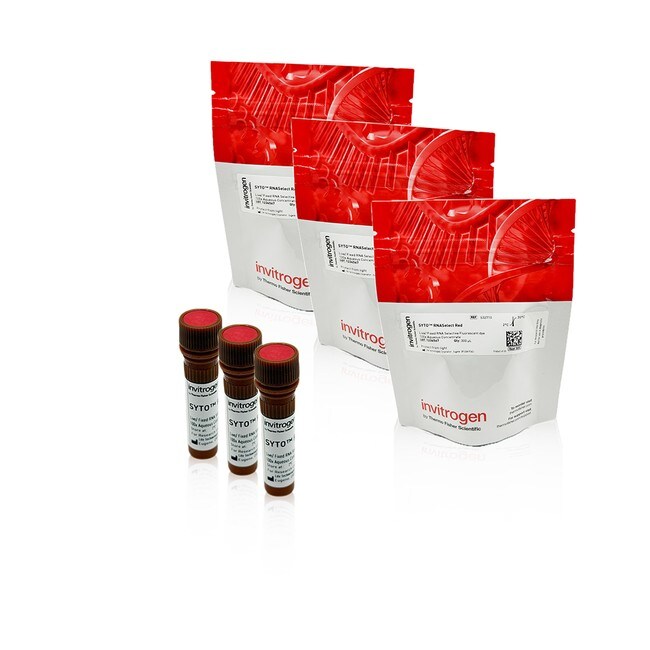
Available as a single vial as S32710 and in a 3-pack format as S32711.
For Research Use Only.
规格
细胞渗透性Live and Fixed Cell Permeable
颜色Red
最大浓度1 mM in 25% DMSO/DI H2O
检测方法Fluorescence with Texas Red Filter Set
染料类型Fluorogenic Organic Dye
发射626 nm
激发波长范围595 nm
适用于(应用)Live Cell Imaging, Fixed Cell Imaging, High Content Screening, Fluorescence Microscopy
适用于(设备)Fluorescence Microscope, Spectral Imaging Instrument, Flow Cytometer, High Content Imager
形式Aqueous Liquid with 25% DMSO
产品规格Vial
测试数量900 Tests
产品线SYTO RNASelect
数量3 x 300 μL
反应性RNA, Nucleolar Structure
试剂类型Fluorogenic RNA Label
靶标RNA
技术High Content Imaging, Fluorescence Microscopy
经证实的应用Live Cell Imaging, Fixed Cell Imaging, High Content Imaging
容积(公制)900 μL
标签类型Fluorescent Dye
产品类型RNA-specific Label
亚细胞定位Nucleolus
Unit SizeEach
内容与储存
•3 Vials
•Store at 2°C to 30°C
•Protect from light
•Do not freeze
•Store at 2°C to 30°C
•Protect from light
•Do not freeze