Search


引用和文献 (33)
Invitrogen™
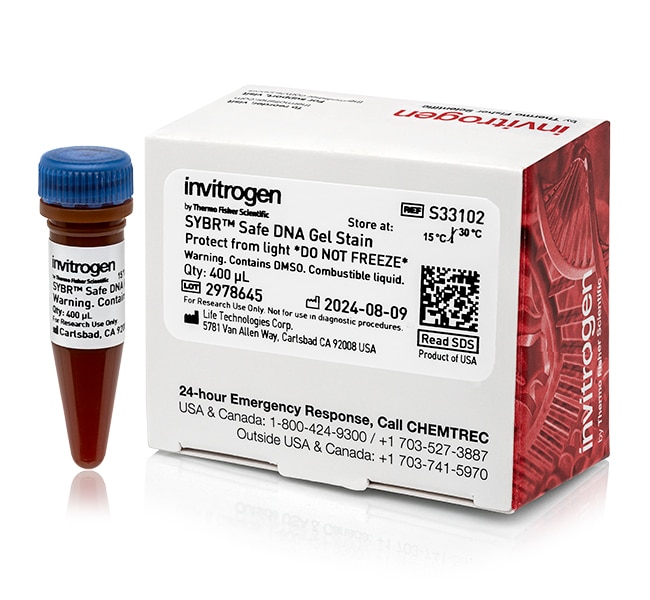
SYBR™ Safe DNA 凝胶染料
SYBR™ Safe DNA 凝胶染料是一种高灵敏度染料,适用于琼脂糖或丙烯酰胺凝胶上的 DNA 染色。SYBR™ Safe 染料使用独特配方,是 EB了解更多信息
| 货号 | 数量 |
|---|---|
| S33102 | 400 μL |
货号 S33102
价格(CNY)
673.00
飞享价
Ends: 26-Sep-2026
1,403.00共减 730.00 (52%)
Each
数量:
400 μL
价格(CNY)
673.00
飞享价
Ends: 26-Sep-2026
1,403.00共减 730.00 (52%)
Each
SYBR™ Safe DNA 凝胶染料是一种高灵敏度染料,适用于琼脂糖或丙烯酰胺凝胶上的 DNA 染色。SYBR™ Safe 染料使用独特配方,是 EB 的安全替代物,可使用蓝光或紫外光进行激发。
•降低暴露在高致突变性溴化乙锭和有害紫外光下的机会
• 通过减少非特异性背景荧光增强灵敏度
• 能在所有使用溴化乙锭的染色应用中使用,包括 RNA 染色
更出色的 DNA 染料
SYBR™ Safe DNA 凝胶染料是一种更出色且符合所有分子生物学要求的核酸染色剂。不仅因为 SYBR™ Safe DNA 凝胶染料对人和环境无害,’而且因为其对样品和研究机构有利。具体原因请参见 SYBR™ Safe DNA 凝胶染料是您更佳的选择。
比溴化乙锭更安全
SYBR™ Safe DNA 凝胶染料经过专门配制且已经过一系列的毒性试验评估,结果表明用其进行工作比使用溴化乙锭导致突变的几率更低,也更为安全。一个独立实验室证明,在 Ames 试验中,SYBR™ Safe 染料与溴化乙锭相比致突变性有所减少(见图)。可通过用可见蓝光照明 SYBR™ Safe 染料而非紫外光照明的方式进一步减少暴露的危险。这对在进行切除凝胶中的条带等暴露密集型试验非常有价值。
卓越的灵敏度
SYBR™ Safe 染料具有卓越的核酸可视化灵敏度,不管是紫外光激发还是蓝光激发,都有文献应用证明其灵敏度。与核酸结合后,绿色荧光 SYBR™ Safe 染料的最大荧光激发波长为 ∼280 和 ∼502 nm,最大发射波长为 ∼530 nm(见图)。并且,在蓝光照射激发时,SYBR™ Safe 染料比紫外光照射的溴化乙锭–染色凝胶的背景荧光更少。
易于使用
SYBR™ Safe 染料以 DMSO 配制的 10,000X 浓缩液形式提供,可作为溴化乙锭溶液使用。SYBR™ Safe 染料可以混合成一种琼脂糖凝胶,用于在电泳过程中染色,或者电泳后在 SYBR™ Safe 染料溶液中培养。SYBR™ Safe 可在室温下,储于其原始包装中,以避免过度光暴露。为最终的便利起见,我们同样提供 SYBR™ Safe E-Gel 预制琼脂糖凝胶。
•降低暴露在高致突变性溴化乙锭和有害紫外光下的机会
• 通过减少非特异性背景荧光增强灵敏度
• 能在所有使用溴化乙锭的染色应用中使用,包括 RNA 染色
更出色的 DNA 染料
SYBR™ Safe DNA 凝胶染料是一种更出色且符合所有分子生物学要求的核酸染色剂。不仅因为 SYBR™ Safe DNA 凝胶染料对人和环境无害,’而且因为其对样品和研究机构有利。具体原因请参见 SYBR™ Safe DNA 凝胶染料是您更佳的选择。
比溴化乙锭更安全
SYBR™ Safe DNA 凝胶染料经过专门配制且已经过一系列的毒性试验评估,结果表明用其进行工作比使用溴化乙锭导致突变的几率更低,也更为安全。一个独立实验室证明,在 Ames 试验中,SYBR™ Safe 染料与溴化乙锭相比致突变性有所减少(见图)。可通过用可见蓝光照明 SYBR™ Safe 染料而非紫外光照明的方式进一步减少暴露的危险。这对在进行切除凝胶中的条带等暴露密集型试验非常有价值。
卓越的灵敏度
SYBR™ Safe 染料具有卓越的核酸可视化灵敏度,不管是紫外光激发还是蓝光激发,都有文献应用证明其灵敏度。与核酸结合后,绿色荧光 SYBR™ Safe 染料的最大荧光激发波长为 ∼280 和 ∼502 nm,最大发射波长为 ∼530 nm(见图)。并且,在蓝光照射激发时,SYBR™ Safe 染料比紫外光照射的溴化乙锭–染色凝胶的背景荧光更少。
易于使用
SYBR™ Safe 染料以 DMSO 配制的 10,000X 浓缩液形式提供,可作为溴化乙锭溶液使用。SYBR™ Safe 染料可以混合成一种琼脂糖凝胶,用于在电泳过程中染色,或者电泳后在 SYBR™ Safe 染料溶液中培养。SYBR™ Safe 可在室温下,储于其原始包装中,以避免过度光暴露。为最终的便利起见,我们同样提供 SYBR™ Safe E-Gel 预制琼脂糖凝胶。
仅供科研使用。不可用于诊断程序。
规格
检测定位凝胶内检测
检测方法荧光
数量400 μL
有效期每 6 个月
运输条件室温
靶标分子DNA
标签或染料SYBR Safe
产品类型DNA 凝胶染料
Unit SizeEach
内容与储存
• 以 DMSO 配制的 10,000X 浓缩液形式提供
在室温下储存在原装容器中。
在室温下储存在原装容器中。
常见问题解答 (FAQ)
使用SYBR Safe DNA凝胶染料染色,为什么我有时候会在凝胶内看到斑点?
SYBR染料的pH范围是多少?
电泳时,SYBR Safe染料朝哪个方向迁移?
乙醇沉淀法能否去除SYBR Safe染料?
能否将SYBR Safe DNA凝胶染料重复用于第二块凝胶?
引用和文献 (33)
引用和文献
Abstract
Features of medullary thymic epithelium implicate postnatal development in maintaining epithelial heterogeneity and tissue-restricted antigen expression.
Journal:J Immunol
PubMed ID:16670287
'Although putative thymic epithelial progenitor cells have been identified, the developmental potential of these cells, the extent of medullary thymic epithelium (mTEC) heterogeneity, and the mechanisms that mediate the expression of a wide range of peripheral tissue-restricted Ags (TRAs) by mTECs remain poorly defined. Here we have defined several basic
Diversity of human small intestinal Streptococcus and Veillonella populations.
Journal:FEMS Microbiol Ecol
PubMed ID:23614882
'Molecular and cultivation approaches were employed to study the phylogenetic richness and temporal dynamics of Streptococcus and Veillonella populations in the small intestine. Microbial profiling of human small intestinal samples collected from four ileostomy subjects at four time points displayed abundant populations of Streptococcus spp. most affiliated with S. salivarius, S. thermophilus,
Rediscovery of the Yesso scallop pathogen Perkinsus qugwadi in Canada, and development of PCR tests.
Journal:
PubMed ID:23670082
'Perkinsus qugwadi, a pathogenic protozoan parasite of Yesso scallops Patinopecten yessoensis, is found only in cultured populations in British Columbia, Canada. This pathogen was first identified in 1988 and caused significant mortalities at some locations during the early 1990s. Prevalence of infection decreased dramatically following 1995, and the disease was
Temporal role of Sertoli cell androgen receptor expression in spermatogenic development.
Journal:Mol Endocrinol
PubMed ID:23160479
'Sertoli cell (SC) androgen receptor (AR) activity is vital for spermatogenesis. We created a unique gain-of-function transgenic (Tg) mouse model to determine the temporal role of SCAR expression in testicular development. The SC-specific rat Abpa promoter directed human Tg AR [Tg SC-specific AR (TgSCAR)] expression, providing strong premature postnatal AR
P-glycoprotein in sheep liver and small intestine: gene expression and transport efflux activity.
Journal:J Vet Pharmacol Ther
PubMed ID:23409949
'The role of the transporter P-glycoprotein (P-gp) in the disposition kinetics of different drugs therapeutically used in veterinary medicine has been demonstrated. Considering the anatomo-physiological features of the ruminant species, the constitutive expression of P-gp (ABCB1) along the sheep gastrointestinal tract was studied. Additionally, the effect of repeated dexamethasone (DEX)