Search


引用和文献 (61)
Invitrogen™
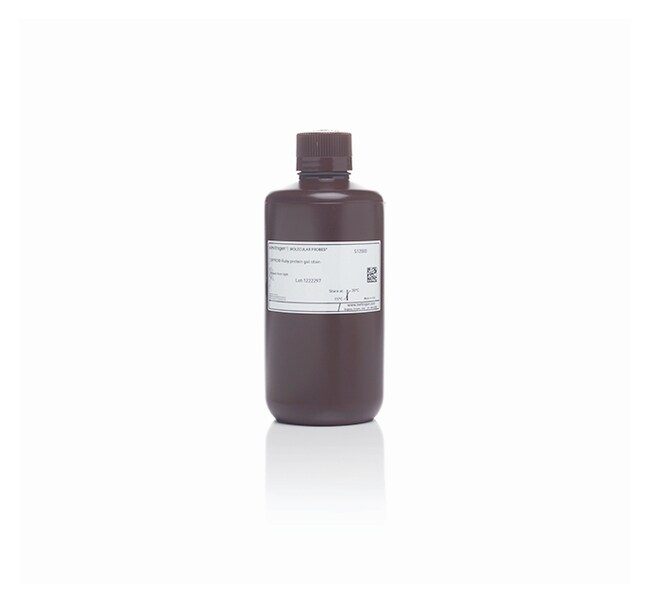
SYPRO™ Ruby 蛋白凝胶染色剂
SYPRO Ruby 蛋白凝胶染色剂是一种高度灵敏的即用型荧光染色剂,用于检测通过聚丙烯酰胺凝胶电泳 (PAGE) 分离的总蛋白。它非常适合在 1D 和 2D PAGE了解更多信息
Have Questions?
更改视图

| 货号 | 颜色 | 数量 |
|---|---|---|
| S6653 | Red | 500 μL |
| S6650 | Orange | 500 μL |
| S6651 | Orange | 10 x 50 μL |
| S12010 | Tangerine | 500 μL |
| S6654 又称 S-6654 | Red | 10 x 50 μL |
| S12001 | Ruby | 200 mL |
| S12000 | Ruby | 1 L |
| S21900 | Ruby | 5 L |
货号 S6653
价格(CNY)
4,773.00
Each
颜色:
Red
数量:
500 μL
价格(CNY)
4,773.00
Each
SYPRO Ruby 蛋白凝胶染色剂是一种高度灵敏的即用型荧光染色剂,用于检测通过聚丙烯酰胺凝胶电泳 (PAGE) 分离的总蛋白。它非常适合在 1D 和 2D PAGE 中使用。SYPRO Ruby 凝胶染色剂的灵敏度可媲美或超过一流银染技术。染色蛋白可使用含有适当过滤器或激光的标准紫外线或蓝光透射仪或者成像设备进行观察。
特点:
•简单的染色程序—无需脱色或定时步骤
•三个数量级以上的线性定量范围
• 与质谱分析和微测序兼容
比较所有荧光染色剂 ›
特点:
•简单的染色程序—无需脱色或定时步骤
•三个数量级以上的线性定量范围
• 与质谱分析和微测序兼容
比较所有荧光染色剂 ›
仅供研究使用。
规格
最大浓度5000X,溶于 DMSO 中
检测定位凝胶内检测
检测方法荧光
激发/发射300,550/630 nm
数量500 μL
运输条件室温
靶标分子蛋白质
颜色Red
标签或染料SYPRO Red
产品线SYPRO
产品类型蛋白凝胶染色
Unit SizeEach
内容与储存
室温避光储存。
常见问题解答 (FAQ)
如果我将SYPRO Orange或SYPRO Red染色液的终浓度增加至1X以上,会增强染色蛋白质的信号吗?
经SYPRO Ruby、SYPRO Orange或SYPRO Red染色的凝胶能否干燥?
我能否使用SYPRO Ruby、SYPRO Orange或SYPRO Red蛋白质凝胶染料对蛋白质进行预染,然后将蛋白质在凝胶上进行电泳?
If I increase the final concentration of my SYPRO Orange or SYPRO Red staining solution above 1X, can I increase the signal of my stained proteins?
Can I dry my SYPRO Ruby, SYPRO Orange, or SYPRO Red stained gels?
引用和文献 (61)
引用和文献
Abstract
Design and characterization of a compact dual channel virus counter.
Journal:Cytometry. Part A : the journal of the International Society for Analytical Cytology
PubMed ID:15830378
Adenosine to inosine editing by ADAR2 requires formation of a ternary complex on the GluR-B R/G site.
Journal:J Biol Chem
PubMed ID:12163487
'RNA editing by members of the ADAR (adenosine deaminase that acts on RNA) enzyme family involves hydrolytic deamination of adenosine to inosine within the context of a double-stranded pre-mRNA substrate. Editing of the human GluR-B transcript is catalyzed by the enzyme ADAR2 at the Q/R and R/G sites. We have
Defining the SNARE complex binding surface of alpha-SNAP: implications for SNARE complex disassembly.
Journal:J Biol Chem
PubMed ID:12730228
'N-Ethylmaleimide-sensitive factor (NSF) and its adaptor protein alpha-soluble NSF attachment protein (alpha-SNAP) sustain membrane trafficking by disassembling soluble NSF attachment protein receptor (SNARE) complexes that form during membrane fusion. To better understand the role of alpha-SNAP in this process, we used site-directed mutagenesis to identify residues in alpha-SNAP that interact
Involvement of DnaE, the second replicative DNA polymerase from Bacillus subtilis, in DNA mutagenesis.
Journal:J Biol Chem
PubMed ID:14593098
'In a large group of organisms including low G + C bacteria and eukaryotic cells, DNA synthesis at the replication fork strictly requires two distinct replicative DNA polymerases. These are designated pol C and DnaE in Bacillus subtilis. We recently proposed that DnaE might be preferentially involved in lagging strand
Dynamics of myo1c (myosin-ibeta ) lipid binding and dissociation.
Journal:J Biol Chem
PubMed ID:12221091
'Myosin-I is the single-headed member of the myosin superfamily that associates with lipid membranes. Biochemical experiments have shown that myosin-I membrane binding is the result of electrostatic interactions between the basic tail domain and acidic phospholipids. To better understand the dynamics of myosin-I membrane association, we measured the rates of