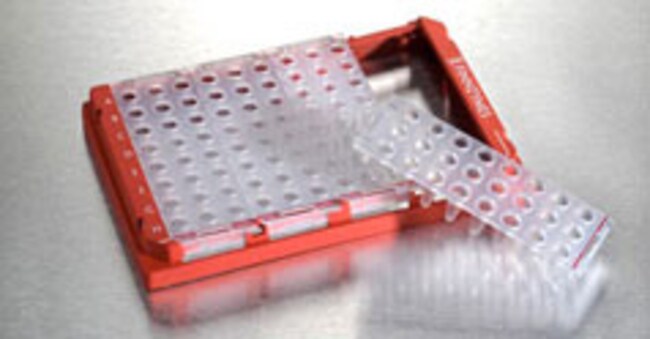
Are Thermo Scientific ABgene plastics endotoxin-free?
They are not certified endotoxin-free. However, their entire production process, from molding to final packaging, is carried out in a Class 100,000 clean room under ISO 9001 guidelines. All Thermo Scientific PCR plastics are certified free from RNase, DNase and human DNA.
Find additional tips, troubleshooting help, and resources within our Real-Time PCR and Digital PCR Instruments Support Center.
Are Thermo Scientific ABgene plastics sterile?
Thermo Scientific Abgene plastics are not typically sterilized as their entire production process, from molding to final packaging, is carried out in a Class 100,000 clean room under ISO 9001 guidelines. All Thermo Scientific PCR plastics are certified free from RNase, DNase and human DNA. In contrast, during typical non-clean room production, plastics are exposed to many contaminants including dust, bacterial cells, and DNA. The plastics are then sterilized to kill bacteria and inactivate RNases and DNases, but sterilization does not remove dust or DNA contamination. The dust particles left behind can inhibit PCR, and the damaged DNA fragments can still act as templates, leading to non-specific amplification.
Find additional tips, troubleshooting help, and resources within our Real-Time PCR and Digital PCR Instruments Support Center.
Will ultra thin wall (UTW) vessels automatically speed up reactions on my conventional thermal cycler?
To realize the time savings of the UTW plastics on conventional thermal cyclers, optimization of the protocol is required. This typically involves reducing hold times and changing the actual hold temperatures.
Find additional tips, troubleshooting help, and resources within our Real-Time PCR and Digital PCR Instruments Support Center.
Are ultra thin wall (UTW) vessels prone to break more often because of their thinner walls?
When used as instructed, these vessels are remarkably robust and can handle typical laboratory conditions, without fracturing or resulting in loss of volume. It is recommended that, when applying caps, a proper tray be used to protect the bottom of the tubes from excessive force that is typically used.
Find additional tips, troubleshooting help, and resources within our Real-Time PCR and Digital PCR Instruments Support Center.