Search


引用和文献 (319)
Invitrogen™
FM™ 4-64 染料(N-(3-三乙基铵丙基)-4-(6-(4-(二乙氨基)苯基)己三烯基)吡啶二溴化物)
已报告苯乙烯基染料 FM 4-64 能够选择性地用红色荧光(最大激发/发射波长 ∼515/640 nm)对酵母菌液泡膜进行染色。该亲脂性染料是一种重要工具,可用于观察液泡细胞器形态和动力学、研究胞吞途径以及筛选和表征酵母菌胞吞作用突变体了解更多信息
Have Questions?
更改视图

| 货号 | 数量 |
|---|---|
| T13320 | 10 x 100 μg |
| T3166 | 1mg |
货号 T13320
价格(CNY)
6,213.00
飞享价
Ends: 31-Dec-2026
8,629.00共减 2,416.00 (28%)
10 x 100 µg
数量:
10 x 100 μg
价格(CNY)
6,213.00
飞享价
Ends: 31-Dec-2026
8,629.00共减 2,416.00 (28%)
10 x 100 µg
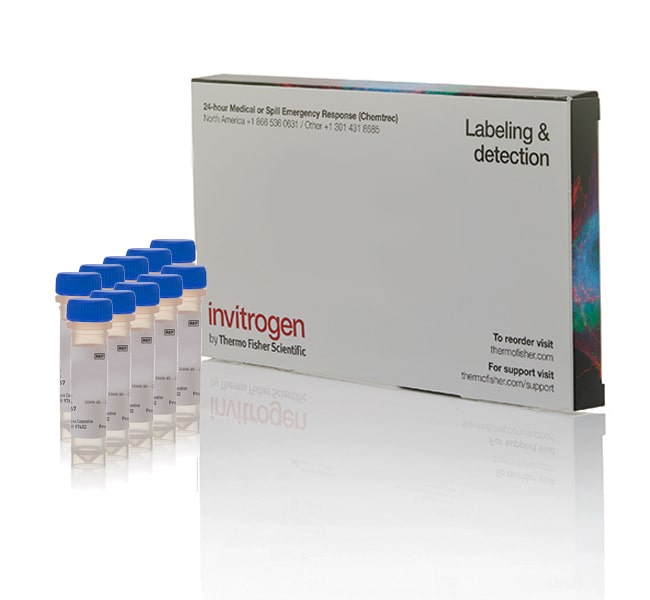
已报告苯乙烯基染料 FM 4-64 能够选择性地用红色荧光(最大激发/发射波长 ∼515/640 nm)对酵母菌液泡膜进行染色。该亲脂性染料是一种重要工具,可用于观察液泡细胞器形态和动力学、研究胞吞途径以及筛选和表征酵母菌胞吞作用突变体。FM 4-64 也可以特殊包装提供,10样品瓶,每样品瓶 100 µg (T-13320)。
仅供科研使用。不可用于诊断程序。
规格
颜色红色
检测方法荧光
适用于(设备)荧光显微镜
产品线FM
数量10 x 100 μg
运输条件室温
标签类型Fluorescent Dye
产品类型染料
亚细胞定位细胞膜
Unit Size10 x 100 µg
内容与储存
在室温下避光储存。
常见问题解答 (FAQ)
I want to study endosomes trafficking using FM 4-64. Will the label be retained after fixation? And can I label already-fixed cells?
引用和文献 (319)
引用和文献
Abstract
Apg9p/Cvt7p is an integral membrane protein required for transport vesicle formation in the Cvt and autophagy pathways.
Journal:The Journal of cell biology
PubMed ID:10662773
In nutrient-rich, vegetative conditions, the yeast Saccharomyces cerevisiae transports a resident protease, aminopeptidase I (API), to the vacuole by the cytoplasm to vacuole targeting (Cvt) pathway, thus contributing to the degradative capacity of this organelle. When cells subsequently encounter starvation conditions, the machinery that recruited precursor API (prAPI) also sequesters
Glutamate induces the rapid formation of spine head protrusions in hippocampal slice cultures.
Journal:Proceedings of the National Academy of Sciences of the United States of America
PubMed ID:15831587
Synaptic plasticity at neuronal connections has been well characterized functionally by using electrophysiological approaches, but the structural basis for this phenomenon remains controversial. We have studied the dynamic interactions between presynaptic and postsynaptic structures labeled with FM 4-64 and a membrane-targeted GFP, respectively, in hippocampal slices. Under conditions of reduced
Fab1p is essential for PtdIns(3)P 5-kinase activity and the maintenance of vacuolar size and membrane homeostasis.
Journal:The Journal of cell biology
PubMed ID:9763421
The Saccharomyces cerevisiae FAB1 gene encodes a 257-kD protein that contains a cysteine-rich RING-FYVE domain at its NH2-terminus and a kinase domain at its COOH terminus. Based on its sequence, Fab1p was initially proposed to function as a phosphatidylinositol 4-phosphate (PtdIns(4)P) 5-kinase (). Additional sequence analysis of the Fab1p kinase
Slow spontaneous secretion from single large dense-core vesicles monitored in neuroendocrine cells.
Journal:FASEB J
PubMed ID:15180959
Hormones are released from cells by passing through an exocytotic pore that forms after vesicle and plasma membrane fusion. In stimulated exocytosis vesicle content is discharged swiftly. Although rapid vesicle discharge has also been proposed to mediate basal secretion, this has not been studied directly. We investigated basal hormone release
Traffic-independent function of the Sar1p/COPII machinery in proteasomal sorting of the cystic fibrosis transmembrane conductance regulator.
Journal:J Cell Biol
PubMed ID:12538638
'Newly synthesized proteins that do not fold correctly in the ER are targeted for ER-associated protein degradation (ERAD) through distinct sorting mechanisms; soluble ERAD substrates require ER-Golgi transport and retrieval for degradation, whereas transmembrane ERAD substrates are retained in the ER. Retained transmembrane proteins are often sequestered into specialized ER