Search


引用和文献 (161)
Invitrogen™
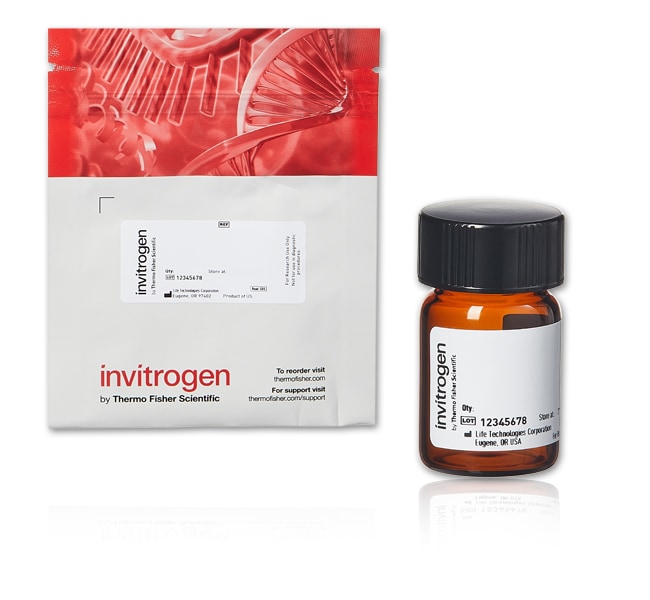
盐酸三-(2-羧乙基)膦 (TCEP)
蛋白质中胱氨酸的二硫化物交联可由 TCEP(三-(2-羧乙基)膦)还原为半胱氨酸残基。与 DTT(二硫苏糖醇)不同,TCEP 不含硫醇,因此通常不需要在硫醇修饰前将其去除。了解更多信息
| 货号 | 数量 |
|---|---|
| T2556 | 1 g |
货号 T2556
价格(CNY)
2,047.00
1 g
数量:
1 g
价格(CNY)
2,047.00
1 g
蛋白质中胱氨酸的二硫化物交联可由 TCEP(三-(2-羧乙基)膦)还原为半胱氨酸残基。与 DTT(二硫苏糖醇)不同,TCEP 不含硫醇,因此通常不需要在硫醇修饰前将其去除。
仅供科研使用。不可用于诊断程序。
规格
形式实心
数量1 g
运输条件室温
Unit Size1 g
内容与储存
在室温下储存。
常见问题解答 (FAQ)
Can other reducing agents other than DTT or BME be used to reduce proteins prior to electrophoresis? For example, what about TCEP (Tris Carboxy Ethyl Phosphene)?
引用和文献 (161)
引用和文献
Abstract
A general strategy for site-specific double labeling of globular proteins for kinetic FRET studies.
Journal:Bioconjugate chemistry
PubMed ID:12236801
Site-directed mutagenesis provides a straightforward means of creating specific targets for chemical modifications of proteins. This capability enhanced the applications of spectroscopic methods adapted for addressing specific structural questions such as the characterization of partially folded and transient intermediate structures of globular proteins. Some applications such as the steady state
Determination of disulfide structure in agouti-related protein (AGRP) by stepwise reduction and alkylation.
Journal:Biochemistry
PubMed ID:9724530
The agouti-related protein gene (Agrp) plays an important role in body weight regulation. The mature human protein is a single polypeptide chain of 112 amino acid residues, consisting of an N-terminal acidic region and a unique C-terminal cysteine-rich domain. The disulfide structure of recombinant human AGRP was determined by chemical
Hydrogen exchange/electrospray ionization mass spectrometry studies of structural features of proteins and protein/protein interactions.
Journal:Anal Biochem
PubMed ID:10036128
'The rate at which amide hydrogens located at the peptide backbone in protein/protein complexes undergo hydrogen/deuterium exchange is highly dependent on whether the amide groups participate in binding. Here, a new mass spectrometric method is presented in which this effect is utilized for the characterization of protein/ligand binding sites. The
A synthetic lipopolysaccharide-binding peptide based on amino acids 27-39 of serum amyloid P component inhibits lipopolysaccharide-induced responses in human blood.
Journal:J Immunol
PubMed ID:9759883
'LPS-binding proteins in plasma play an important role in modifying LPS toxicity. Significant properties have already been attributed to the LPS-binding protein (LBP). It accelerates LPS toxicity as well as incorporation into high-density lipoproteins, leading to neutralization of LPS in serum. A search for other LPS-binding components in serum, using
Mass spectrometric characterization of transferrins and their fragments derived by reduction of disulfide bonds.
Journal:J Am Soc Mass Spectrom
PubMed ID:12781465
'Mass spectrometry, proteomics, and protein chemistry methods are used to characterize the cleavage products of 79 kDa transferrin proteins induced by iron-catalyzed oxidation, including a novel C-terminal polypeptide released upon disulfide reduction. Top-down electrospray ionization tandem mass spectrometry (ESI-MS/MS) of intact multiply-charged transferrin from a variety of species (human, bovine,